Somerset Wharf to Factory Wharf at HM Dockyard in 1928
A photograph taken at the Malta Dockyard in early 1928 frames a series of reminiscences on places and episodes in the rich history of this area of Grand Harbour.
A picture is worth a thousand words
Interpreting and dating old photographs is protégé learning ‒ identifying and sharing details of locations that have undergone radical changes that defy recognition. Photographs of the former HM Dockyard are two a penny, but the panoramic view of a specific area taken from Corradino (see photo above) makes it possible to avoid the clichéd ‘view of HM Dockyard’ and ‘circa’. In this case, knowledge of dockyard industrial heritage and ships of the Royal Navy gives this photograph an absolute date: HM submarine XI at the dockyard, January through April 1928, with repeated failure of port/starboard camshaft driveshafts.
Before the Dockyard had reached its full potential
About 20,000 years ago, rising sea levels created rias: bays, harbours and creeks. In Grand Harbour, the sheltered creeks – Dockyard Creek and French Creek – induced early habitation in what became the maritime cities of Vittoriosa and Cospicua. Senglea followed.
The Order of St John encircled the whole with a double enceinte, and civilian and naval shipbuilding thrived in both creeks. At French Creek, old Porte de la Sengle ou de François, ships were careened and built by Bonello, Ninian (Douglas), Debarro, German, Busuttil, Mirabitur, Piscopo, Camilleri and Vella. The industry floundered with the advent of iron ships and the Admiralty’s insatiable appetite for better facilities.
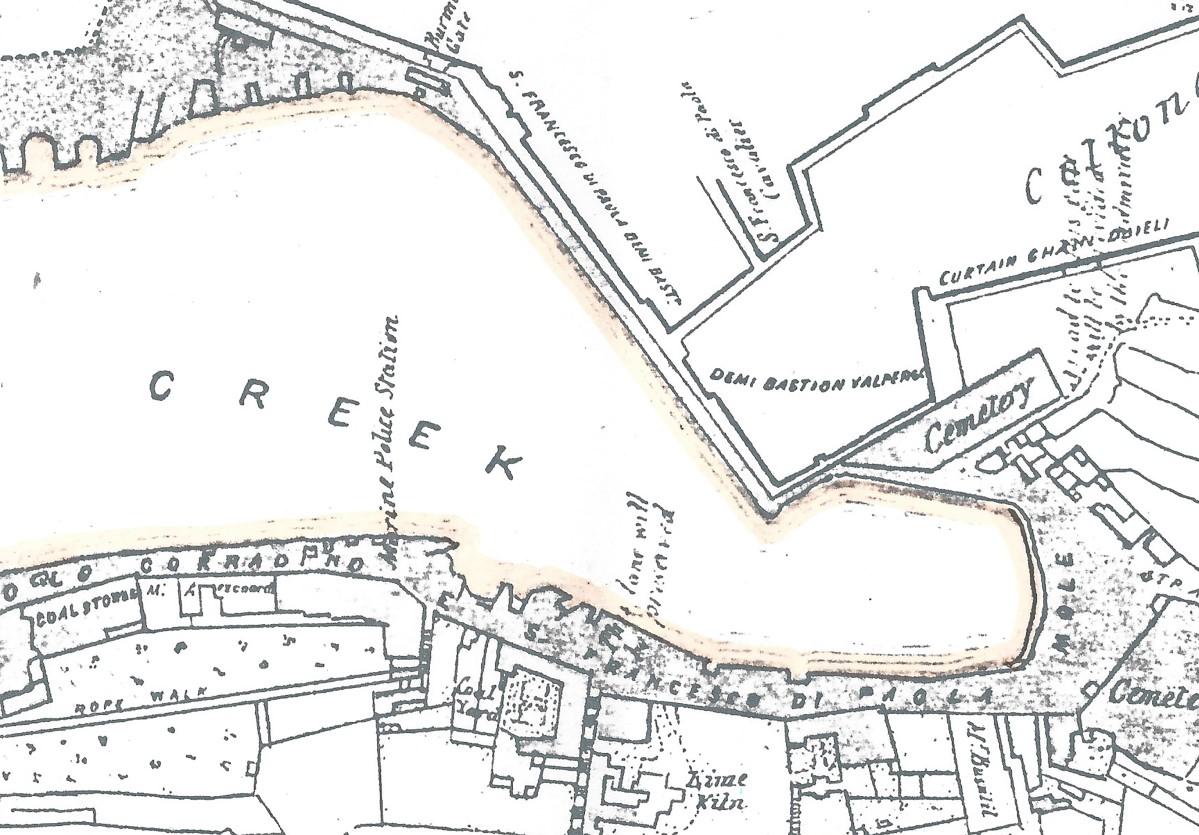 The way it was: Part of French Creek in 1869.
Cospicua, which straddled both creeks, bore the brunt of this industrial revolution until it ceased to be a maritime city. In Dockyard Creek, No. 1 graving dock was completed in 1848 and extended in 1862. Watermen moved to French Creek with access from Cospicua Gate in the eponymous Curtain at the junction with San Francesco di Paola Bastion. In 1858, a resolution in Council appropriated French Creek for the Admiralty and the mercantile community moved to Marsa.
Two graving docks behind Senglea bastions – wara l-Isla – were built: Somerset in 1871 and Hamilton in 1892. Public access from Cospicua Gate was withdrawn after another two were completed at Għajn Dwieli. Curtains and bastions were demolished, and new wharves bridged the area between the docks, where Fratelli German used to build ships in the 19th century.
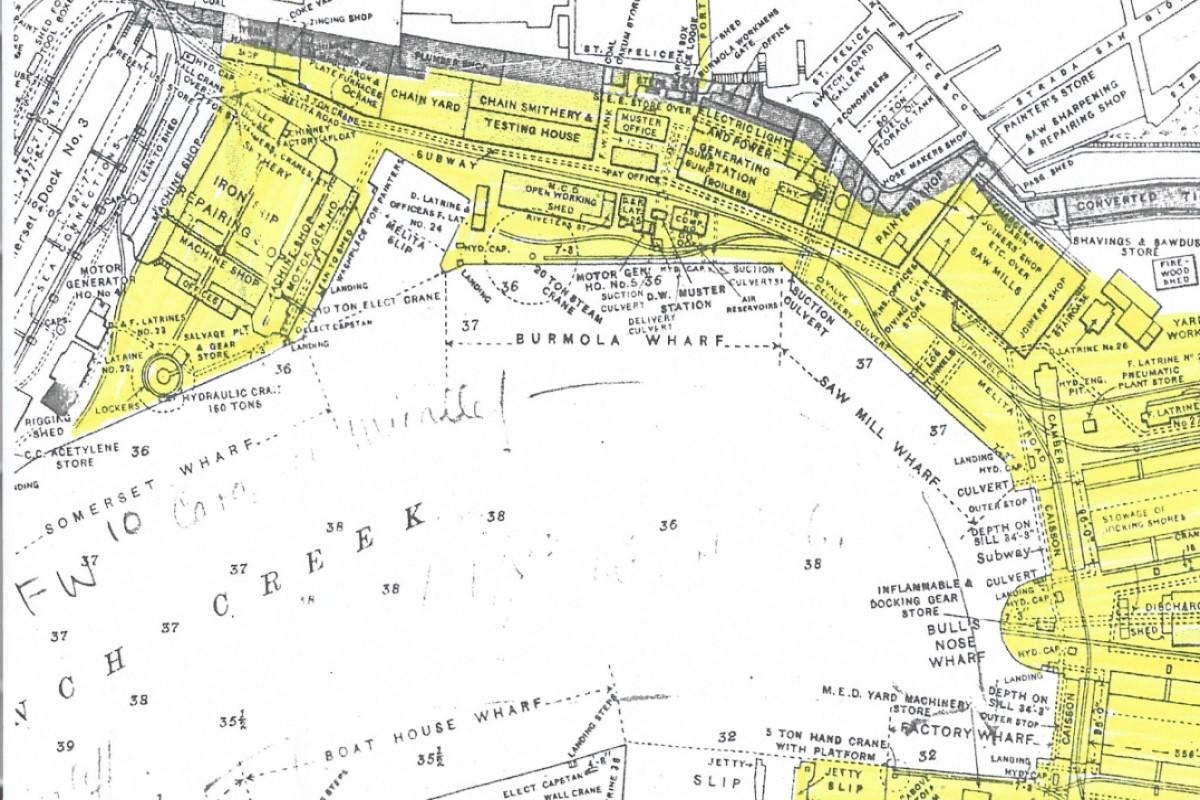 Facilities (highlighted) from Somerset Wharf to Factory Wharf at the time of the main photograph above.
The dockyard was complete by 1906. A myriad of facilities: docks, workshops, armament depots, stores, power plants, ablution blocks and countryside depots that made Malta one of the largest naval bases. Facilities were recorded in a huge tome: Malta Works and Buildings Returns.
The dockyard was complete by 1906. A myriad of facilities: docks, workshops, armament depots, stores, power plants, ablution blocks and countryside depots that made Malta one of the largest naval bases
The author has seen the 1947 updated edition that listed war damage, permanent and temporary repairs to facilities. Significant additions after 1906 included underground workshops that saved lives and allowed the dockyard to function between air raids.
Referring to the above main photograph of Somerset Wharf and Factory Wharf, taken in 1928, the heyday of the Royal Navy in Malta, this is a numbered guide, starting clockwise from top left, and terse descriptions and dates of construction below of the places, ships and facilities seen in the photo:
1. HMS XI (1925), Somerset Wharf (1871), Armstrong Mitchell 160-ton hydraulic crane (1886).
2. Senglea Clock Tower (1907-1909), St Michael’s Bastion, Senglea Elementary School under construction on site of St Michael’s Cavalier (demolished from December 17, 1923).
3. Iron Ship Repair Shop (1886), Melita Slip (HMS Melita launched March 20, 1888).
4. HMS Vampire (1917), ex-HMS Wallace at Cospicua Wharf, Fairbairn 20-ton steam crane, Chain Yard, Chain Smithery & Testing House, Electric Light & Power Generating Station, workmen’s access from Cospicua Gate to Strada Porta Burmola.
5. ‘Burmola Market’ (replaced that demolished at No. 1 Dock), Margherita Arches/Admiralty Arches (1848) Vittoriosa Advanced Gate (1722).
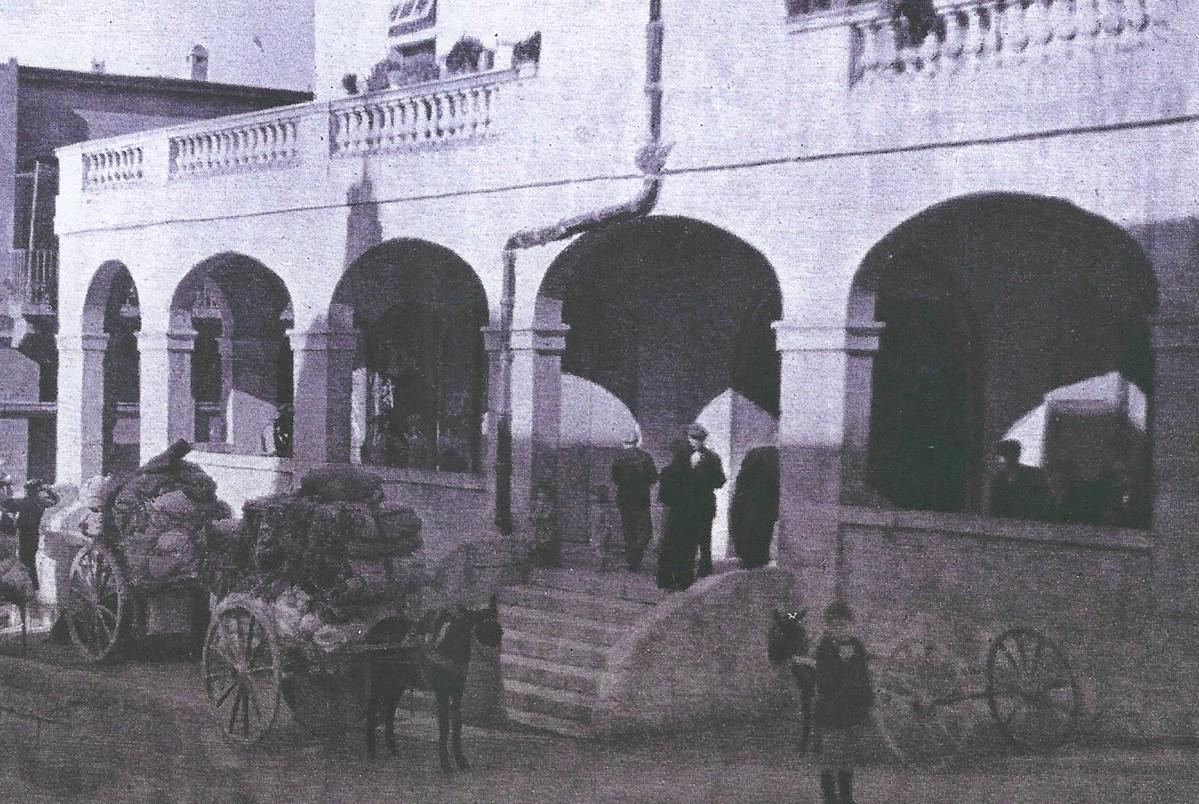 Cospicua Market
6. Annunciation church, Vittoriosa (1650-1941), Rinella Radio Wireless Telegraphy Station (early 20th century).
7. Kalkara parish church (1895, parish December 10, 1897, church blessed January 8, 1898, bombed April 10, 1942).
8. Sawmills Wharf, Sawmills, Joiners’ Shop, target towing barge at wharf.
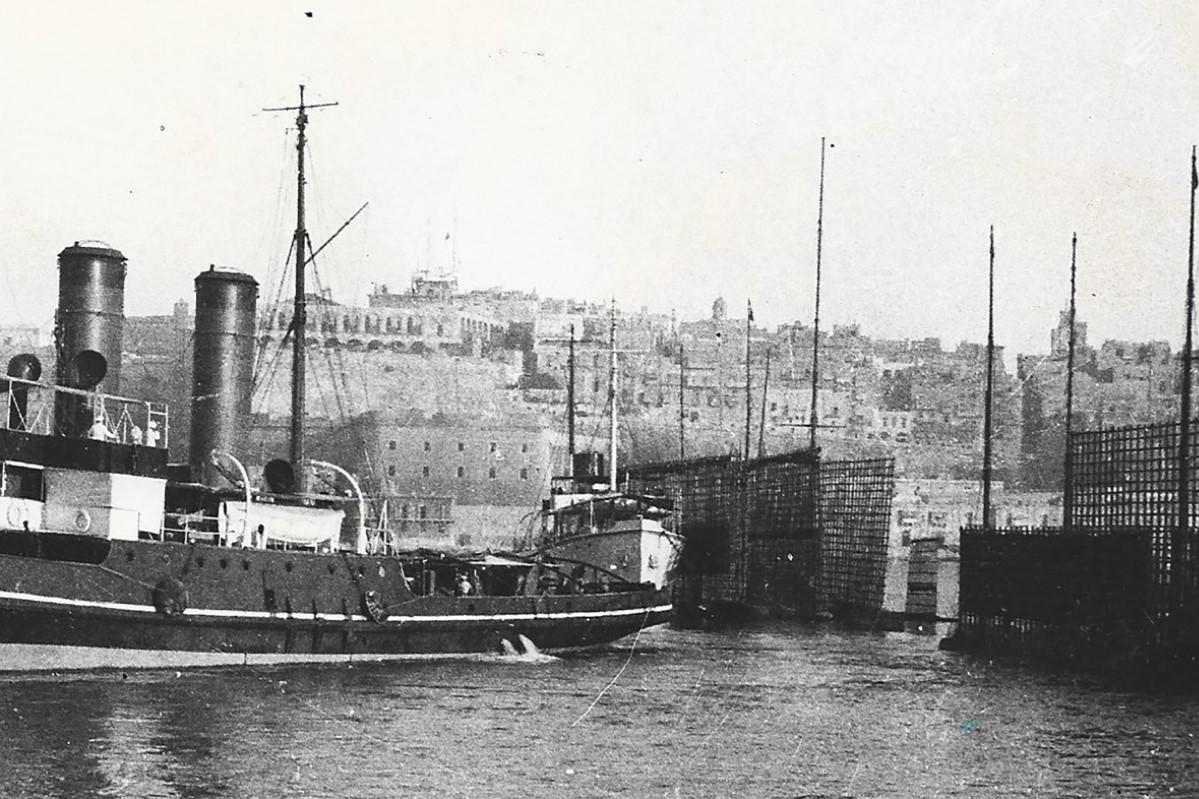 Dockyard tugs and target barges.
9. Melita Road and railway track. 13,100’ roadways, 14,850’ standard gauge 4’ 8½” track, Loco Shed 1907, extended 1921, turntable 1909, three original locos (1907) replaced by three R & W Hawthorn Leslie 0-4-0 saddle tank engines Yard No. 2 Works No. 3585 (1924), Yard No. 402, Works No. 3804 (1932), Yard No. 440, Works No. 3759 (1930). Photographs of locos at work are rare. They were presumably scrapped after the war.
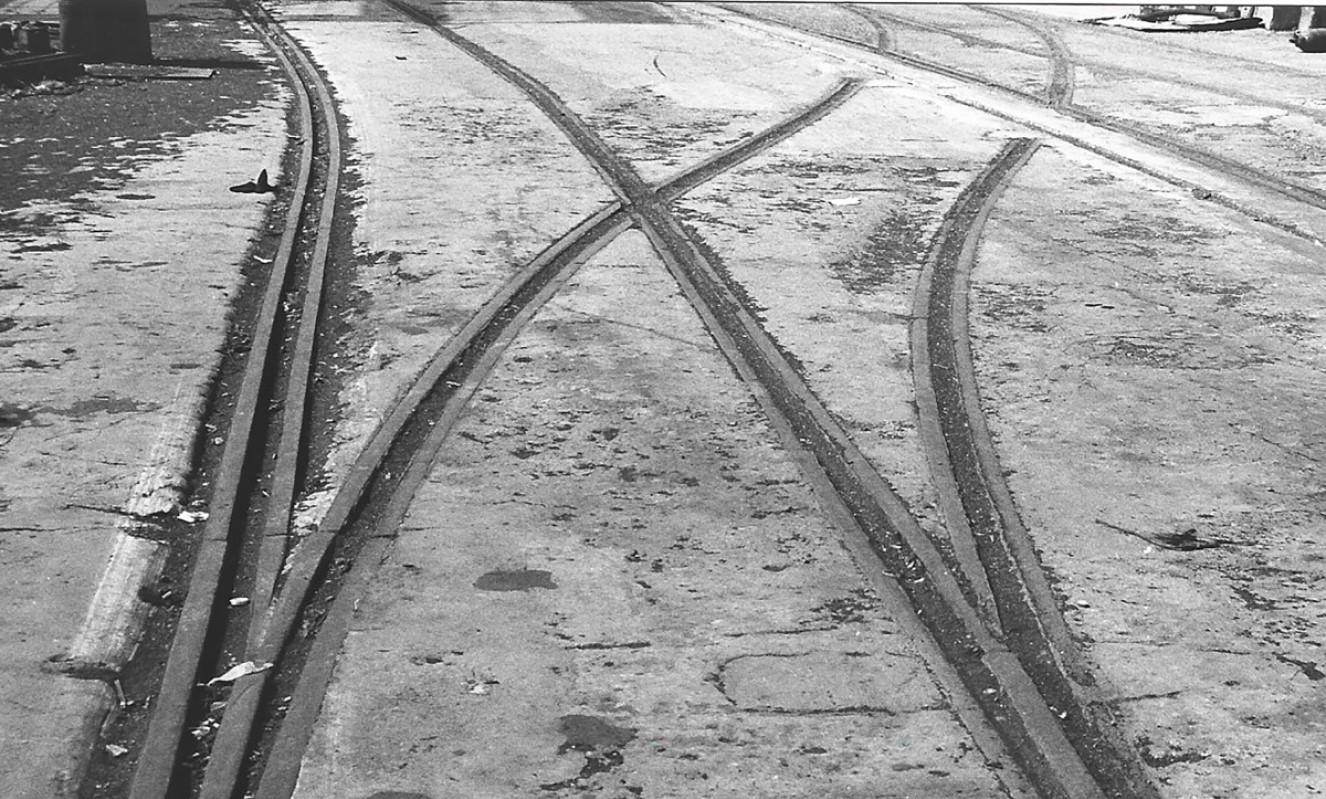
The Dockyard railway.
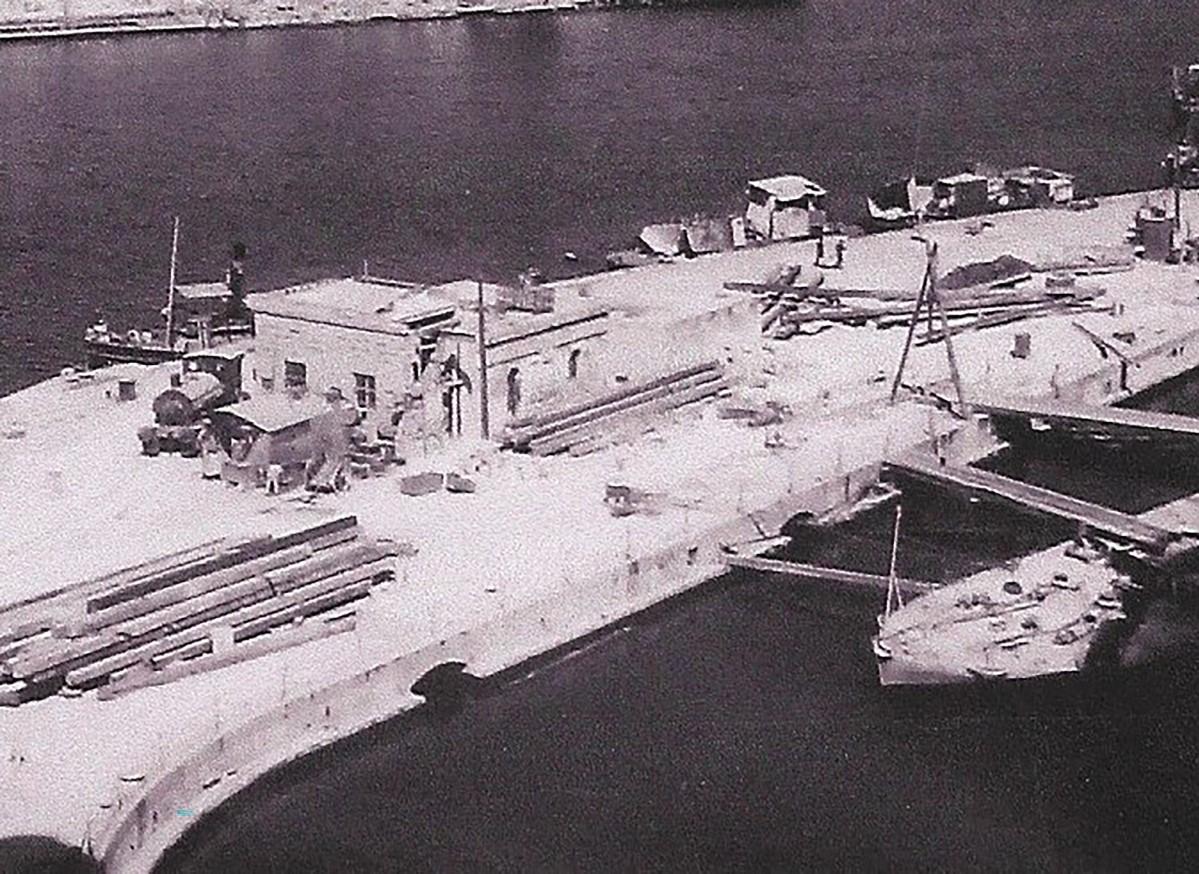
A rare image of one of the elusive Dockyard locos (at left) on Hamilton Wharf.
10. No. 4 Dock, the largest of the Għajn Dwieli duo built by S. Pearson & Son between 1901 and 1906. A double dock, completion delayed, Pearson’s financial loss owing to intractable water seepage.
11. Bull Nose Wharf straddles Dock nos. 4 and 5. Two ‘C’ or ‘D’ Class cruisers are in the docks.
12. No. 5 Dock follows roughly the northern wall of the old creek with its chapel dedicated to St Francis of Paola, cemeteries outside the walls, the Busuttil factory, gardens, lime kiln and road from Paola. On the left side of the caisson (dock gate) are written: DOCKED 28-5-24 and, underneath, UNDOCKED 30-7-24. Dates on caissons that refer to a docking, two months in this case, are very unusual. Also, that they remained there after four years.
13. Dgħajjes at the dockyard demonstrate either a lack of security or a high level of trust. There is anecdotal evidence that the boatmen, barklori, picked up a lot of intelligence about the dockyard and ships while ferrying sailors. Officers even asked: “What’s the news Joe?” Intelligence that could be valuable to rival navies. XI, for example, was a one-off experimental submarine.
14. Factory Wharf and a small part of the huge ‘factory’ in the foreground. After the graving docks, the factory was the largest and most important industrial facility.
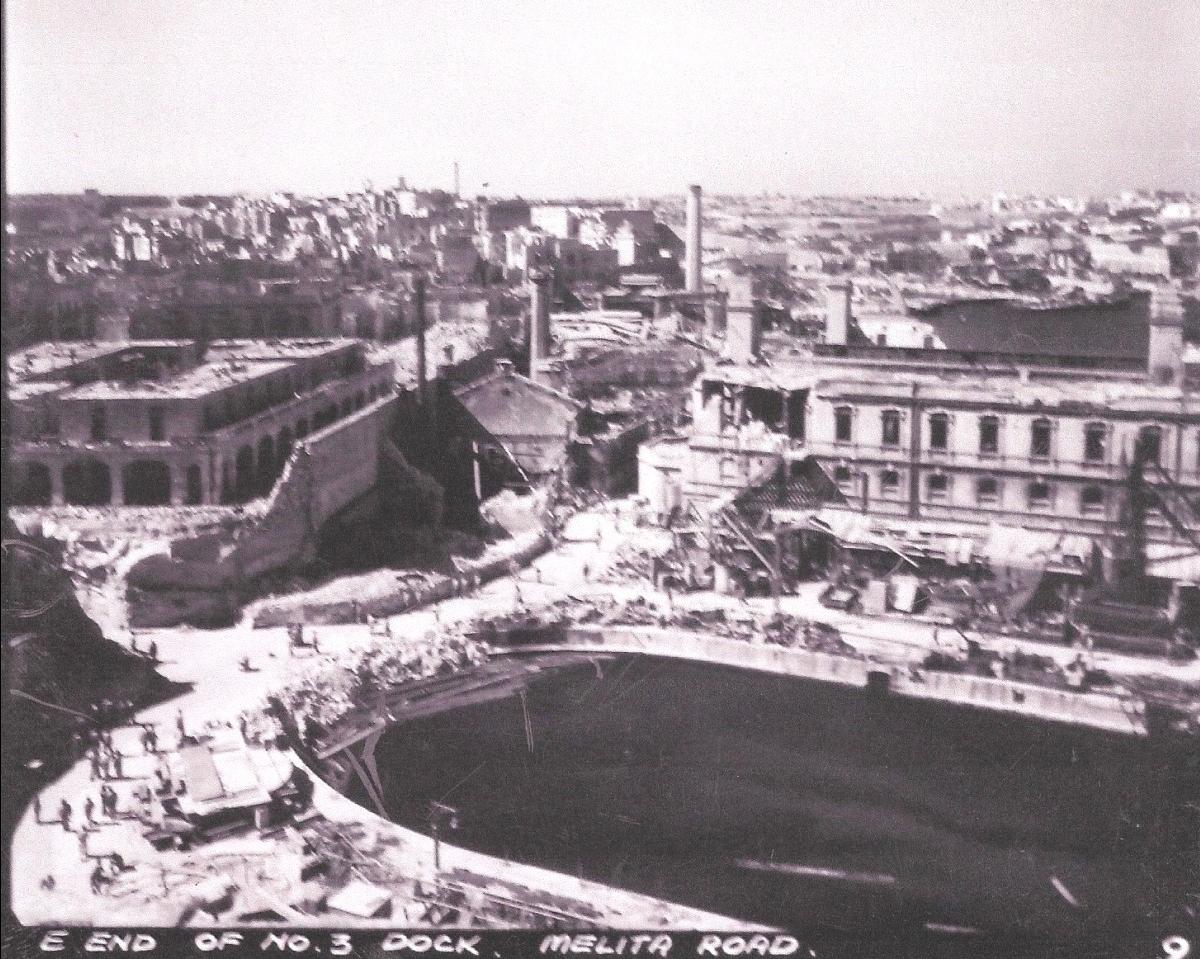
Devastation at Melita Road, Cospicua Market and No.3 Dock.
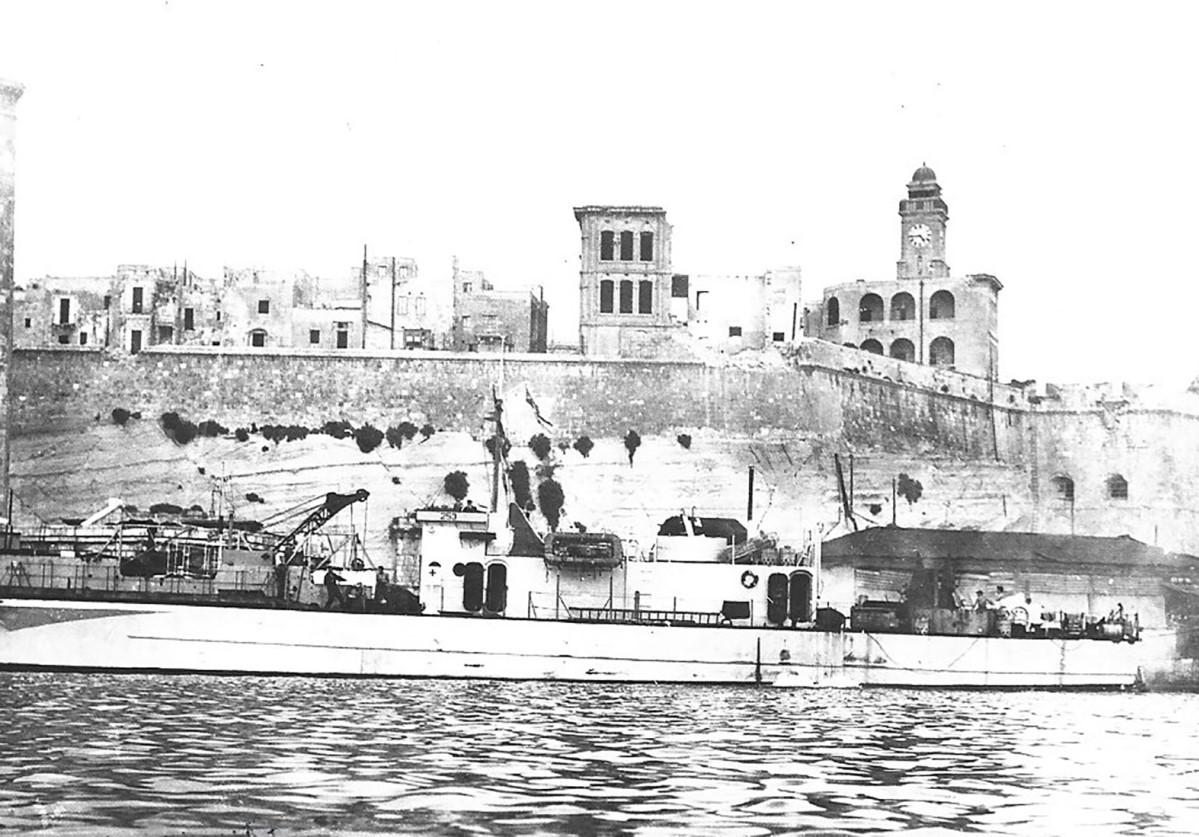
What remained of Senglea primary school after the attack on the Illustrious.
Undoing the dockyard and its environs
The devastation wrought on the dockyard during World War II is documented in official reports, personal accounts and hundreds of photographs. It was inevitable that, like other dockyard towns, the contiguous Cottonera would suffer destruction and punishment.
It was a cruel paradox that more people died there than at the dockyard, whose massive underground network saved lives and permitted undisturbed operations. Except for part of the Iron Ship Repair Shop and the Melita Slip, none of the buildings on the wharves escaped destruction.
It was a cruel paradox that more people died [at Cospicua] than at the dockyard, whose massive underground network saved lives and permitted undisturbed operations
Emergency repairs and temporary workshops − Nissen, Romney huts and corrugated steel sheeting − proliferated. Temporary became permanent; money was tight and there was a sense that the heyday of the empire was over.
HMS XI, the ‘Red crane’ and Senglea government primary school
Somerset Wharf, adjacent to No. 3, the first graving dock in French Creek, was built in 1871. A decade later, Armstrong checkmated Britain by selling its heaviest guns to the Italian Navy; the threat was offset by similar guns at Rinella and Tigné.
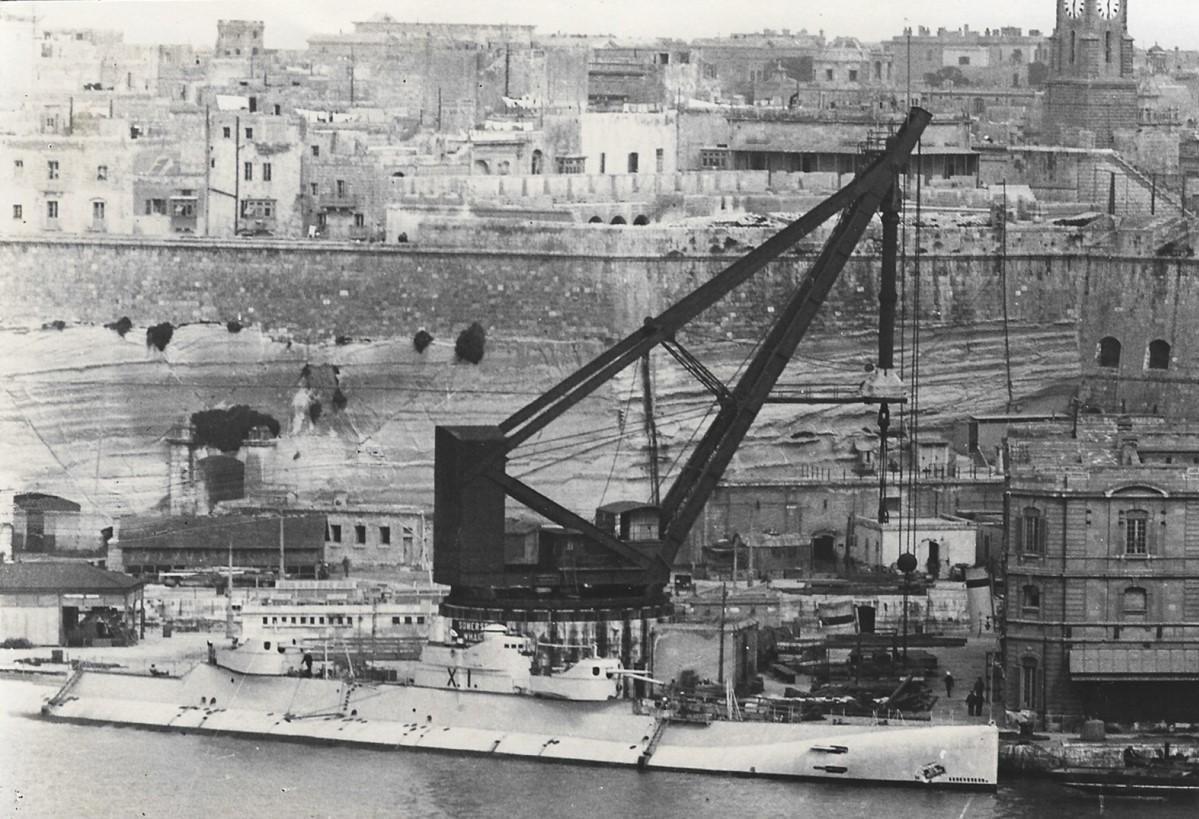 HMS XI, the ‘Red crane’ and Senglea primary school under construction on St Michael’s Bastion.
The pre-dreadnoughts of the Royal Navy were armed with four 12-inch gun barrels on twin turrets. The gun barrels required regular servicing at the Dockyard’s Iron Ship Repair Shop, removal from turrets being handled, unsurprisingly, by another Armstrong product, the 160-ton hydraulic crane. The ‘Red’ crane (rust or red oxide?), as it was called by the men, was dismantled in 1965-66. A similar crane is preserved at the Arsenale di Venezia.
HM submarine XI was at Somerset Wharf in the first quarter of 1928. The massive, experimental submarine, at one time the largest in the world, was planned as a commerce raider with twin QF 5.2-inch guns fore and aft of the sail. Its twin diesels and auxiliaries were problematic: the starboard camshaft driveshaft broke down during a full power run in January. It was in dockyard hands for repairs, only to suffer a similar breakdown in its port camshaft. In 1930, after constant repairs and other issues, it was placed in reserve and scrapped in 1936.
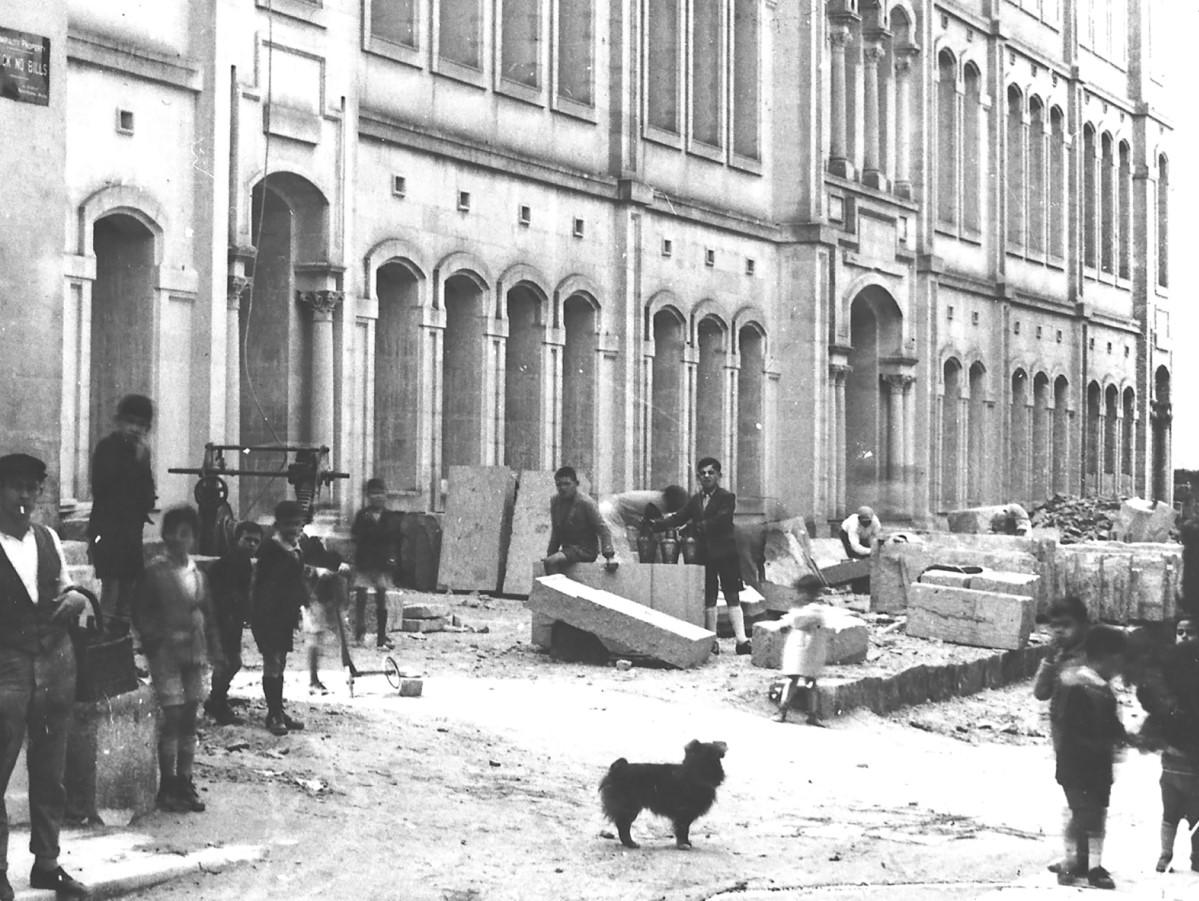 Senglea primary school under construction.
Senglea Primary School
In the Times of Malta of March 8, 2013, Fr Victor Jaccarini, SJ, reminisced about his narrow escape at Senglea government primary school during the attack on HMS Illustrious on January 16, 1941.
The school was built on the site of the legendary cavalier of Great Siege fame. Its demolition in 1925 was controversial and construction was considerably delayed; the 1928 photograph of XI shows the first floor under construction on St Michael’s Bastion.
Senglea schoolchildren, then as now, sit literally on the docks. On that fateful day, afternoon classes were interrupted by air-raid sirens. The boys marched to the nearby bomb shelter, “chanting loudly an anti-Mussolini ditty” popular at the time. Two successive air raids flattened the school.
Victor ventured out of the shelter to recover his books from the classroom in the only part that remained standing. He rushed back home only to be told that his family had joined an exodus of others seeking safety elsewhere.
Years later, he asked his mother why they had left without him, to which she replied: “You know, my child, we had forgotten about you in the confusion.” In the crowded shelter, a woman held up a baby, crying “Whose baby is this?”. It was Carol, his youngest brother.
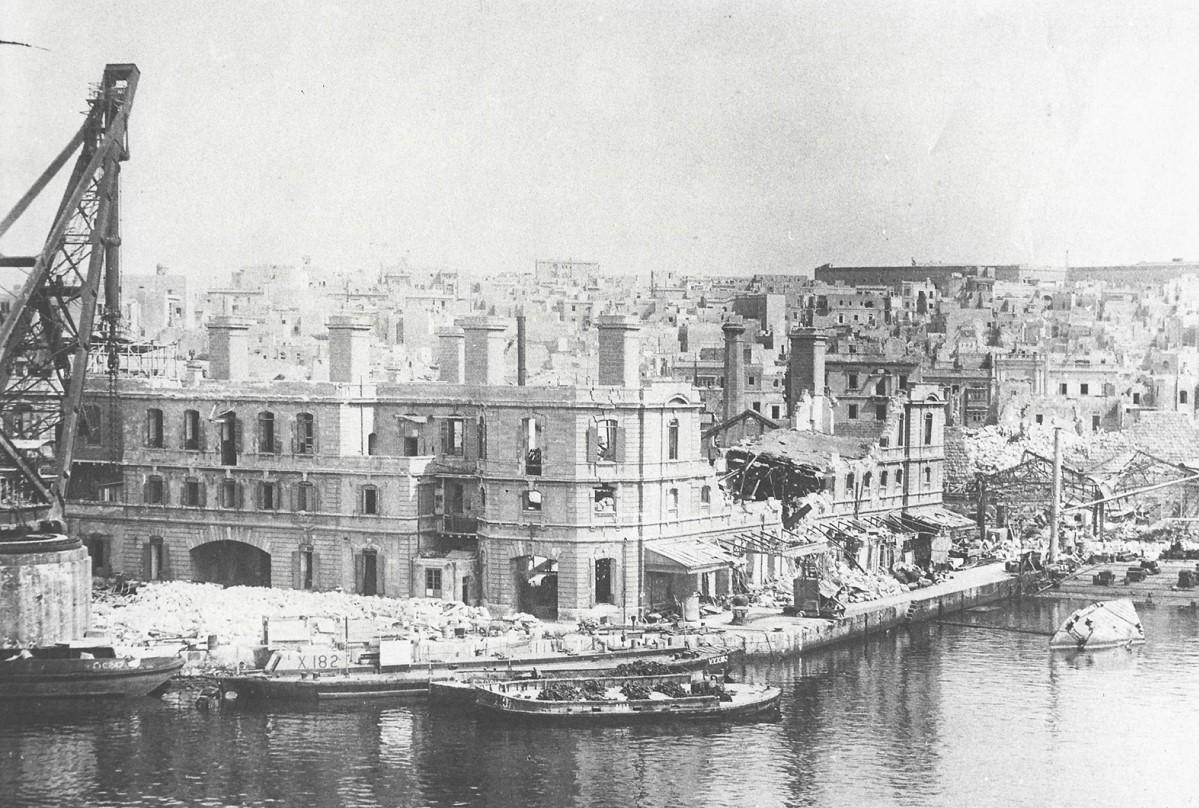 The heavily damaged Iron Ship Repair Shop and the Melita Slip.
The Iron Ship Repair Shop and Melita Slip
The impressive two-storey building was completed in 1886 next to No. 3 Dock. At 52,700 square feet, it was the largest in the dockyard before the Factory (1907). It was built of mixed materials; hardstone and steel steps led from the fire hearth to an intermediate floor and the upper storey. The blitzed section was rebuilt in 1947. It is now an accommodation and leisure block at Palumbo Malta Superyachts.
Next to the Iron Ship Repair Shop was the Melita Slip where the eponymous ironclad sloop was built between 1883 and 1892. An inordinately long time but construction provided work during lean times. It was launched on March 20, 1888, by 12-year-old Princess Victoria Melita, who was born at San Anton Palace. The 192-foot by 155-foot slip was paved with concrete, with timber skids and hardstone coping on the sides.
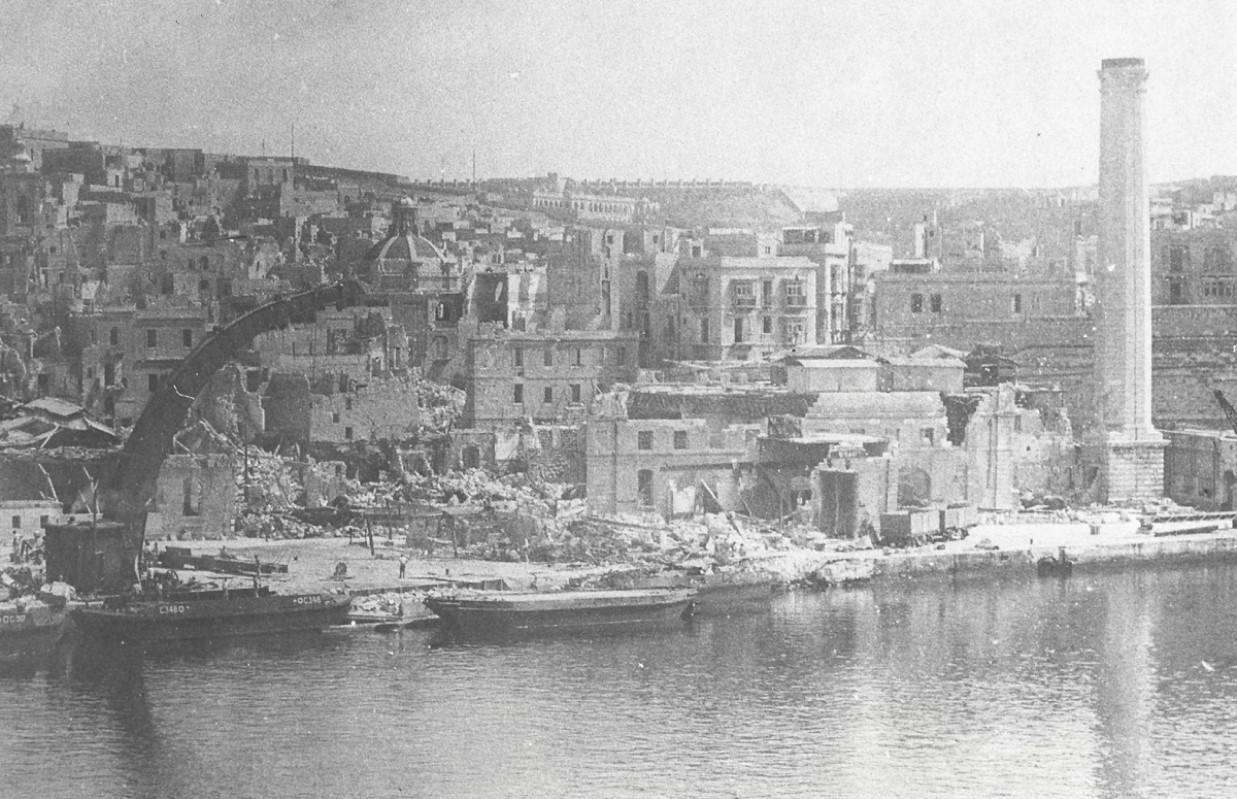 Cospicua Wharf disappeared.
Cospicua Wharf and Saw Mills Wharf disappeared
HMS Vampire (D68) was at Cospicua Wharf in 1928. The V Class destroyer was transferred to the Royal Australian Navy in 1933. In December 1941, it picked some of the survivors of HMS Repulse and HMS Prince of Wales, which were sunk by Japanese bombers. Vampire met a similar fate in April 1942.
The service crane on the wharf was a crescent-shaped Fairbairn 20-ton steam crane. A second 40-ton Fairbairn was installed near No.2, Hamilton Dock. Both had arrived in knocked-down condition and erected at the dockyard in the early 1890s.
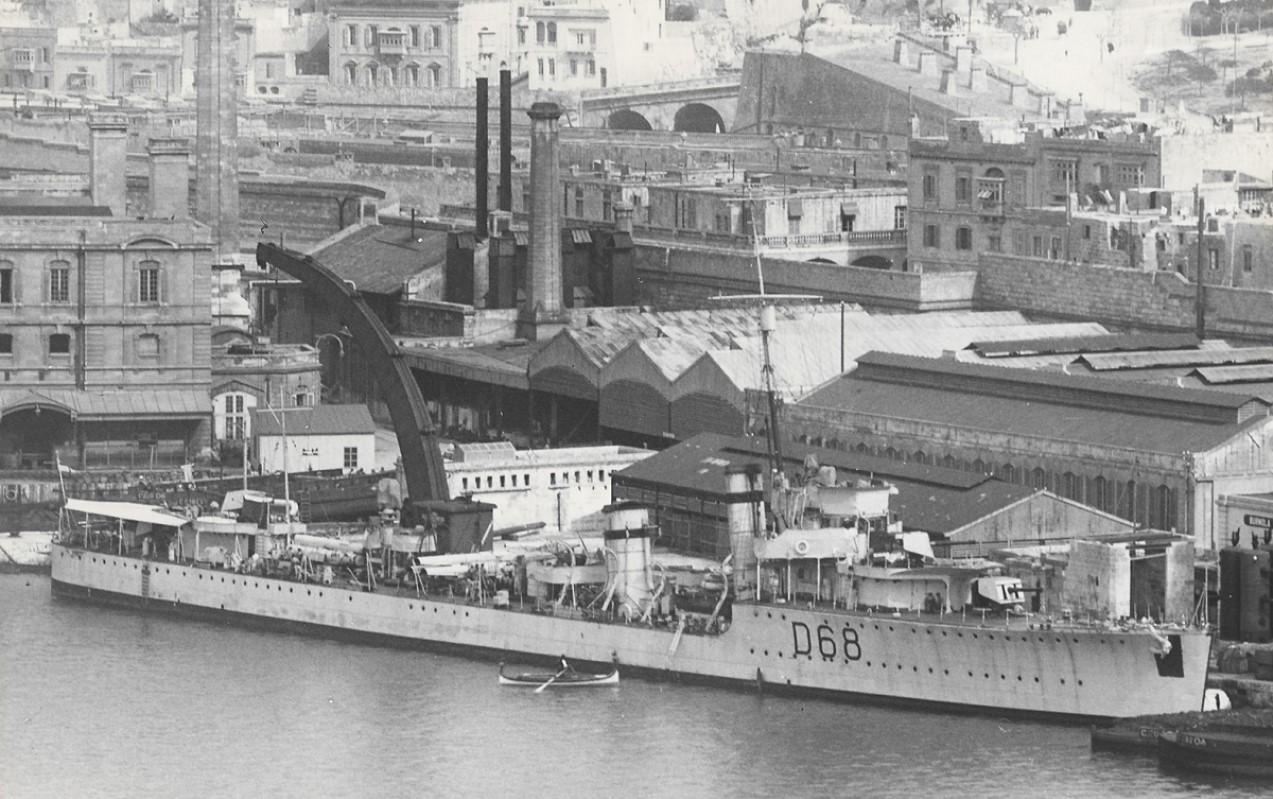 HMS Vampire, the electric light power station and the 20-ton Fairbairn steam crane on Cospicua Wharf.
The most important building on Cospicua Wharf was the Electric Light and Power Generating Station. It produced electricity from seven direct-current diesel generators. In 1940, a bomb fell between two generators and destroyed the plant.
Two of the remaining five were quickly dismantled and set up in the unfinished underground power station begun at Corradino in 1938. They were still in use in 1972, albeit converted to alternating current. The 11,800-square-foot Saw Mills Workshop was completed in 1907. After steel, timber was the next most used material. The huge stone building was equipped with heavy-duty wood-working machinery and several joiners’ shops. What remained after the blitz was salvaged and enclosed within stone, timber and corrugated sheet accommodation.
Author’s note
For further information on the 160-ton crane, see ‘Servicing the big guns of the Royal Navy in Malta and the invention of the Armstrong Mitchell 160-ton hydraulic dockside crane’ in The Sunday Times of Malta of May 29, 2016, and ‘Rise and fall of Malta’s Armstrong Mitchell 160-ton hydraulic crane’ in the edition of June 5, 2016.
Acknowledgement
Thanks to Mario Zerafa for his kind assistance.

Michael Cassar is an author on Malta's maritime history.