Space not the issue with tram systems, says Maltese engineer in UK
Consultant dismisses notion that a tram system is not viable in Malta because of limited space
When Finance Minister Clyde Caruana effectively shot down the idea of a metro during a pre-budget interview with Times of Malta, many interpreted his words as spelling the end to any discussion on a mass-transit system.
But a potential alternative that is both cheaper and faster to set up than a metro could be on the horizon in the UK, thanks in part to a Maltese engineer.
Christopher Micallef is a consultant for a pilot project called the Coventry Very Light Rail (CVLR), which is being tested in the West Midlands city, population 400,000. The aim of the publicly-funded project, overseen by a consortium of partners including local industry and academia, is to deliver a mass-transit system on a tight budget and with minimal disruption – music to the ears of any government.
Coincidentally, the project’s coordinator, Nicola Small, also has a connection to the island, as her mother is Maltese.
The CVLR is a tram system, but not as you know it.
The project is innovative in several ways. The tram is powered by a battery, avoiding ugly overhead wires and increasing environmental friendliness. The installation of the track is less disruptive – the rails sit on concrete slabs that can be laid down relatively quickly, requiring only around 0.3 metres of excavation, significantly less than conventional trams whose weight needs more support.
And perhaps most importantly for the often-narrow streets of Malta’s towns, the vehicle’s pioneering wheel-axle system allows it to turn corners tighter than a typical tram.
Despite living in the UK, Micallef – who has been involved in the project since 2018 and is now working specifically on the CVLR’s track – tells Times of Malta he is up to date with the local transport debate.
“Every time I visit, I can’t help but think that Malta could be a paradise if it weren’t for how dependent we are on cars. There’s a cultural affection for driving that makes it hard to promote alternatives.”
Caruana said Malta would be “royally screwed” if a metro system went wrong and the engineer agrees on its lack of feasibility: “Once you commit to such a massive project, it consumes all available energy and funding. If it fails or doesn’t deliver the expected results, there’s little room to pivot.”
A metro, Micallef points out, comes with a massive price tag – Prime Minister Robert Abela recently said it would cost around €2.8 billion, revised down from the €6 billion arrived at by consultancy firm Arup in 2021.
“We would also need to import all the necessary expertise, machinery and materials. Plus, the island’s geology is challenging. Tunnelling through limestone and clay layers isn’t straightforward,” he says, adding that if a country commits the majority of its financial and human resources to one project, it risks leaving other important issues unaddressed.
On the other hand, Micallef waxes lyrical about trams.
“When implemented well, they can be transformative. They tend to drive urban regeneration and boost property values along their routes. Cities that invest in trams usually see new businesses flourish in those corridors because it signals long-term commitment to an area’s development,” he says.
 Christopher Micallef is a consultant for a pilot project called the Coventry Very Light Rail (CVLR)
Problem terrain
Micallef points out that a typical traffic lane typically moves between 600 and 1,600 people per hour, whereas a dedicated tram or segregated bus lane routinely carries several thousand per hour per direction.
In other words, the same strip of carriageway can move between four and 10 times more people, with far greater reliability.
So could the CVLR system work in Malta? The engineer gives a qualified ‘yes’.
“It’s designed as an affordable, battery-powered system with minimal infrastructure. The innovative features reduce disruption and cost, which is crucial for dense cities.
“However, trams still have physical limitations. They can’t handle steep gradients, and that’s a challenge in Malta, given the terrain. But there’s no reason why such a system couldn’t work in certain parts of the country, such as the south, for example.”
Micallef dismisses the notion that a tram system is not viable in Malta because of limited space.
“Narrow streets are not unique to Malta. Many historic European cities are dense and constrained, yet they’ve successfully implemented tram systems. Space isn’t the real issue – it’s how we allocate it.”
Nevertheless, if the system is not designed well, Micallef says, people will not make the switch.
“If trams don’t run frequently, or if you’re left waiting in the sun for 15 minutes, people will default to cars. They’ll only switch if the alternative is clearly faster and more pleasant. In that respect, people are the same everywhere.”
Micallef is keen to stress that there is no single, one-size-fits-all solution.
“You need a mix of transport modes – trams, buses, ebikes and so on – all working together. In the same way that you would use a toolkit, you have to choose the right mode for each context.”
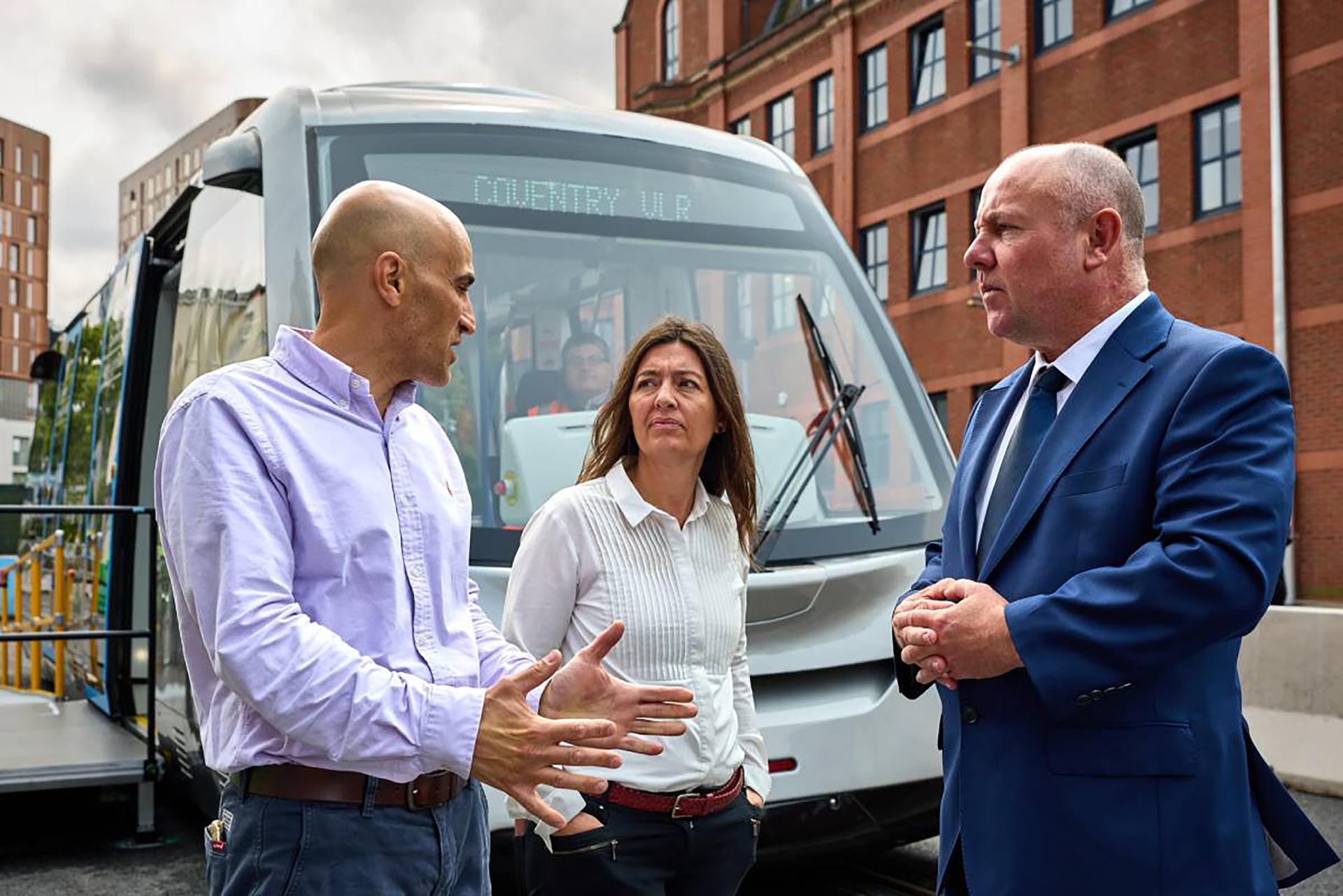 Christopher Micallef (left) is pictured with the project’s coordinator, Nicola Small. Photo: Andrew Moore/CVLR
Carrot and stick
Transport Minister Chris Bonett is fond of saying that he prefers the carrot to the stick – incentivising people to leave their cars at home rather than punishing them.
But while Micallef sees the logic behind this line of thought, he argues that by refusing to make it harder to drive, other groups end up getting the stick.
“There is always a trade-off. If you choose not to disincentivise car use, you’re effectively penalising everyone else – pedestrians, cyclists and public transport users. If you try to please everyone, you please no one.”
Micallef echoes another point raised by Caruana: any mass-transit system would mean taking away space from motorists – not just lanes but also parking spaces.
“If you measured the total area used for parking in Malta, I suspect it would equate to dozens of football pitches. It’s frankly mad how much space we give to cars, allowing them to dominate beautiful public spaces. Imagine replacing them with trees, benches and open areas where people can actually meet. Cars isolate individuals; shared spaces bring people together.”
Ditching cars also comes with health benefits. “Air pollution from cars doesn’t just consist of exhaust fumes. Another major source is particles from tyres. Modern cars are heavier, so they also wear out roads faster than they used to. Then there’s noise pollution too, which people often take for granted.”
Micallef says he has not approached the government about the CVLR project, nor has he been approached, but would welcome the chance to share his ideas.
“I’m just a humble engineer but I would love to give back to the country.”
Correction: A previous version of this article stated that the CVLR requires three metres of digging. The actual figure is 0.3 metres.