Malta's 'tallest' palm and Żebbuġ's 'oldest tree' downed by Storm Harry
The two trees are among 228 blown over by the fierce storm
Malta’s tallest palm tree and the oldest oak tree in Żebbuġ were casualties of Storm Harry on Tuesday after hundreds of years standing strong.
They are among 228 trees that succumbed to the gale force winds, some causing obstruction and danger on the roads, according to the Civil Protection Department’s latest update.
The downed trees, some damaging monuments in Floriana and others ending up entangled in wires and causing electricity outages, were more than just a hazard though; they were “heartbreaking” losses.
Żebbuġ’s oldest oak tree (Siġra tal-Ballut) – estimated to be around 200 years old – and other age-old trees were “part of the collective memory and urban landscape”, acknowledged Żebbuġ mayor Steve Zammit Lupi.
 Żebbuġ's oldest tree fell, taking out the power to houses with it. Photo: Żebbuġ local council
“Anyone living in the area knows it,” he said, describing the oak tree as “iconic”.
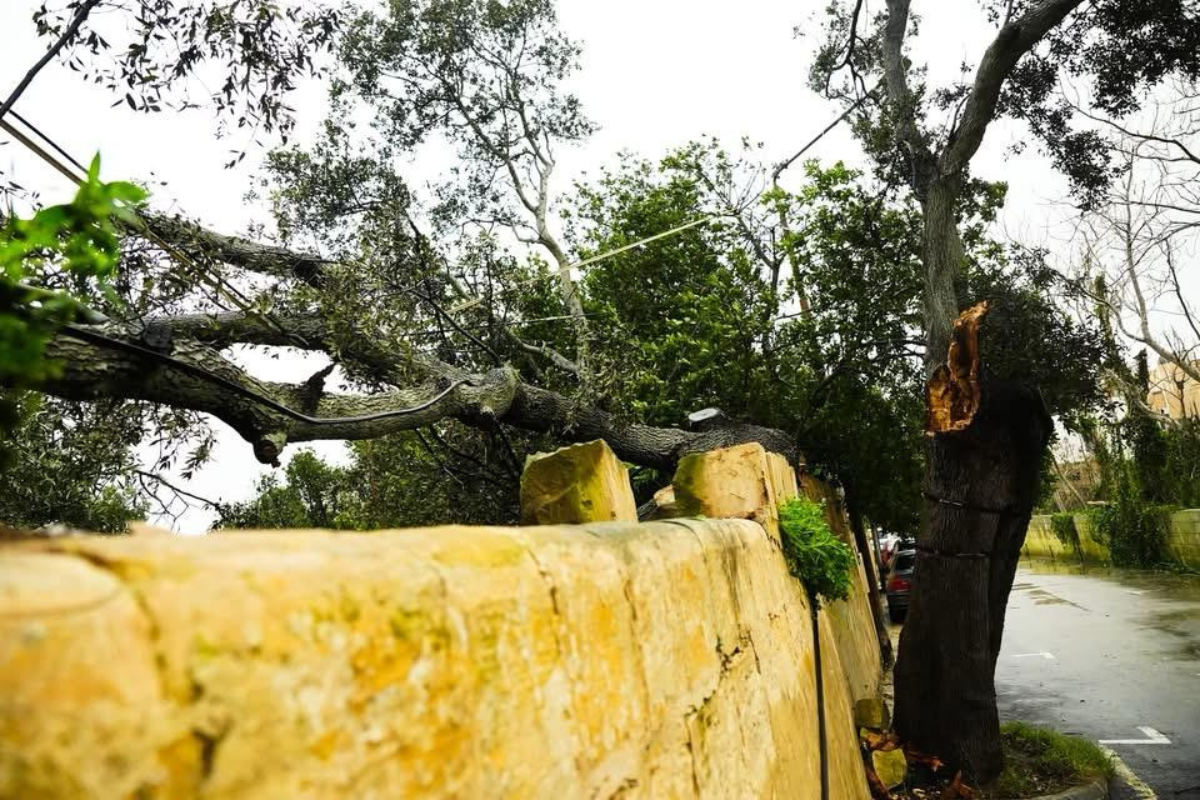
Located in Triq il-Madonna, in front of the Chapel of the Our Lady of the Abandoned, the tree was severely damaged by the storm, with more than half of it collapsing, the local council announced.
Fortunately, it fell onto a wall and not onto people and parked cars beneath it. But its branches hit the electricity wires, leaving eight homes in the road without electricity for over 24 hours in the middle of the storm.
“Their first priority was their safety, which is understandable,” Zammit Lupi said about the locals.
 The tree, pictured in its heyday, was one of 228 brought down by Storm Harry. Photo: Żebbuġ council
The tree had already sustained some damage 10 years ago and interventions to safeguard it had been made. But it could not withstand the Force 9 and 10 winds and “gave in” immediately on Monday evening, when Storm Harry had just about started and before the gale strengthened.
Zammit Lupi said an assessment would be made of what was left of the tree to determine whether it could be protected to prevent further damage, adding it would take many years to grow as tall and big again.
Other large trees in Żebbuġ, which were sheltered by buildings and had been pruned and tended to, were unaffected by Storm Harry, he said.
‘Like a guiding star’
Rising an estimated 21 metres and arguably the tallest, and possibly the oldest, according to Malta Records, another “iconic” palm tree also got into harm’s way and bit the dust at the hands of Storm Harry.
Struck directly by the powerful southeastern winds, the tree’s life – spanning generations, across hundreds of years – came to an abrupt and “sorrowful” end, said the owner of the old Ix-Xerriek farmstead, known as Tal-Palma, in the limits of Birżebbuġa, where it was located.
It was considered a landmark that guided many to the surrounding fields in the island’s southeast, said David Carabott.
“It is a very sad day for my family and close friends. Today, a piece of me is gone. For many, it was more than just a tree. It was a point of reference, serving as an orientation landmark even when viewed from aircraft,” he said.
 David Carabott photographed the tree every day.
Almost every single day, Carabott used to capture it in photos at sunset. “The older I grew, the more attached to it I felt. I am 45 and I grew up with it, but so did my 70-year-old father, while at 90, my grandfather remembered it his whole life too.”
Malta Records estimated the leaning palm tree was more than 21 metres long, Carabott said, adding he did not care about records and that it meant something personal to him.
“It was like a guiding star,” he said, adding he had recently had the premonition that it would end the way it did, comparing it to the Azure Window.
Its height had caused it to bend – “a silent reminder that even the tallest and strongest are not eternal,” Carabott had prophesised.
“The storm killed the iconic palm tree but not its memory, which is firmly rooted in many. It will live on, immortalised in my heart and on the pages of the paper forever,” said Carabott.
The palm tree had also made it to the pages of the January edition of the in-flight magazine and in the same month it died – "just like the stars", he said.