Third-generation ice cream maker balances family trade with medical career
Tony Muscat Gelateria in Birżebbuġa marks half a century
He is studying to be a doctor, but occupational therapist Nick Muscat is an ice-cream maker at heart, proudly running a family business celebrating 50 years, leaving him split between a future churning gelato and curing patients.
As Tony Muscat Gelateria, in Birżebbuġa, marks half a century, the third-generation medical student recalls growing up in the parlour, watching the ingredients still being used today turn into a creamy cold dessert, much the same way they did back in his grandfather’s time.
Now, it feels like déjà vu as his young nephew and niece run around the shop, and he wonders if they, too, will follow in the family’s footsteps.
“History repeats itself”, or so Muscat would like to think as he watches the potential “fourth generation” in a “passive learning” phase, asking if they can help, just like he did.
Twenty years ago, together with the founder, his grandfather, Tony, would stand outside the shop to attract customers, calling out at the top of his lungs: “Tal-ġelat!” It was all part of the game.
Now, at 27, he is driven by a strong work ethic and commitment to the small business, run only by four family members – himself, his mother, his father and his girlfriend.
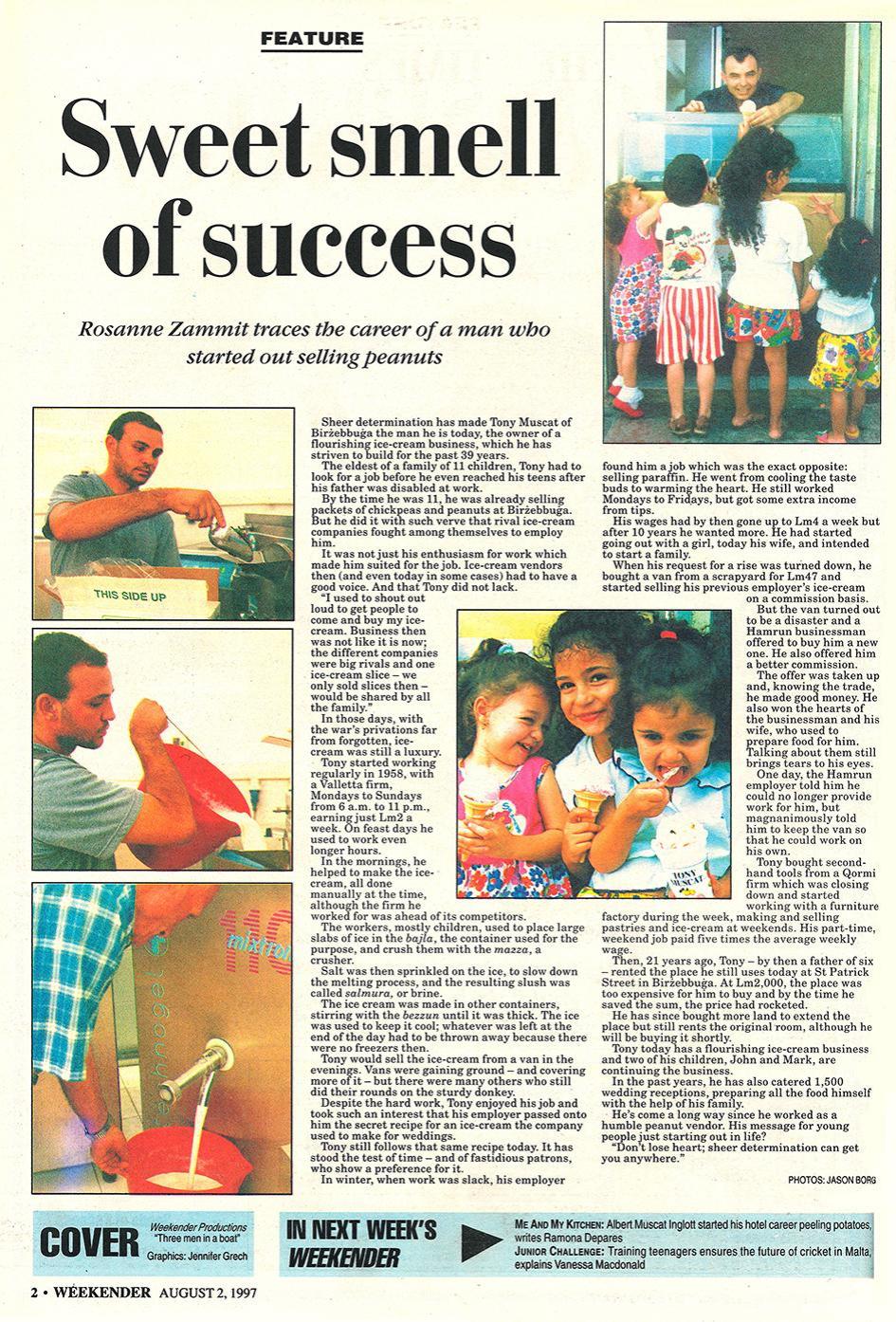 A copy of a Times of Malta story from the past proudly hangs on the ice cream parlour wall. Photo: Chris Sant Fournier
Over 50 years ago, Muscat recounted, his grandfather, who had learnt the trade from working with renowned catering companies, was lent a wonky van to go around selling his own ice cream in summer, while working as a street lamplighter in winter.
When the vehicle broke down, he was given another “out of pity” until he opened his own shop.
Muscat’s grandmother, Carmena, got involved in the catering, making ice cream with the help of her own father, Gianmarie Gauci.
Both his grandparents are still around, with co-founder Nanna Carmena recently being celebrated for pouring her heart into every detail. His father, John Mary, took over and, by the age of eight, Muscat was spending time in the shop with his grandmother, learning the ropes.
Family affair
At about 16, he started making ice cream and has never looked back, taking the business to another level.
Stepping in was not just about taking over but improving. Together with the input of his girlfriend, Alessia Camilleri, they reinvented the wheel with their specialised vegan ice cream line and invested in a cart that can be seen at weddings, events and fairs.
Camilleri is the only ‘outsider’ who helps with the ice cream production after her 9-to-5 job and at weekends. It was she who recommended the ġbejniet tal-bżar (traditional Maltese peppered cheeselet) flavour, which is going down well. She convinced her boyfriend to push the boundaries, but so did his mother, Rose, who played a major part at the ice cream parlour – the face behind the display, serving up the scoops.
The fact that he did well in his occupational therapy studies even while making ice cream was one of the reasons Muscat continued with another degree.
“She will not let me rest,” he joked about the scoops of “advice” his mother dished out, acknowledging that he could one day be a professor with an ice-cream-making profession on the side.
“The ice cream business means a lot to me. As the third generation, you could say this is not just a job. It is not something I just came up with one day. It is the same traditions; the same unique recipe and the same family,” he stressed.
Muscat freezes when asked about making choices and future plans to juggle ice cream cones and stethoscopes. “My heart is in two places,” he admitted.
What would he advise his own children?
Pausing to reflect, Muscat replied: “The role chooses you!”
Conscious that businesses like his were dying out – or being bought out by bigger companies as large chains devoured them – Muscat acknowledged that the industry was highly competitive. “You either sell out or keep trying,” he said about being “up against the giants” but resisting a recent opportunity to join forces with a big company, go large and penetrate supermarkets.
Muscat knew he could not make both his roles work, and quality overrode quantity. That could be the price of expansion, and he was not willing to pay it, he said.
Behind the display at Tony Muscat Gelateria, past a little corridor for pizza and pastry making, was the ice-cream factory, manned single-handedly by the doctor in the making, who churns out around 120 litres a day, supported by his parents at the front of house.
Wearing his ice cream chef’s hat, Muscat said he started his day by checking what had finished and planning ahead – but not too far. He only produced ice cream two days in advance, meaning his tubs never spent more than 48 hours in the freezer before being served. Once the stock was used, he would make a fresh batch.
“That is how we work, even though we could prepare for a month in advance. That is what gives us our edge,” Muscat said. Freshness was also guaranteed by the fact that the factory was near the shop, meaning a fast move from production to display and no transport in between.
Ice cream today could have a “bad rap”, he said, comparing it with gelato, which has a more pronounced flavour, less fat and less air. The science side of the artisan explained how his machines only pumped 30 per cent of air into the mix for creaminess and to avoid ice crystals forming.
Today’s ice cream was also often made with semi-finished products – throw the mixture into a bowl, add water or milk, et voilà! But Muscat made his ice cream from scratch, using raw and local, quality ingredients, which he weighed individually, the traditional way.
“One machine is older than I am,” he said. “I make one recipe only in this; its metal blades crush and blend everything together for a strong flavour, unlike when you just put the ingredients in the ice cream.”
Customers still harbour memories of buying the Ġelat ta’ l-Għarusa (literally, bride’s ice cream) in the 1980s; some come from as far as Mellieħa and even Gozo and one took some with him back to Australia – “but do not ask me how!
A love for Malta in the mix
With a business based on family, it was not surprising that their signature ice cream is Tan-Nanna, also known as Tat-Tieġ… and Tutti Frutti for foreigners who stumble on its pronunciation.
The traditional vanilla and cinnamon base, with inclusions of candied peel, glazed cherries and almonds, has been selling for a long time and remained “relevant”.
From Ħelwa tat-Tork (literally “Turk’s sweet”, also called Halva) to Imqaret (deep-fried or baked pastry stuffed with dates) and Gozitan salted chocolate flavours, Muscat believed that using the best ingredients gave the best results.
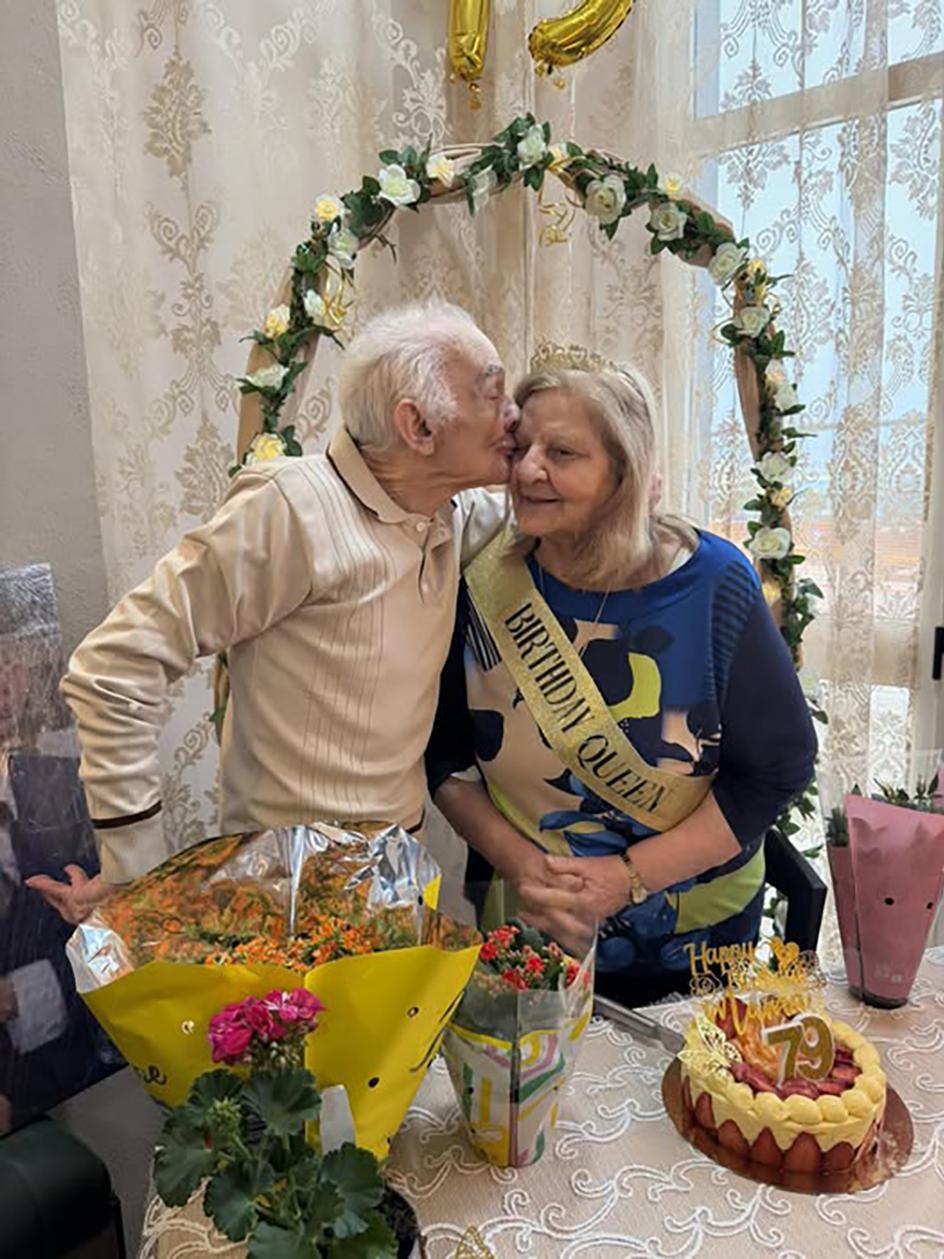 Tony Muscat and wife Carmena. Photo: Facebook
“I really love Malta and believe in giving weight to other Maltese brands. If we do not do it, who will?”
Customers still harbour memories of buying the Ġelat ta’ l-Għarusa (literally, bride’s ice cream) in the 1980s; some come from as far as Mellieħa and even Gozo and one took some with him back to Australia – “but do not ask me how!”
It may be exam time for Muscat, but he is still making ice cream. Summers were always hectic, and he could spend up to 100 hours a week in the little factory, but winter allowed him more time to focus on his studies.
Today, however, ice cream is not just a summer dessert, and the display is hardly ever switched off, he said.
With another two years to go before he graduated and decided how to divide his time, it was a constant debate, and the way the weighing scales would tip remained a question mark. “No pressure,” Muscat joked, liking the sound of “ice cream vendor by summer and doctor by winter”, with a possible PhD behind that too.