The casino law that could change everything
Brussels vs Malta
Malta’s gambling industry has long been a global success story. From historic Valletta to bustling St Julian’s, the island is known not only for its culture and sunshine but also as the European home of online casinos. Over 300 companies are licensed here, generating around €1.5 billion annually and employing thousands.
But now, that model faces its biggest challenge yet. The European Commission has launched formal proceedings against Malta over a controversial law called Article 56A – also known as Bill 55. The case pits Malta’s sovereignty against Brussels’ demand for legal consistency. The outcome could reshape the future of iGaming on the island.
Before diving in, let’s note one way this debate already affects players: fairer, simpler promotions are on the rise. For example, no wagering bonuses, where winnings aren’t tied up in endless small print, are increasingly seen as the kind of transparent offers regulators want to encourage.
What is Article 56A?
At its core, Article 56A gives Maltese courts the right to refuse enforcement of foreign court judgments against Malta-licensed operators if the gambling in question was legal under Maltese law.
Imagine this: a German or Austrian player sues a Malta-based online casino in their local court and wins. That player tries to enforce the judgment in Malta, but under Bill 55, the Maltese court can refuse, because the operator was following Maltese law.
For Malta, this is a matter of protecting its regulatory regime. For Brussels, it undermines mutual trust between EU countries. The Commission says it breaches the Brussels I Regulation, which requires members to respect each other’s civil judgments.
Why Malta chose this path
Malta’s government argues Article 56A simply codifies long-standing policy: that disputes about Malta-licensed operators should be settled under Malta’s rules. The Malta Gaming Authority (MGA) - widely respected as a “gold standard” regulator - already requires strict anti-money-laundering checks, fair play audits, and player protection measures.
From Malta’s perspective, allowing foreign judgments to overrule Maltese licences would weaken the authority of the MGA and threaten the island’s status as an international hub.
Why Brussels is pushing back
For the EU, it’s about consistency. If every country blocked foreign rulings in sensitive industries, the single market would fracture. Critics of Article 56A say it creates a “safe harbour” for gambling companies, letting them dodge accountability abroad.
The Commission’s infringement proceedings give Malta until late summer 2025 to respond. If the issue isn’t resolved, the case could go to the European Court of Justice, with serious implications for the sector.
The stakes: €1.5 billion and thousands of jobs
Malta’s gambling industry is not a niche. It contributes roughly 12–13% of GDP, employs 10,000–16,000 people, and boosts other industries from real estate to hospitality.
- The SiGMA conference alone draws 25,000+ visitors annually, filling hotels and restaurants.
- In 2024, Malta’s four land-based casinos welcomed nearly 900,000 visitors, generating €61 million in revenue.
- The government collected over €80 million in gambling taxes and licence fees last year.
Losing competitiveness or credibility in this sector could hit Malta’s economy hard.
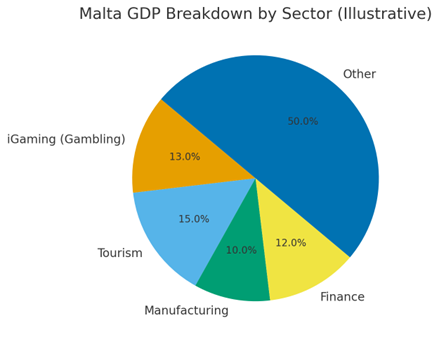 Pie chart showing gambling’s share of Malta’s GDP compared to tourism, manufacturing, and finance.
What players should know
Beyond politics, this case matters because it shapes how safe and fair gambling feels to players. Over the past five years, the MGA has introduced major reforms:
- 2023: Stronger player protection rules, requiring operators to monitor signs of problem gambling and offer easy self-exclusion.
- 2025: New financial reporting rules, making operator finances more transparent.
- ESG initiatives encouraging companies to report on social responsibility.
These changes aim to reassure both regulators and players that Malta’s gambling is not a “wild west.”
For players, it translates into clearer terms, fairer bonuses, and more transparency. That’s why no wagering bonuses - where you keep your winnings without complicated requirements - are being celebrated as a model for fair play.
Case studies: Real-world disputes
- Austrian and German players: Several courts abroad have ordered Malta-based operators to refund players who lost money on sites not locally licensed. Malta’s courts, citing Article 56A, have refused enforcement.
- Trannel International (Unibet/Kindred Group): Now owned by France’s FDJ, this Malta-based company faces multiple lawsuits in Europe. Article 56A is a key defense.
These examples show why the EU insists the law “tilts the scales” in favour of operators, and why Malta defends it as a matter of sovereignty.
Three possible outcomes
- Compromise - Malta tweaks Article 56A to limit its scope, keeping most of its model intact.
- Court defeat - The EU’s top court rules against Malta, forcing repeal of the law.
- Prolonged dispute - Legal limbo deters some operators, creating uncertainty.
For Malta’s workforce and economy, the quicker a resolution is found, the better.
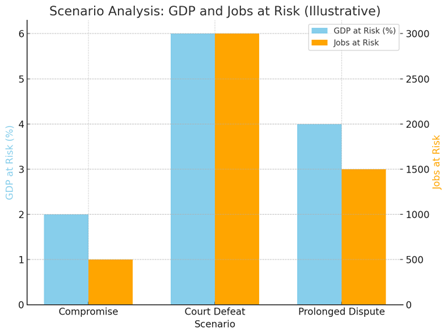 Scenario analysis bar chart - GDP/jobs at risk under each outcome.
Why this matters beyond Malta
This isn’t just an island story. The case is being watched across Europe because it could set a precedent for how much freedom small EU states have to design their own rules in industries with cross-border impact.
If Malta loses, operators may need to shift more resources into locally licensed EU markets. If Malta wins, it keeps a unique edge - but risks souring relations with Brussels.
The bigger picture
Malta has walked this tightrope before. In 2021, when the FATF greylisted the island for weak anti-money-laundering controls, confidence wobbled. Swift reforms saw Malta removed from the list a year later, restoring credibility. The Article 56A case is another defining test: can Malta defend its sovereignty while convincing Europe it remains a trustworthy regulator?
For now, the message is clear. Gambling is too important to Malta’s economy to be left unguarded. And for players worldwide, the pressure of Brussels may actually mean safer, clearer offers - fewer hidden traps, more straightforward bonuses, and a cleaner industry overall.
Bottom line
The EU’s case against Article 56A is not just a legal quarrel. It’s about Malta’s identity as a gaming hub, the livelihoods of thousands, and the fairness of play for millions of players worldwide.
Whatever happens, one thing is certain: the casino law at the centre of this fight really could change everything.
Disclaimer: Play responsibly. Players must be over 18. For help visit https://www.rgf.org.mt/