The feast of the small cross covered in yellow flowers
Little-known Sicilian town of Mazzarino has strong, historical ties to Malta
Over the years, more and more Maltese are visiting Sicily, exploring its many towns and villages. But few would probably have heard of Mazzarino in spite of its rich cultural heritage and its strong, historic links to Malta.
Mazzarino, in the province of Caltanisetta, is a town of about 10,000 people but the population is dwindling at a fast rate. That is because there is very little work beyond agriculture. The town does not even have a functioning hotel, only very small bed and breakfast places with two or three rooms – but it is often difficult to find accommodation there as they operate illegally.
And, yet, it had a glorious past. Its noble families were very rich and married to important European noble families. Suffice it to say that Prince Albert of Monaco has among his titles that of Duke of Mazzarino (I had accompanied him during a visit to the town pre-COVID).
The town is renowned for a number of very beautiful baroque churches, castle ruins and excellent cuisine. Among Sicilians it is mainly known for its feasts, among which is the feast of the Holy Crucifix of the Elm, a very small wooden cross mounted on a very heavy iron coffin that is carried shoulder-high by 120 barefoot men in a procession that lasts about seven hours. The cross dates to the 12th century and the figure of Christ lies on a bed of cotton.
Throughout the year, the Crucifix of the Elm is housed in a recently restored small church that is venerated by the local inhabitants, as well as by many other Sicilians who come for the feast in their hundreds.
A young researcher by the name of Vincenzo Camilleri has just published an extremely well-researched book about the origins of the church and the confraternity of the crucifix.
As the cross is carried along the very narrow streets in the pre-baroque part of the town and the wider baroque roads from 10am on the second Sunday of May, the crowds throw hundreds of necklaces of yellow daisies (‘sciuri di maiu’ – May flowers), adorning and embelleshing the cross.
One of the highlights of the procession is when the cross enters the basilica of Our Lady of Mazzaro, an enormous baroque church. That is when people line up to get a piece from the cotton that is placed under the crucifix.
By the end of the procession at about 4pm, the statue bearers are completely exhausted and return home with dirty, swollen and blistered feet.
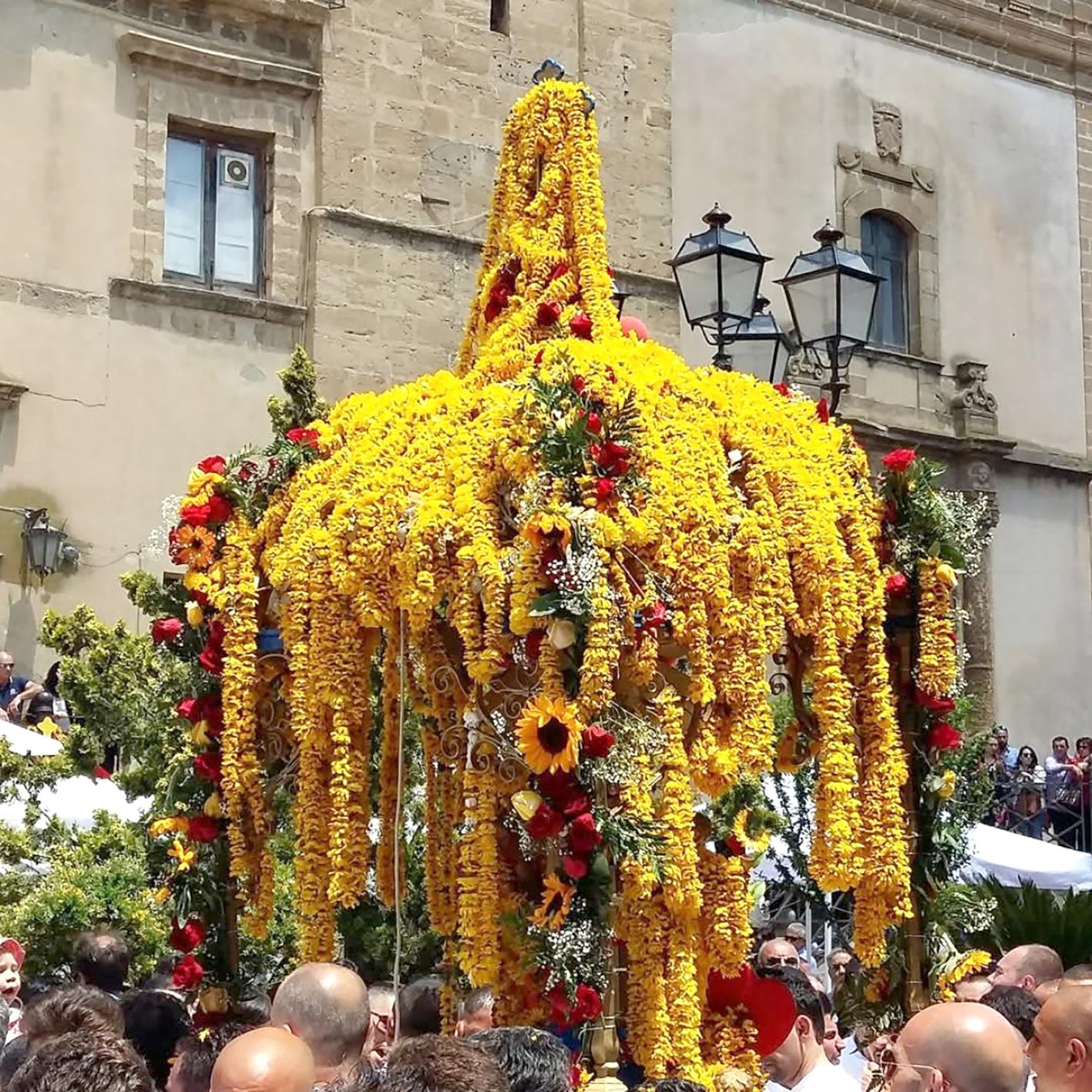 During the procession, people throw necklaces of yellow daisies over the cross.
Maltese surnames
The town had historical links to Malta but my attempts to increase these ties have not been successful. There are many residents with Maltese surnames, the most common being Farrugia and Camilleri.
The Caraffa family owned large areas of land around the town and they are still warmly remembered there. Two important painters had close links with Mazzarino, namely Filippo Paladini and Mattia Preti, who found sponsors among the local noble families.
Unfortunately, an important Preti painting was stolen from a church right next to the municipality on the main road and was never recovered: only a black and white photo of the painting exists.
Paladini actually moved to Mazzarino from Malta and died there: we know the church where he was buried − the Immaculate Conception church − but there is no trace of his burial site. The church, however, has a painting by Paladini which, according to local historian Giuseppe Ferreri, features an image of the painter. But there are other still unresearched links with Malta.
‘Slowly dying’
The town is slowly dying. Many of the large convents, for example those of the Jesuits and Capuchins, have closed down. There is no tourism beyond feast days.
The young have gone away: mostly migrated to far-away countries. Only one level of the school is used, and, at some point, the students have to go to a school in Gela, 35 kilometres away.
Most shops in the town’s main street have closed down and there is just one good restaurant and a café.
Everywhere you see older men sitting outside, lamenting about the days when the city was much more alive. Politicians hope for a revival but the locals find it hard to believe it can ever happen.
Yet, the cornetto alla crema is still the best I have ever tasted in Sicily − this is, however, not enough to draw the crowds.
Ray Bondin is a world heritage expert.