The first Maltese settlers in Corfu
Maltese have been documented on the Greek island since at least 1815
For the past years, I have been doing research work concerning the migration of Maltese people to the Greek island of Corfu in the first decades of the 19th century, both at the Catholic Diocese Archives and at the Greek State Archives in Kerkyra.
Sir Thomas Maitland was appointed governor of Malta on July 23, 1813, during the reign of George II. A couple of years later, in 1815, the Greek Ionian Islands were declared a British protectorate and, consequently, Maitland was appointed as Lord High Commissioner for the Ionian Islands, which included Corfu, Paxos, Cephalonia, Lefkas, Ithaca, Zakynthos and Cythera.
Maitland continued to serve as governor of Malta until January 17, 1824. Corfu, instead, remained under the protection of the British Crown until 1864 (Gauci 2007).
Till now, Maltese scholars and the Maltese government had established the year 1819 as the year in which the first Maltese landed in Corfu and settled down there. In 2014, Bernard Vassallo wrote: “The origins of this small [Maltese] community began in 1819, when the British governor of the Ionian islands, Sir Thomas Maitland, decided to build the palace of St Michael and St George.”
In October 2019, then minister Carmelo Abela marked in Greece the 200th anniversary of the first Maltese immigrant arrivals in Corfu.
The surviving registers at the Catholic Diocese Archives at the bishopric in the old town of Kerkyra belie this dating, since the presence of Maltese in Corfu has been documented since at least 1815.
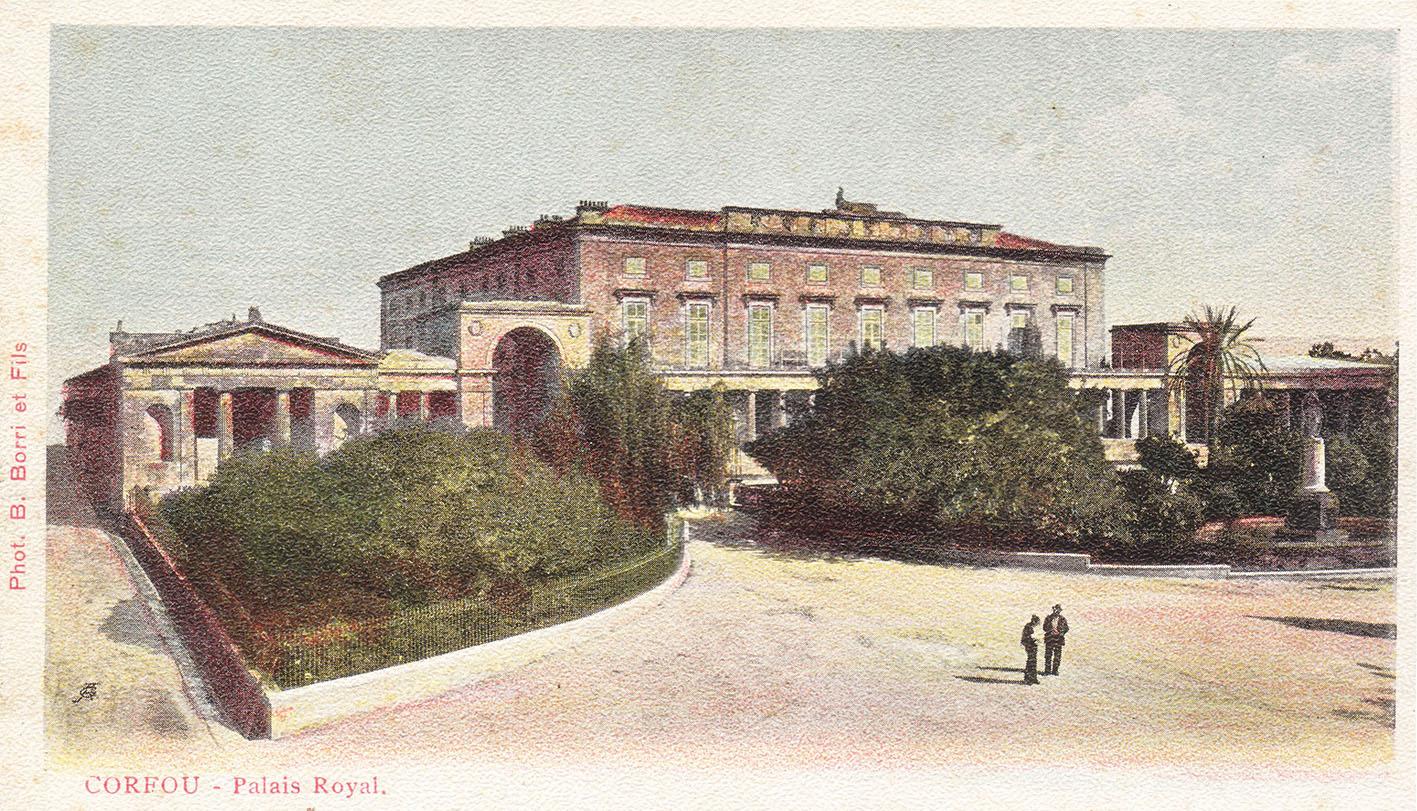 A postcard of the Governor’s Palace, Kerkyra, Corfu, built with Malta stone.
The first Maltese person one encounters in the Corfu diocese registers is Paolo Pace, son of Silvestro. On April 23, 1815, Pace is recorded in the baptism register as the godfather of Catterina Bianchini, whose father, Luigi hailed from Bassano del Grappa, in Italy, while her mother, Rosa Agorastò was a native of Corfu. One would assume that, to qualify as a godfather, one would have to be quite a close acquaintance of the parents.
It would seem, therefore, that a few weeks after having set foot on the island, the Maltese were already intermingling with the other inhabitants of Corfu.
A second Maltese person registered as the godfather of a child born in Corfu was “il Sig. Dr Giuseppe Schembri”, son of Giacomo. On November 17, 1815, Schembri is registered as the godfather of Maria Antonia Giuseppa Ruggeri, born on April 11, 1815, daughter of the Neapolitan Luigi Ruggeri and Angiola di Pietro, from Valdina, in Sicily.
Could this Dr Schembri have been the surgeon Giuseppe Schembri who, after having been in the service of the Knights of the Order of St John, joined the British services in 1801 and then took part in the Egyptian expedition as part of the British contingent? According to Michael Schiavone (2009: 1437), Schembri was taken prisoner by the French in the island of Capri in 1810. He died in 1835.
Could it be that, after his release by the French, Schembri ended up in Corfu? If this were so, it would confirm that a small nucleus of Maltese, among whom Paolo Pace and Giuseppe Schembri, could have already established itself on the island before the landing in Corfu of the British governor Maitland, who arrived there in February 1816. Eventually, Maitland brought over a sizeable group of Maltese, quite a number of whom, but not all, were involved in the building trade.
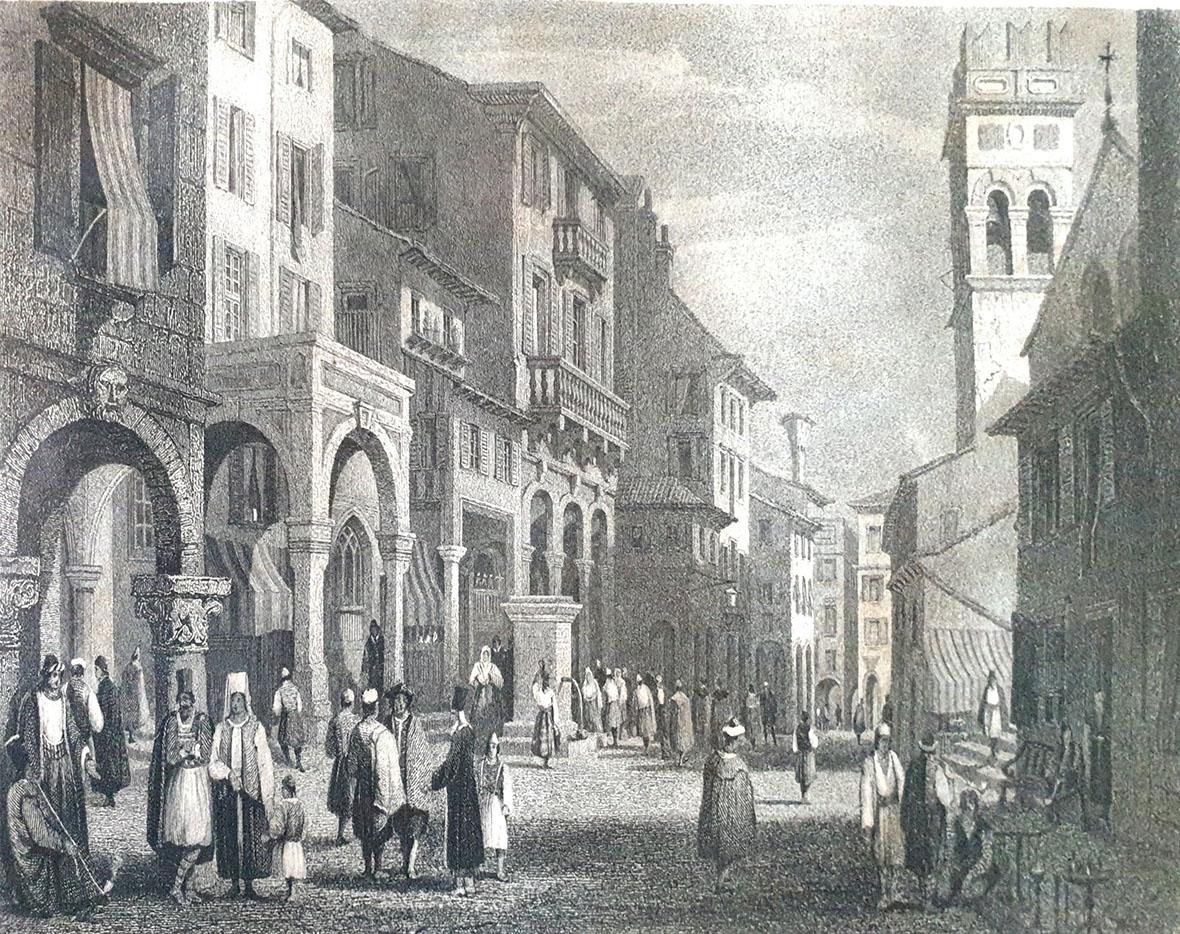 A painting of the Annunziata Catholic church in Kerkyra.
Whatever the case, apart from the Catholic religion, the possible common link between these two Maltese and the Bassanese, Corfiots, Neapolitans and Sicilians to whose children they acted as godparents must have been the Italian language which, in Malta, Corfu and the various regions of Italy, was the common language of culture.
Another person, quite possibly of Maltese origin, is also already recorded in Corfu in the summer of 1816. In fact, on July 29, 1816, a safe passage certificate was issued by the British authorities for Antonio Vella to travel safely from the Ionian island to Venice “per affari suoi”. Vella is described as the 23-year-old “Signor Antonio Vella da Corfù”, with physical features denoting a “statura ordinaria, capelli castagni, occhi castagni, naso regolare” and a “bocca media”.
Interestingly, one child of Maltese origin, Antonio, Francesco, Luigi Farrugia, was born in Corfu before the arrival of Maitland in 1816 and at least three years before the first marriages involving Maltese were recorded.
Antonio was born on July 28, 1815, and baptised on July 30, 1815. His parents were the Maltese Mattio Farrugia, son of Pasquale, and the Sicilian Anna Costanzo. His only godfather was Antonio Salemi, son of Vittorio, from Messina, in Sicily (Baptism Register, vol. 1778-1817, f. 254v.). This would evidently mean that the first Maltese giving birth to their offspring in Corfu must have already been previously married, either in Malta or in Sicily.
This also means that the presence of at least five Maltese − Pace, Schembri, Vella, Antonio and Mattio Farrugia − had already been recorded in Corfu even before Maitland had ever set foot on the island in 1816.
But that is not the only new thing about the findings of my research. Between 1816 and September 1819, 13 Maltese men and one Maltese woman had been issued with a ‘clean bill of health’ certificate by the authorities in Malta to travel to Corfu; between 1817 and 1818, two Maltese youths and an Anglo-Maltese woman married in Corfu; the Maltese Michiel Attardi was one of the two witnesses at the marriage between a Genoese and a Corfiot in June 1819; and nine ‘Maltese’ babies were born in Corfu between 1815-1819, the official year of the first Maltese presence on the island, till today.
A reassessment of the presence of the first Maltese settlers in Corfu is certainly due.