The four maps that broke the news during the Great Siege of 1565
Giovanni Francesco Camocio’s Great Siege maps have survived the ravages of time
Four maps of the Great Siege of Malta of 1565, published by the Piemonte-born Giovanni Francesco Camocio (active 1552-1575), have astonishingly outlasted the ravages of time and change.
Distributed far and wide, these maps were once the most effective means of reporting the latest episodes of the siege on Malta – effectively they were equivalent to today’s bulletins, flash or breaking news coverage. So impressive was the quantity issued that the Great Siege of Malta tops the list of the most represented events in 16th-century cartography.
Rapidity of production, easy legibility and efficiency of circulation were the pressing criteria that guided the creation of these maps. News on the progress of the siege and military operations had to spread with lightning speed, as far as means of travel could allow back then. So, the efficient and express production of these maps, being the only visual sources of reporting, was of the essence.
As illustrated pieces of news, these maps carried the onus of presenting factual and updated information, fast and frequently. Indeed, they served a journalistic function which explains their, at times, economy of appearance.
Even though these maps are not signed, Camocio’s connection is identified by the imprint – In Venetia alla libraria d[e]lla piramid[e] – seen at the foot of the legends at the top left-hand corner. This is a clear reference to the book and printing shop he ran in St Lio in Venice, using the symbol of the pyramid as his identifying mark.
The Great Siege of Malta tops the list of the most represented events in 16th-century cartography
States of news
These four maps represent the last nine weeks of the Great Siege of Malta that ensued between mid-May and early September 1565.
Occupied by the Catholic Order of St John of Jerusalem since 1530, the Maltese islands had for long been the target of the Ottoman Turks. To them, the capture of the Maltese islands was tantamount to the much-desired conquest of the Mediterranean, and hence, of the Christian territories on the continent.
So when news of the approach of the Turkish Armada towards Malta on May 18, 1565, reached Christian leaders across Europe, their eyes and ears were keenly riveted on the developments of this siege. Its outcome would have determined the fate of their dominions.
From the inscription in the legend at the top left-hand corner of each map, it is understood that the images for Camocio’s maps originate from disegni mandati da Malta/fidelisimi, con la nota del campo d’infide/li et altri particolari… [drawings sent from Malta/most faithful ones, with notes about the camp of the unfaithful and other details…].
As in the case of the many maps of the Great Siege, the designs of Camocio’s maps were derived from the illustrated war reports that were dispatched from Malta. Reaching the main print-production houses of the time, these pictorial bulletins were the sources for the maps that were issued from a copper plate on which the image would have been engraved or etched.
As the separate impressions of these four Camocio maps were printed from the same (mother) copper plate, they constitute as (sibling) ‘states’ – hence their individual distinction as ‘States 1, 2, 3 and 4’.
Collectively, these maps collate a series presenting a sequence of those significant events that marked the final stages of the Great Siege in Malta. They are identical in some areas while totally dissimilar in others. This is because each map represents an updated account of military action reflecting, and thus recording, siege developments.
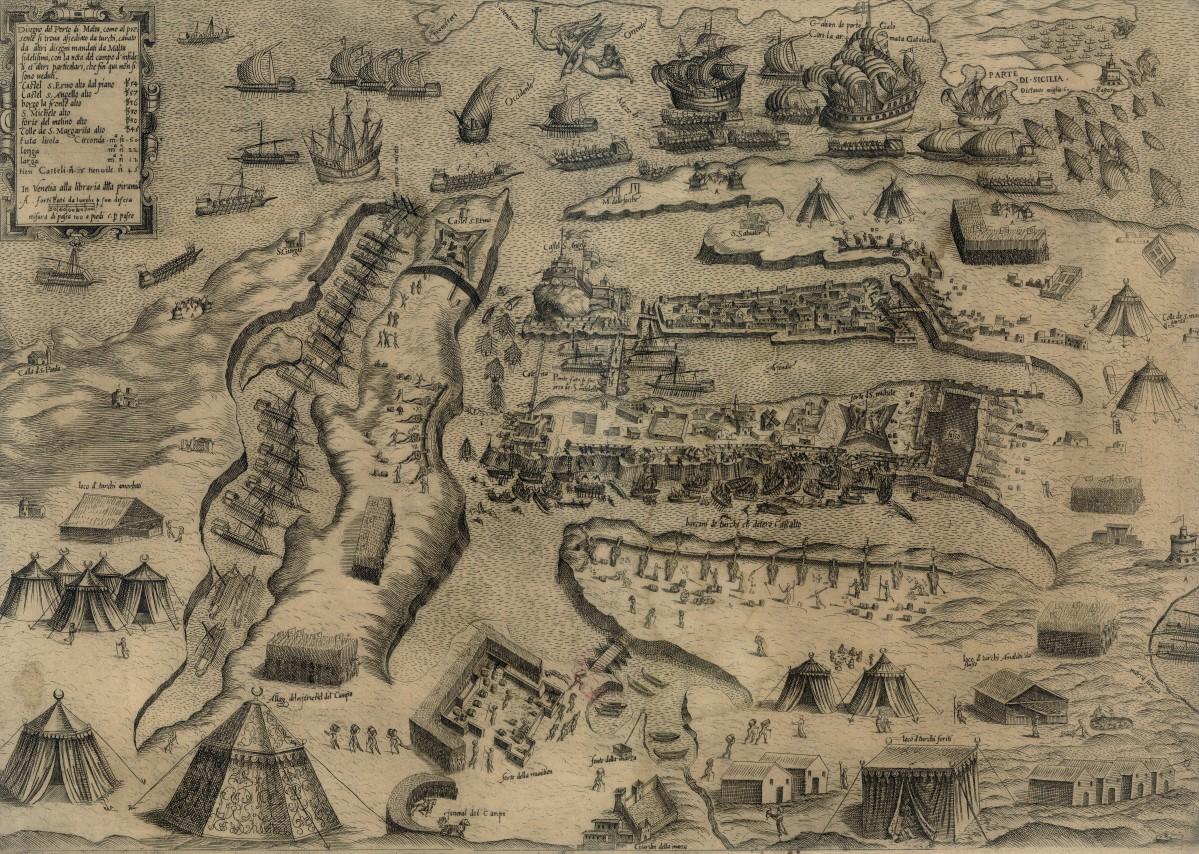 Disegno del Porto di Malta…, by G.F. Camocio, September 1565, etching. Map collection, Geography Department, Faculty of Science, Charles University of Prague, Czech Republic. Photo: Charles University of Prague
The unchanged details, throughout this series, are proof that each map was issued from one and the same copper plate. The differences, noticed from the addition and erasure of features, are also evidence of the use of the very same plate throughout the manufacture of these four printed maps. Before an updated print was issued, the plate would have had to first be altered according to fresh news on the Great Siege.
The north-eastern harbour area of Malta is the configuration that is retained in all of the four maps. Another common feature is the guardian angel, at the top centre, who doubles up as a compass due to the four surrounding main wind directions.
One of the rarest, the first-state map introduces us to an overview of the various placements of the Ottoman Turkish camps, troops and fleet. The completely abandoned Fort St Elmo, Fort St Angelo and the no longer extant Fort St Michael are clearly viewable on the Mount Sceberras (Valletta), Vittoriosa and Senglea promontories, respectively.
Issued mainly to report the large-scale amphibious assault on Senglea, which took place in mid-July, this map also shows the Catholic fleet secretly anchored in the impossibly close Syracuse harbour.
An update of the siege in full swing is then presented by the second state as the various skirmishes testify. Turkish forts, battalions and troop formations have now increased and the pontoon-bridge behind the chain between Vittoriosa and Senglea has been inserted, together with the ditch outside Fort St Elmo.
Another important update is the increased vessels in the Sicilian Channel, evidence of the gradually strengthening Catholic Armada preparing for its journey to Malta where it finally landed in early September and radically changed the course of the Great Siege.
 Disegno del Porto di Malta…, by G.F. Camocio, early October 1565, etching, Albert Ganado Malta Map Collection, Cartographic Collection, MUŻA. Courtesy: Heritage Malta; Photo: Malta Study Centre at the Hill Museum & Manuscript Library, Minnesota, USA
Camocio’s third-state map was the first on the market to announce the end of the Great Siege. The alterations to the copper plate that distinguish this map from its second-state predecessor were minimal, as the speedy reporting of the then latest news about the arrival in Malta of the ‘Gran Soccorso’ on September 7, 1565, was an absolute must.
The rush to produce this third state is made bare by the subtle but key changes introduced, such as the cross of the Order banners carried by troop formations replacing those of the crescent of the Ottoman Turks that predominated in the first two states. Short inscriptions substitute earlier ones to inform about the landing of the Christian fleet and the Turks abandoning their artillery.
The fact that much of the map’s contents essentially remained untouched – including the lingering and by then anachronistic sea assault on Senglea – is further proof of the urgency with which it had to be disseminated. Time and priority for refinement and correction of illustration were nought.
 Disegno del Porto di Malta…, by G. F. Camocio, late October 1565, etching, Count Messina Bequest, Cartographic Collection, MUŻA, Valletta. Courtesy: Heritage Malta; Photo: Malta Study Centre at the Hill Museum & Manuscript Library, Minnesota, USA
Late in October 1565, around three weeks after the third-state map was out, the fourth one was printed. It represents the dramatic surrender and evacuation of the Ottoman Turks from Malta after the ‘Great Relief’ of the Christian forces came to the Order of St John’s rescue and marked a critical turning point in the siege.
In sharp contrast to the previous three states, many parts of the harbour areas and inland terrain are clearly vacant as the Turkish armies broke camp and fled to Marsamxett Harbour to board their ships. During their frantic escape, many hurled themselves into the water, some drowning in the process, as is clearly shown. Small groups of Turkish soldiers, struggling to drag heavy cannon and weaponry, replace the Turkish tents, troops and munitions disposal site seen in the earlier states.
During the mass exodus of the Turkish troops from St Paul’s Bay (seen on the extreme left), some fierce final battles are seen being waged between the Christian and desperate Turkish soldiers, as the strewn dismembered bodies demonstrate. Among the numerous combatants, two emerge from anonymity: ‘Don Alvaro’ (viceroy and captain general of the Spanish Navy, Don Garcia Álvarez de Toledo y Osorio) and ‘il S. As[c]anio della cornia’ (the Italian mercenary, Ascagnio della Corgna). As the main protagonists that successfully took the helm of the ‘Gran Soccorso’, it is little wonder that they were granted a place and identified in this map.
Appearing for the first time, the trumpeter on horseback at the bottom right heralds the news about the Christian victory. This is supported by the 12-line panel that accurately describes the drastic events of the siege’s final days.
The first-state map… also shows the Catholic fleet secretly anchored in the impossibly close Syracuse harbour
Noteworthy features
Assaults, skirmishes, artillery, smoke, fire and all that typically goes with the heat of battle make up the iconography of the four Great Siege maps. Also of interest is the human presence. Apart from those engaged in battle or preparations for it, there are tiny, mainly Ottoman Turkish, figures eating, marching, burying their dead and suffering injuries or ailments.
Human activity and particular places are indicated by concise text. Intricate topographical features are omitted from the depiction of the harbour area as it was enough to show its boundaries approximately.
More effort was dedicated to precisely representing the various encampments, cannon placements, enemy and defender positions, as well as vessels and areas under assault. The rest mattered less – so much so that the inaccurate proximity of the port of Syracuse to Malta’s main harbours, for instance, was justifiable, exactly because it played such a pivotal role in the final developments of the Great Siege.
For the same reasons, the erroneous placement of the locations of St Paul’s Bay, St George’s Bay and Marsaxlokk prevail over fidelity to geography. As urgent means of information, it was vital for these special maps to compact as many updates and compress as many places as possible for a great deal of news to be covered in one issue.
Erasures made on the copper plate have in some of the states, especially the fourth, remained unintentionally exposed. They are conspicuous through the patchy, rough markings that were meant to remove details in order to provide an updated scenario of the siege. Indeed, they are evidence of the hurry with which they were scratched off.
Some very fierce final battles are seen being waged between the Christian and desperate Turkish soldiers
UNESCO International Memory of the World Register
This four-state Great Siege map series brought together two institutions in two countries: Malta and the Czech Republic. This is because the state 1, 3 and 4 maps form part of MUŻA’s Cartographic Collection (Heritage Malta), while state 2 belongs to the map collection of the Geography Department at the Charles University of Prague.
The latter was discovered in 2014 by the books and paper conservator, librarian and author Joseph Schirò. Such was the enthusiasm ignited by this find that a year later, Charles University collaborated with Heritage Malta to jointly submit a nomination for this four-state series to be listed in the prestigious UNESCO International Memory of the World Register (IMWR). All the hard work to compile this application finally paid off. In 2017, the G. F. Camocio Maps of the 1565 Great Siege of Malta were officially inscribed in the IMWR – a first for Malta.
At MUŻA, a special display for these cartographic gems has been set up to honour this international mark of distinction that they are now permanently stamped with.
Conclusion
The over-450-year-old siege maps are part of our cultural heritage because they, first and foremost, represent a decisive event in Malta’s history and, secondly, because they cast light on man-made and natural features of the island that have disappeared forever.
The political and historical context in which they were made and for which they were conceived belongs to an age now defunct, as much as their original journalistic purpose has long been superseded. In this respect, the maps capture a distant past, impossible to reminisce, as it is not within living memory, but possible to educe. This is because these siege maps essentially secure the collective memory of a historic happening that has had a huge emotional and significant hold on the Maltese and beyond.
Keeping collective memory safe and alive entails safeguarding and championing such map treasures in order to foster awareness and ease accessibility to all.
For more information on the Camocio Maps, visit www.unesco.org/en/memory-world/camocio-maps and https://artsandculture. google.com/story/observe-the-battles-of-the-1565-great-siege-of-malta-captured-in-the-camocio-maps-unesco-memory-of-the-world/uwURK25-Z0XqaQ?hl=en. One of the Camocio maps may be viewed at MUŻA.
Bernadine Scicluna is principal curator at MUŻA.
Acknowledgements
The author thanks MUŻA – Malta’s National Community Art Museum, Heritage Malta, the Malta Map Society, the Malta Study Centre at the Hill Museum & Manuscript Library, Minnesota, USA, Charles Farrugia, Albert Ganado, Daniel Gullo, Eva Novotná and Joseph Schirò.