The Sliema murder of a Palestinian jihadist that sparked fire in the Middle East
30 years ago, the founder of the Palestinian Islamic Jihad was shot dead on Tower Road
On an October morning 30 years ago, a man with a Libyan passport and a briefcase arrived in Malta on the Thursday morning ferry from Libya.
As he had done many times before, the 43-year-old was planning to fly from Malta, as Libya was under an air embargo at the time.
Having checked in at the Diplomat Hotel for the night, the man known as Ibrahim Ali Al Shawesh strolled along the Sliema front, shopping in the commercial and tourist hub.
With two plastic bags in hand, after shopping at Bernardi (now Zara), he was about to walk into the hotel in Sliema’s Tower Road just after 1pm when a man wearing a bandana and carrying a black and blue bag approached him. Gunshots followed. The man died on the pavement.
Little did forensics know at that point that the victim was Fathi Shaqaqi, founder of the Palestinian Islamic Jihad. The assassins fled on a motorbike.
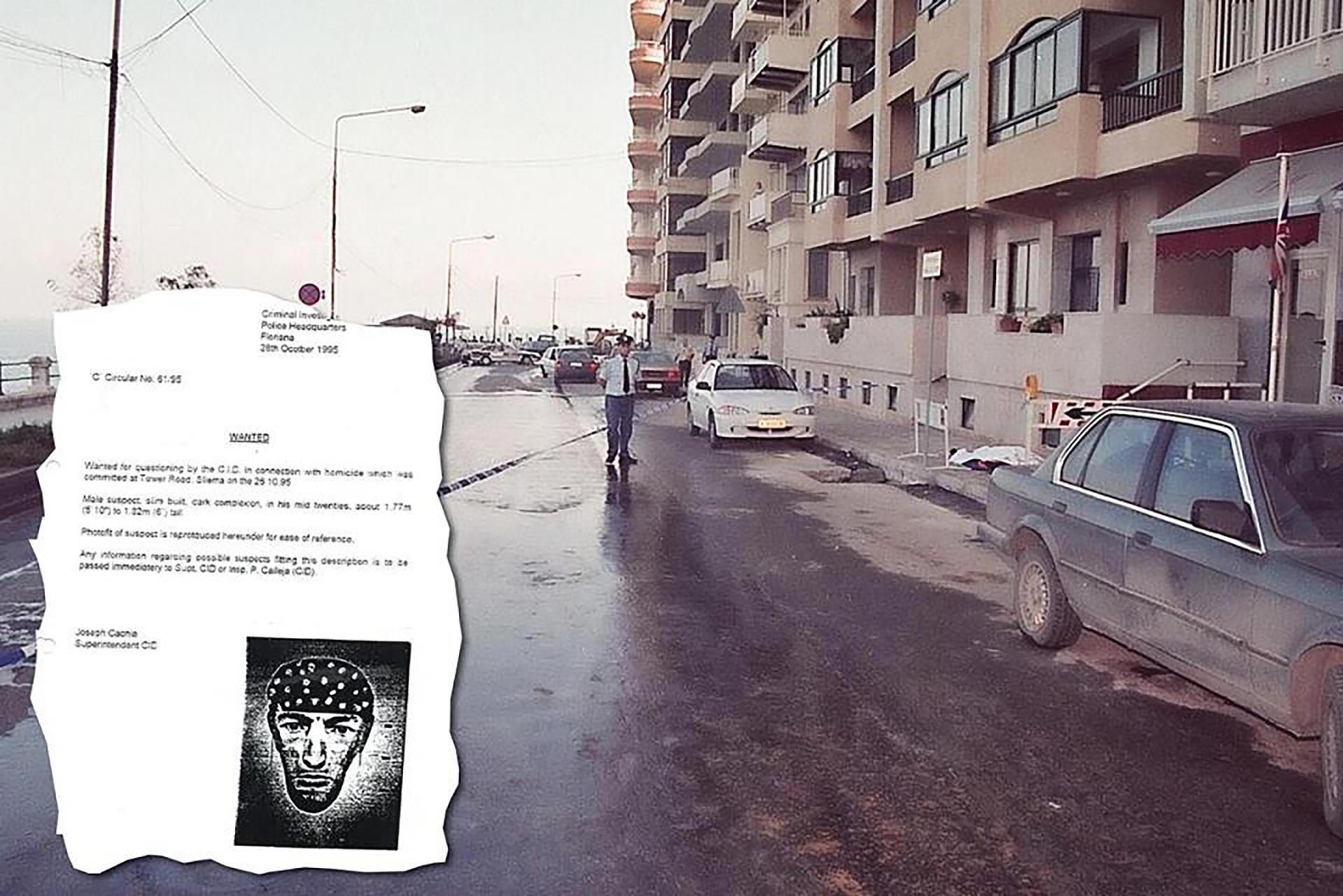 A policeman stands by the crime scene on Tower Road. Inset: Police documents
A professional job
John Charles Ellul, who was head of the police’s crime scene unit at the time, recalls the crime: “The cadaver was found face down with five shots to his head.
“Immediately, you could tell that the murder was not a random act of violence or that it followed an argument. It was a planned and professional hit,” he told Times of Malta.
Ellul said the assassins took many precautions not to leave evidence that could lead to their identification.
“That in itself says a lot,” he said.
Several things about the victim were also peculiar.
“He had a wig. With hindsight, we know he was using it as a disguise because he was travelling under a false identity and knew he was a target,” Ellul said.
Police searched the victim’s hotel room, and the contents of his suitcase indicated that he was not who his passport claimed he was.
A 38-year-old Tonio Borg had just become home affairs minister a few months before the October 1995 assassination.
“On that day, Police Commissioner George Grech called me to say that a Libyan man had been murdered. But soon after, Prime Minister Eddie Fenech Adami told me that this was an especially important case and could be more than just an ordinary murder,” Borg said.
He had a wig. With hindsight, we know he was using it as a disguise because he was travelling under a false identity and knew he was a target
Fenech Adami told him that the circumstances around the case – that it happened during daylight hours and seemed to be a professional job – meant the home affairs minister needed to be on special alert.
By night, the true identity of the victim was not yet known, at least by the general public.
In fact, Times of Malta’s front page headline the day after the murder read: ‘Libyan national gunned down in broad daylight.’
It was only on Sunday, October 29, that the identity of the victim was reported to be Shaqaqi.
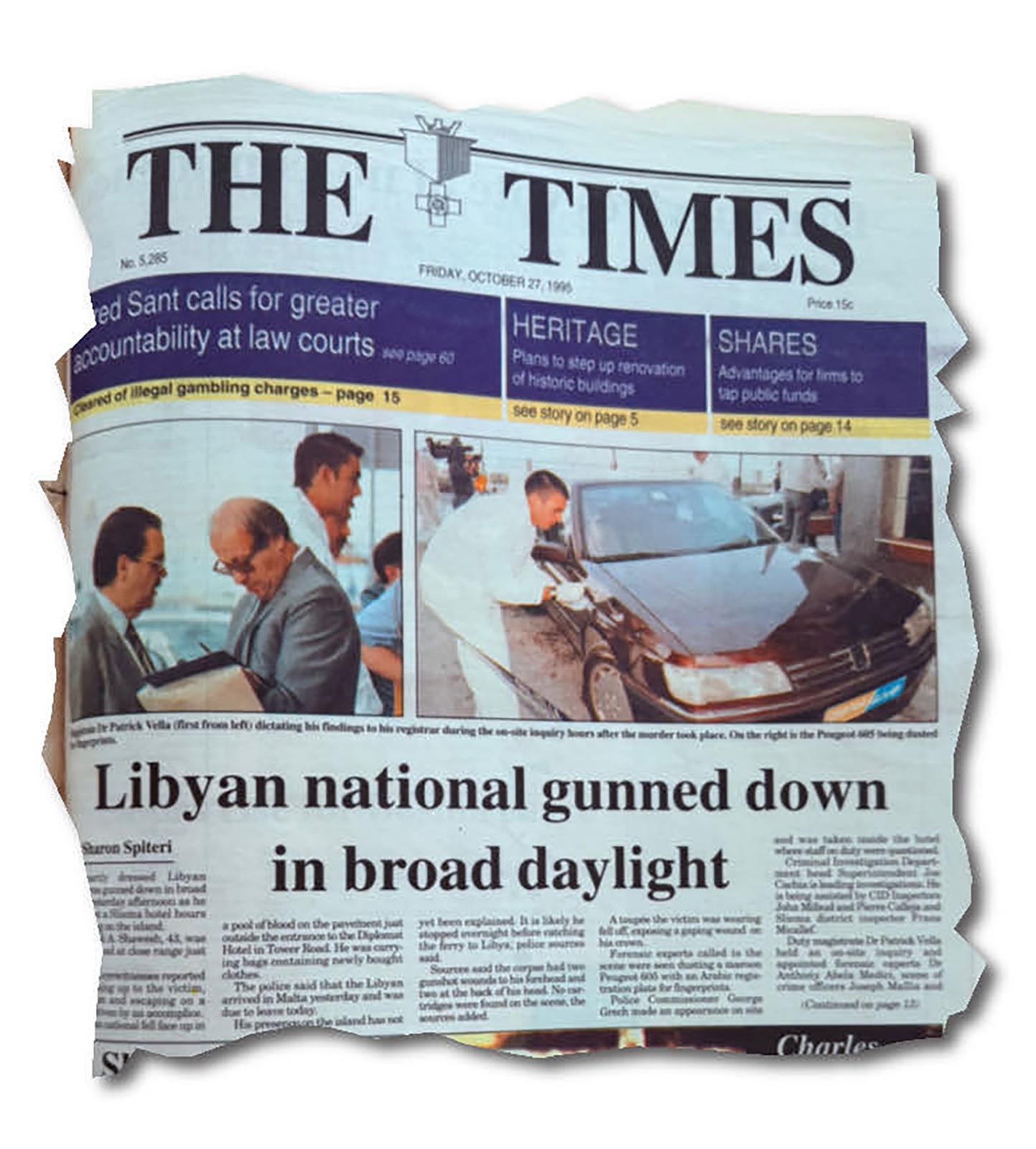 The Times of Malta’s front page the day after the murder.
Mossad’s involvement?
Israel’s secret service, Mossad, was immediately suspected of being the perpetrators of the Sliema murder.
“Even though many things pointed to Mossad, Israel never admitted to the assassination,” Borg said, adding that as a rule, “Israel never admits to extra-judicial killing.”
Ellul, who worked on several terrorist cases during his career, added that close-range gunshots to the head were part of Mossad’s modus operandi.
After the hit, a foreign couple saw the shooter immediately hop onto a Yamaha motorbike being driven by an accomplice, former journalist Joe Mifsud writes in his book Terror’s Footprints.
The motorbike was abandoned on Manuel Dimech Street.
A third person was waiting for them with another means of transport, probably a car. The assassins are believed to have driven to the Msida marina and fled on a small boat before getting on an offshore ship.
Mifsud, now a magistrate, also points out that the assassins could have flown out of Malta, possibly via a private flight to Tunisia.
The motorbike, left in one of Sliema’s more prominent streets, was one of the clues that investigators could look into.
The motorbike had been purchased in Greece by a man named ‘Harmand Philippe Renè,’ however, Greek authorities had no data suggesting the same man entered or left the country.
After changing from Greek to French licence plates, the motorbike made its way to Malta in August.
But when it was recovered, shortly after the murder, the motorbike had forged Maltese number plates.
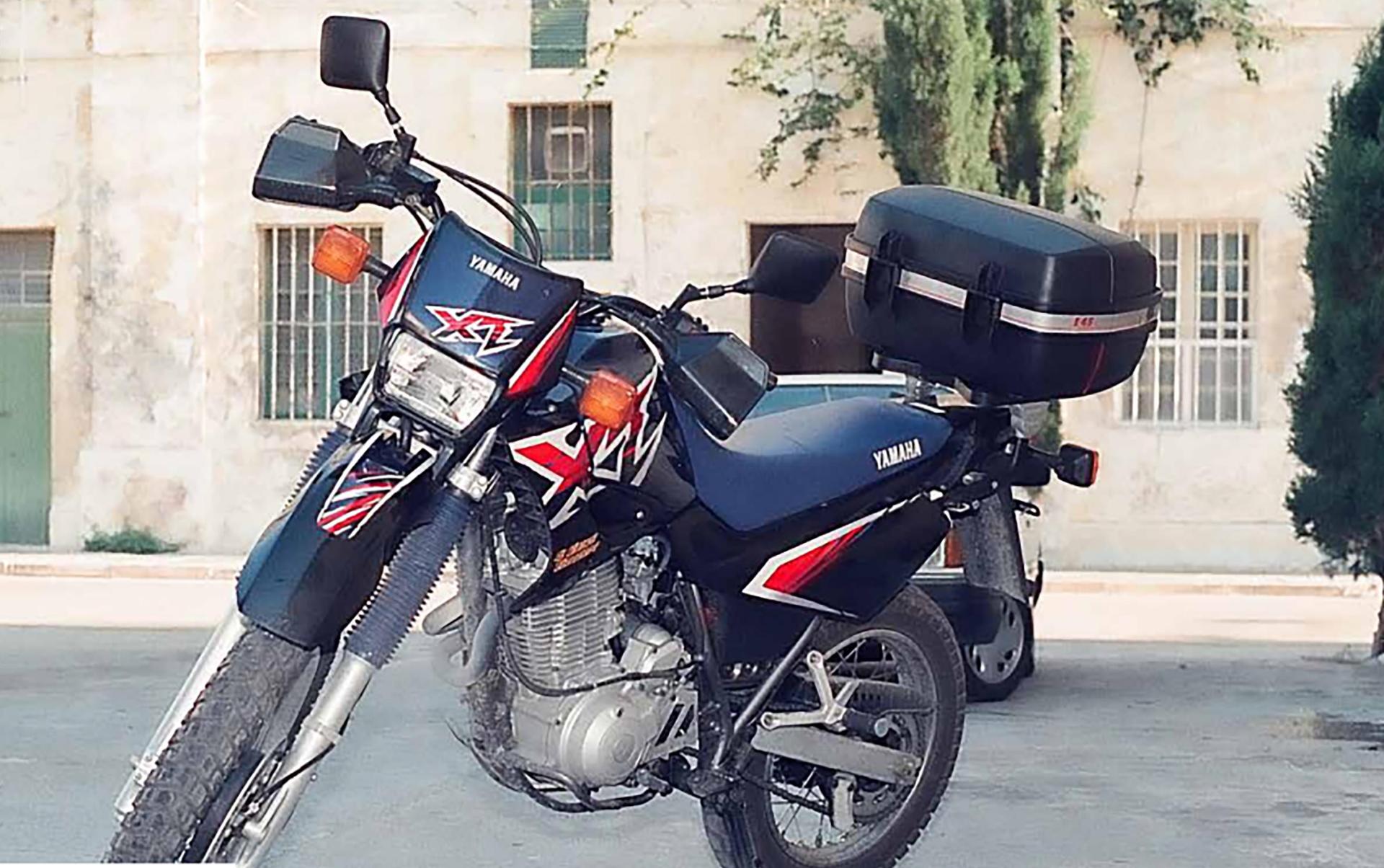 The getaway Yamaha motorbike was one of the few clues police had in hand. Photo: Terror’s Footprints/Joe Mifsud
Analysis of fuel in the motorbike’s tank also revealed that the petrol used came from Italian petrol stations – indicating that the motorbike had barely been used in Malta.
Asked whether Israel was behind the assassination, an Israeli government spokesperson declined to comment. Speaking to the media soon after the murder, then Israeli Prime Minister Yitzhak Rabin said:
“He [Shaqaqi] was the head of a terrorist murderous organisation that carried out murderous attacks against innocent civilians. He had several enemies... I imagine that he also had Palestinian enemies, and if he was the man that was killed, wherever he was killed, I am certainly not sorry about it.”
On the Monday after the murder, Fenech Adami said the murder was “a case of political assassination”.
Then-foreign minister Guido De Marco went a step further when confronted by journalists at the airport.
“That the Israelis could have been behind the attack is one of the theorems,” he told Times of Malta.
“I would be inclined, following certain amount of statements made by the Israeli authorities, to say that the theorem that it was the Mossad is a theorem that can hold its own,” De Marco said.
International fallout
The murder of Shaqaqi soon led to blowback in the Middle East, as protests erupted in Gaza, with demonstrators burning Israeli and American flags.
Islamic Jihad said they would take revenge, vowing to “set the ground on fire underneath the feet of the criminal Zionists.”
They promised more suicide attacks, styled on two carried out in the previous year in Beit Lid, north of Tel Aviv, and in Jerusalem.
The group, alongside Hamas, claimed responsibility for a suicide bombing in March the following year, when a suicide bomber detonated a bomb outside Tel Aviv’s largest shopping mall, killing 20 and wounding 75 others.
In Malta, relations with Libya, which had remained friendly after the Nationalist Party took over government, soured for a while.
Peaceful protests by Palestinians living in Libya even erupted in front of the Maltese Embassy.
The ferry connecting Libya with Malta was suspended in the immediate aftermath of the assassination.
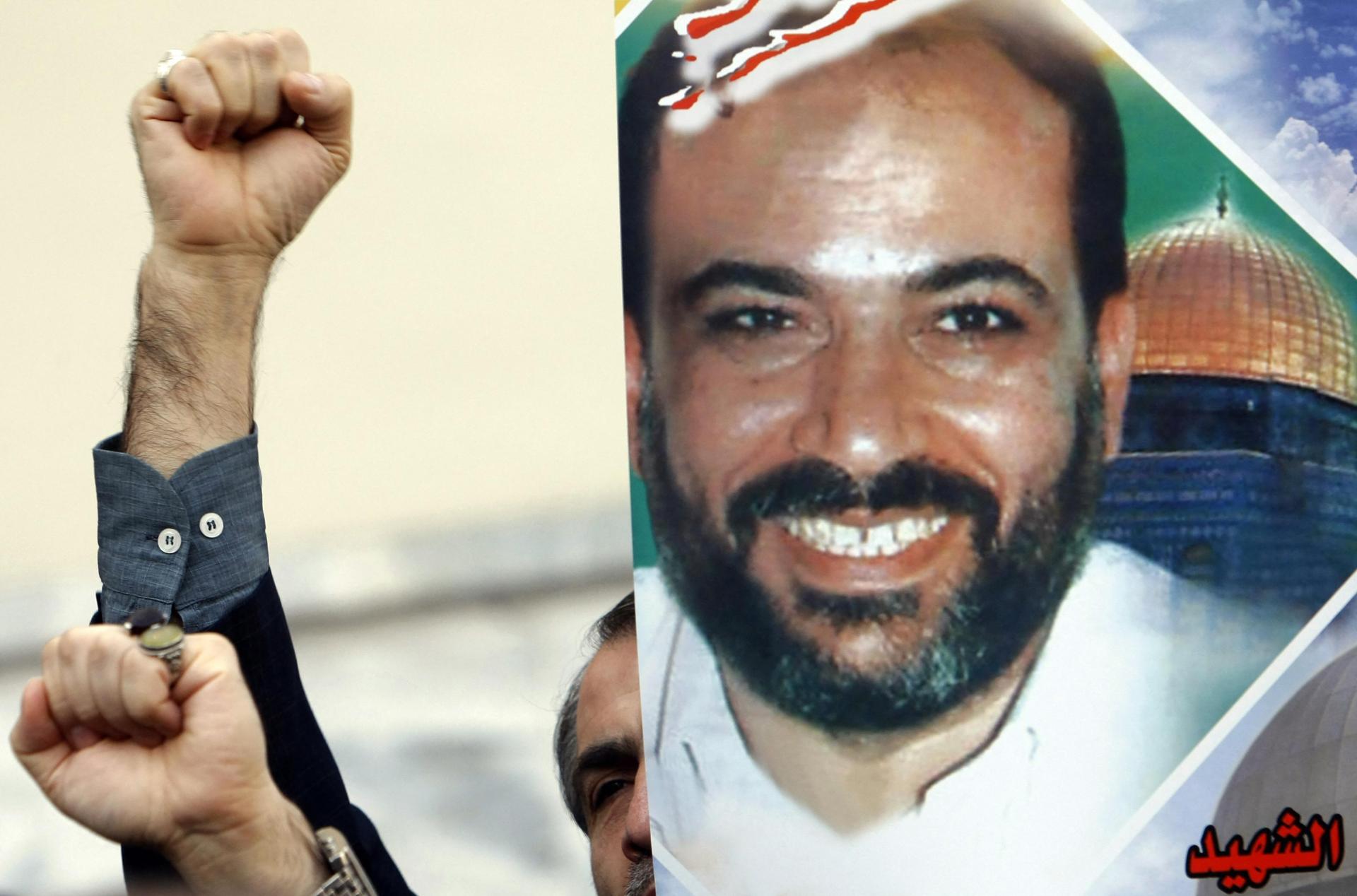 An Iranian demonstrator chanting anti-Israeli slogans and holding a protrait of Fathi Shaqaqi in Tehran’s Palestine square in 2008. Photo: AFP
De Marco’s diplomacy, however, led to the restart of the ferry operation soon after, Borg told The Times of Malta.
Borg, who would later go on to serve as foreign minister, said the Libyans had “abused” their friendship with Malta so that Shqaqi could travel through Malta.
“Shqaqi’s false Libyan passport was not forged but issued by the Libyan government. In that case, it was nearly impossible for Maltese authorities to know he had a fake identity.”
He said the Maltese government had no idea that Shaqaqi was often travelling through Malta.
Borg also said the government was upset with having an “extra-judicial killing,” especially in the heart of the tourist centre.
Who was Fathi Shaqaqi?
Born to a refugee family in Gaza, Shaqaqi’s family fled to the West Bank in 1948, fearing massacres. Shaqaqi went on to graduate as a medical doctor in Egypt, and it was during his studies in the 1970s that he founded the radical organisation.
Islamic Jihad would go on to conduct a number of terrorist attacks and suicide bombings, mostly in Israel.
“As Palestinian students, we would discuss Islam and Palestine, and we saw two categories of Palestinians: the nationalists, who talked about liberating Palestine but who forgot about Islam, and the traditionalists, who talked about Islam and an Islamic state but who forgot about Palestine,” Shqaqi said 10 months before his assassination.
“We had to solve this problematic issue, to make the crossing-point between nationalist and Islamist. So we talked about Islam, Palestine and Jihad [holy struggle] – Islam would be the idea we would start with, Palestine the goal to liberate, and Jihad would be the way.”
Shaqaqi believed that only an Islamist movement could achieve any political or military success against Israel.