This 500-year-old poem is the oldest piece of literature in Maltese
Medieval poem Il-Kantilena joins UNESCO list after a decade in waiting
In bustling and vibrant Valletta, where the streets are alive day and night, there is history in every nook and cranny. With a story spanning centuries, the fortified city is the ideal home to the island’s oldest piece of literature in Maltese, il-Kantilena.
Located on a corner of St Paul Street, the Notarial Archives is a treasure chest bursting with a collection of 20,000 volumes full of colourful and insightful notarial deeds, and the 15th-century poem is the priceless jewel of the archive.
Back in April, the poem was added to UNESCO’s prestigious Memory of the World Register, more than 11 years after it was first submitted for consideration back in March 2014.
While philosopher Pietru Caxaro’s allegory was penned over 500 years ago, to this day, the linguistic treasure echoes along the archive’s walls and in the minds of local and foreign researchers who continue to debate and dissect the poem.
Historian and founder of the Notarial Archives Foundation, Joan Abela, said the medieval poem offers insight into a language lost over time and sheds light on the social and cultural aspects of Malta in the 15th century.
“Language is an identifier, and here we see the Maltese language given so much importance at a time when we thought it was a language of the lower class, and not the literate class,” Abela said.
Though written in Latin script, the poem contains Arabic vocabulary and reflects how the literate and elite class also spoke a form of Maltese, which was known to be the language of the lower class.
 Dr Joan Abela says the Kantilena gives us a taste of what the sound of Maltese was like during the 15th and 16th centuries.
Another 200 years would pass before the second piece of Maltese literature was discovered.
Abela said many of the Maltese words found in the poem are now lost, which makes it even more prestigious.
“That is why it is with great pride we say it forms part of the UNESCO World Heritage register. “It (the poem) is part of our heritage that deserves to be part of this register, as it is not only our heritage, but it is world heritage for its uniqueness, for the fact that it continues to produce so much research and debate.”
A medieval poem discovered in a 1533 notarial register
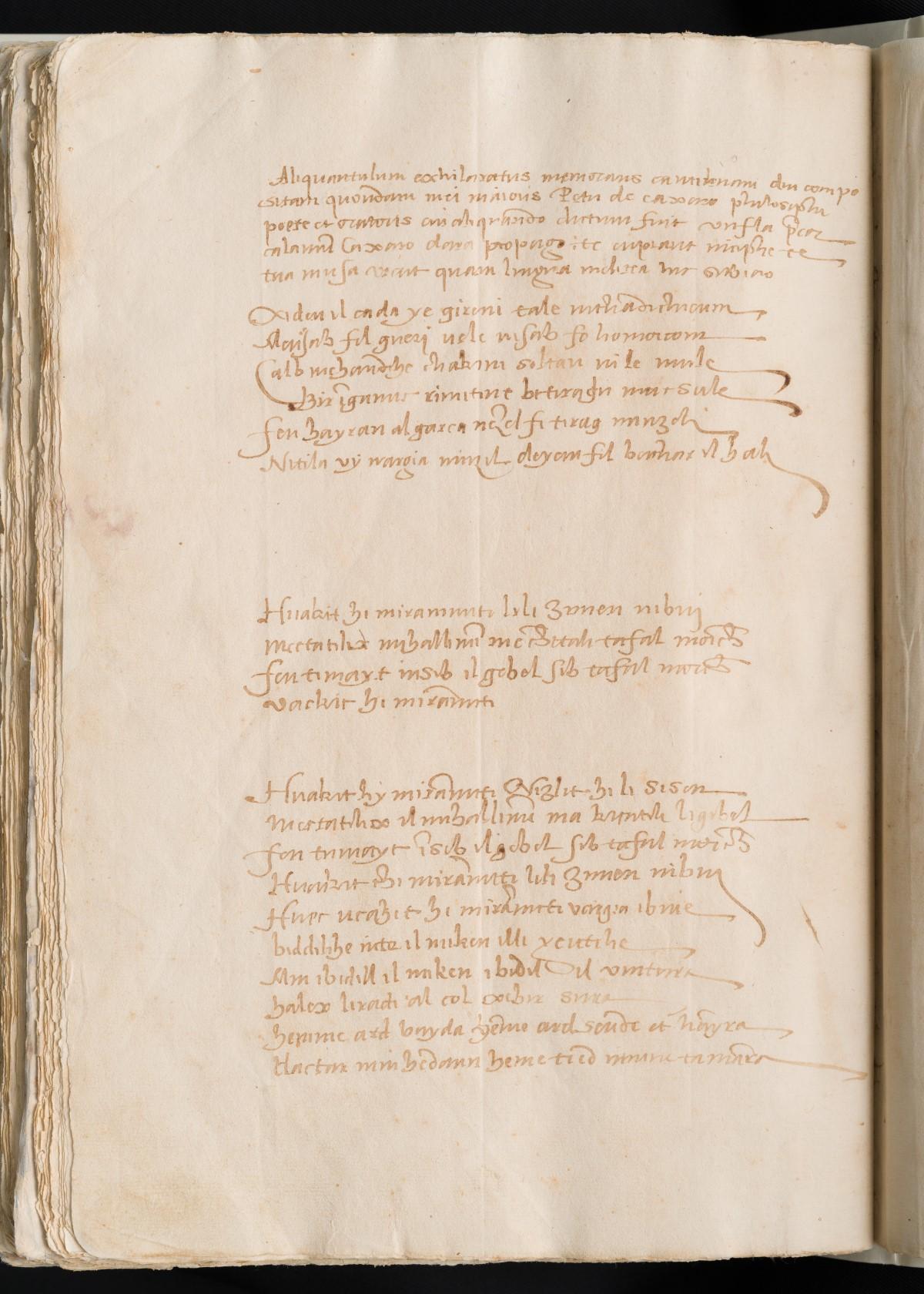 Many researchers have debated and studied the three-paragraph poem.
The poem was recorded by Caxaro’s nephew, Brandano, in his notarial register (December 1533-May 1536) and was discovered by historian Godfrey Wettinger and Fr Mikiel Fsadni in 1966.
Abela explained how, while the poem was found in Brandano’s register dating to 1533, academics know it is a transcription and that Caxaro died in 1485, so it was written prior to the date.
“At the beginning of the poem, in Latin, Brandano informs the reader he is transcribing Caxaro’s poem. He describes Caxaro as a poet, a philosopher, and a deep person,” she said.
“The introduction is one of the most important components of the poem. Without it, we would not have known it is medieval and who wrote it.”
Abela said that following its discovery, many researchers have debated and studied the three-paragraph poem, one debate surrounding the meaning behind the poem.
Il-Kantilena tells the tale of a collapsed house built on unstable ground. Many have interpreted it as an allegory for a failed relationship.
“We do not know exactly why Pietro wrote the poem, but we know he had a great love for a woman called Franka, but this love never materialised due to various obstacles in the couple’s way.”
 The poem’s Latin introduction tells researchers how the poem was penned by Pietru Caxaro.
A prime debate surrounding the poem is the language used and what it says about the time it was written.
“The poem refers to a certain social aspect of Malta at the time,” Abela explained.
“He tells us how no one rules over the heart – “Qalb bla ħakkiem, sultan u lanqas sid”. Here he mentions ruling figures (lord or king) in Maltese society.”
The original line of the poem is written: “Calb mehandihe chakim soltan ui le mule.” The orthography was so unusual to the Maltese eye that at the time of its discovery, Wettinger and Fsadni could not make out the “foreign” language of the text.
Another 200 years would pass before the second piece of Maltese literature was discovered
“The Kantilena gives us a taste of what the sound of Maltese was like during the 15th and 16th centuries, and that is something lost today,” she said.
“If you were to read the Kantilena today, which we do often, many of our guests, even Maltese, cannot make out what the verse means. They can pick out certain words like ‘sultan’ and ‘tafal’.”
“These are beautiful pronunciations of Maltese, which, for modern years, are lost.”
Other academics debate what dialect the poem is written in and whether Brandano translated it from the original Maltese to a more modern Maltese.
“Different academics have their views and interpretations on the subjects,” she added.
For Abela and the staff of the archives, the poem is their ‘holy of holies’, and the achievement of being added to the UNESCO heritage list is one Malta should be proud of.