Three altarpieces at Għaxaq parish church conserved
Though executed by two different artists, the altarpieces are united by shared symbolic motifs, most notably the white lilies, referencing the church’s dedication to the Annunciation
During the 16th century, Għaxaq was part of the larger parish of Żejtun, and the earliest records indicating the presence of a church dedicated to the Assumption of the Virgin at the current site of Għaxaq parish church date back to 1511. These references indicate the existence of a vernacular structure prior to Għaxaq’s establishment as an independent parish in 1626, whereby the church likewise then assumed the same status.
Between circa 1640 and 1655, this first structure serving as a parish church was either enlarged or completely built anew. No exact records have been discovered to date. Nonetheless, the construction of the more elaborate baroque church that we know today took place between 1733, when the first stone was laid, and 1777, when all sculptural motifs were completed.
This article examines three altarpieces commissioned as part of a post-baroque architectural renovation of the newly constructed church, intended to affirm its renewed status as a parish church. Two of the said altarpieces were executed by Francesco Zahra (1710-1773), one of the leading figures of baroque art in Malta, and the other by Dun Carlo Zimech (1696–1766).
The oldest of the three paintings is Virgin and Child with St Anne and John the Baptist (also known as Our Lady of Graces), painted by Zahra in 1740. Produced during a period when his style had reached maturity, the work demonstrates his command of the baroque tradition.
The composition is divided in two distinct registers: in the upper section, the Virgin and Child, crowned and accompanied by St Anne in adoration, are surrounded by playful putti and bathed in divine rays of light. In the lower section, St John the Baptist kneels as if interceding for the souls in purgatory gathered beside him.
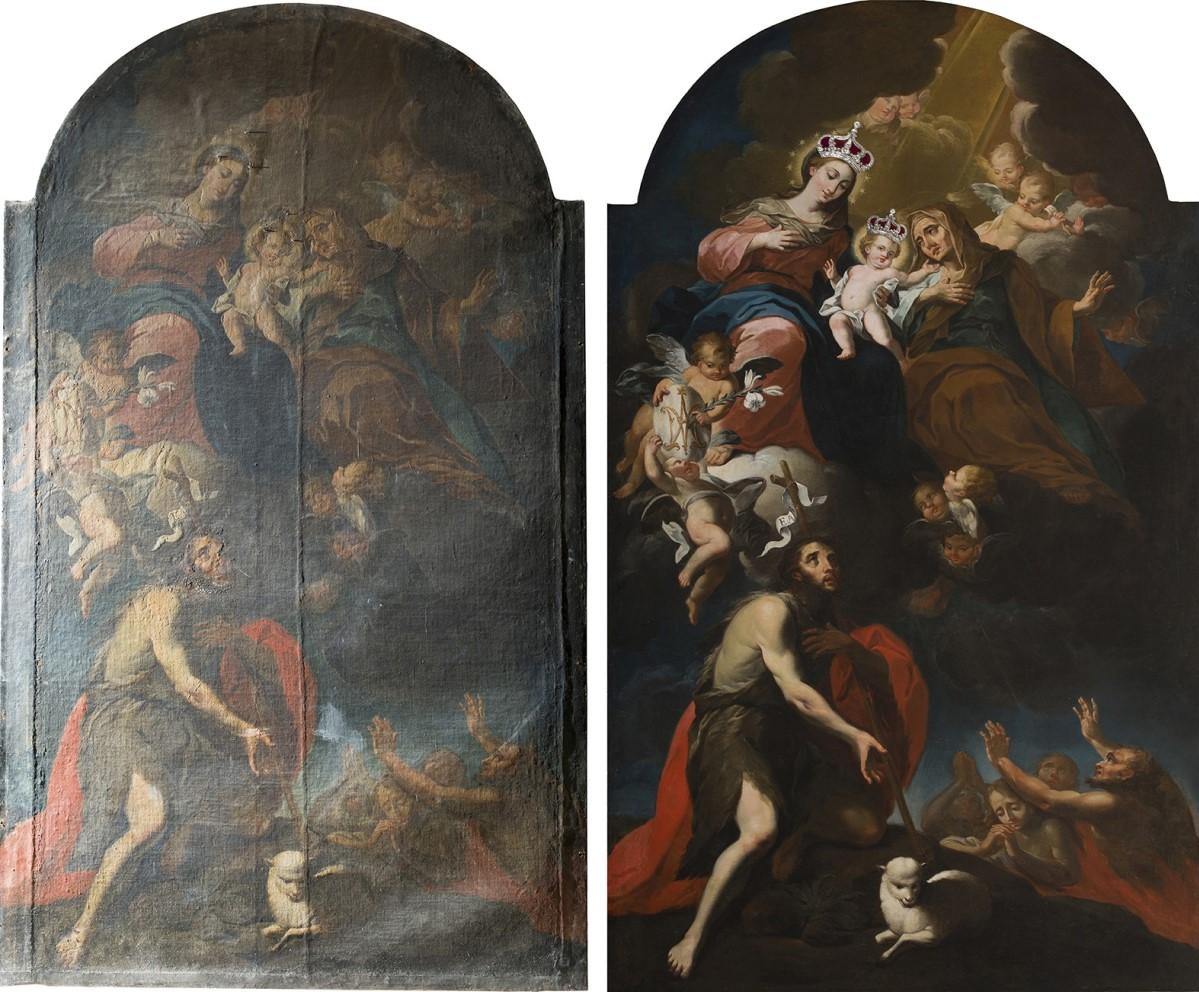 The Virgin and Child with St Anne and John the Baptist (Our Lady of Graces) before and after conservation. Magnets was used to put the crowns back in place. Photos: Manuel Ciantar and Suzanne Ciantar Ferrito obo ASC Conservation Conservation Centre Ltd
A notable juxtaposition emerges in the painting’s colour scheme. The upper register is bright and vibrant, infused with warm golden undertones that create harmony between the figures and the background, enhancing the sense of divine illumination. The Virgin is clothed in vivid red drapery with a bright blue mantle resting on her lap, combining symbolic colours of humanity and divinity. At the centre of the scene, the putti are holding an oval medallion bearing a gilded Marian monogram and a white lily, the latter symbolising purity.
Zahra’s vivid palette and contrasts embody the dynamism and theatricality of the late Baroque
In contrast, the lower register adopts a subdued palette of earthy tones and darkening clouds. Strong chiaroscuro reinforces the separation between the celestial and terrestrial realms, with St John’s red drapery visually echoing the fiery pit of purgatory, reinforcing the dramatic tension between salvation and suffering. Zahra’s vivid palette and contrasts embody the dynamism and theatricality of the late baroque.
Zahra’s second altarpiece, completed in 1759, depicts the Holy Trinity flanked by St Cajetan of Thiene and St Anthony of Padua. Executed nearly two decades after the previously discussed work, it belongs to a later and more fully mature phase of the artist’s career. The 1750s constituted a decisive period in Zahra’s development, marked by the assimilation of Antoine Favray’s influence and an engagement with the early oeuvre of Mattia Preti. Within this context, the Trinity altarpiece reveals a distinct dimension of Zahra’s maturity.
The scene unfolds within a celestial setting, its figures arranged in a dynamic yet balanced triangular composition that guides the viewer’s gaze upward from the saints to Christ, and ultimately to God the Father, with the Holy Spirit descending between them. St Anthony, in the brown Franciscan habit, gazes towards the Holy Trinity in an attitude of adoration and devotion, a gesture mirrored by an angel enveloped in clouds opposite him.
At the saint’s feet, a putto rests upon a book while holding a branch of white lilies, a traditional symbol of purity. In the lower register, St Cajetan, dressed in the black attire of the Theatine order, holds an open book inscribed Servate et Facite, underscoring the moral exhortation of the scene, along with a white lily.
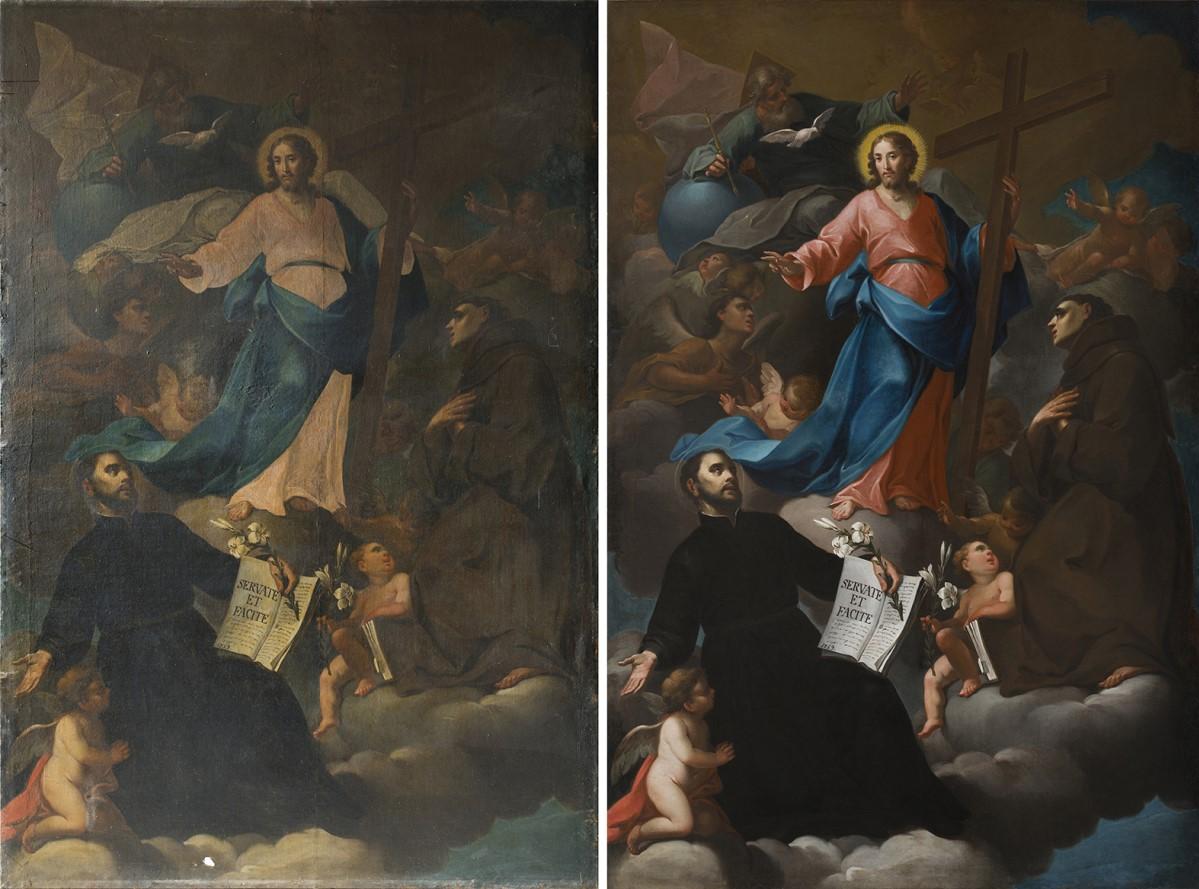 The Holy Trinity altarpiece before (left) and after conservation treatments. Photos: Manuel Ciantar and Suzanne Ciantar Ferrito obo ASC Conservation Centre Ltd
The colour scheme mirrors Our Lady of Graces: the upper register glows with warm golden light, contrasting the cooler tones below. However, here the transitions are smoother, and the integration between figures and background more unified. Drapery is rendered with heightened sophistication; the folds of Christ’s blue mantle and red tunic convey both weight and fluidity, reinforcing the divine presence while preserving a Maltese baroque sensibility. Unlike the earlier composition, which bridged heaven and earth, this work remains entirely in the celestial sphere.
Għaxaq parish church stands as a remarkable example of Maltese High Baroque, embodying the stylistic grandeur and devotional iconography of the period
The third altarpiece, The Annunciation, signed “C.Z. 1744”, is attributed to Dun Carlo Zimech (1696-1766), a Maltese priest and baroque painter. Zimech, principally recognised for his ecclesiastical commissions in parish churches across Malta and Gozo, produced a limited oeuvre that nonetheless reflects the baroque’s dramatic composition, vivid colour and meticulous detail.
Like Zahra’s Our Lady of Graces, Zimech’s Annunciation adopts a vertical orientation, drawing the gaze upward towards the divine light and the descending dove of the Holy Spirit. The Archangel Gabriel offers a stalk of white lilies to Mary, who kneels in humility at her prayer stand. A host of cherubs animate the space, bridging heaven and earth through expressive gestures.
Zimech’s composition incorporates clear quotations from Zahra’s 1740 altarpiece, particularly in the arrangement of the putti: those beneath Gabriel echo the grouping under St Anne in Zahra’s work. The division between realms is marked by clouds darkening towards earth. Unlike Zahra, however, Zimech illuminates Mary’s chamber, underscoring her holiness and divine favour.
 The Annunciation altarpiece before (left) and after conservation treatments. Photos: Manuel Ciantar and Suzanne Ciantar Ferrito obo ASC Conservation Centre Ltd
Zimech’s handling of rich colour, dynamic arrangement and chiaroscuro reveals the influence of Italian baroque masters, yet his intimate detailing lends the work a distinctive character. The Annunciation not only confirms his artistic skill but also reflects the enduring importance of sacred imagery in shaping devotional practice in baroque-era Malta.
Għaxaq parish church stands as a remarkable example of Maltese high baroque, embodying the stylistic grandeur and devotional iconography of the period while reflecting the broader artistic and cultural currents that shaped the islands’ ecclesiastical heritage.
The three altarpieces, though executed by two different artists, are united by shared symbolic motifs, most notably the white lilies referencing the church’s dedication to the Annunciation. This symbolism appears not only in Zimech’s depiction of the patronal scene but also in both of Zahra’s compositions, creating a visual and thematic cohesion that reinforces the parish’s spiritual identity.
Conservation
Up until recently, the aesthetic qualities of these three remarkable paintings could not be appreciated due to their poor condition linked not only to the passage of time but also to incidents such as candle burns and to numerous past interventions they endured.
In view of this, on October 5, 2024, all three altarpieces were lowered down from their niches and taken for scientific studies and conservation-restoration treatments at ASC Conservation Centre. Non-invasive scientific investigations using different forms of light and wavelengths, gave further insight into their physical history, from the moment the artists started sewing the pieces of canvas to attain the desired surface area, to the various damages endured throughout the centuries and interventions carried out by previous restorers.
The most deteriorated was Zahra’s Our Lady of Graces, on which there had been heavy intervention on various occasions. Some of the canvas deformations seemed to be due to a very thick layer of organic adhesive that had been applied to the back of the canvas to stick the oxidised original to a secondary canvas support. This was the thickest layer of relining adhesive the conservators encountered for the past 20 years. The thick layer of glue was contributing to stresses in the various strata, and it took months to remove it from the fibres of the original canvas.
The paint layer was found to have been heavily overpainted on multiple occasions, and removing non-original material and paint involved the use of various solvents, both in gel and liquid form, in combination with the use of surgical knives. The entire cleaning procedure was systematically monitored using ultraviolet light and magnifying equipment. Numerous wax drippings were also cleaned from the surface of the painting.
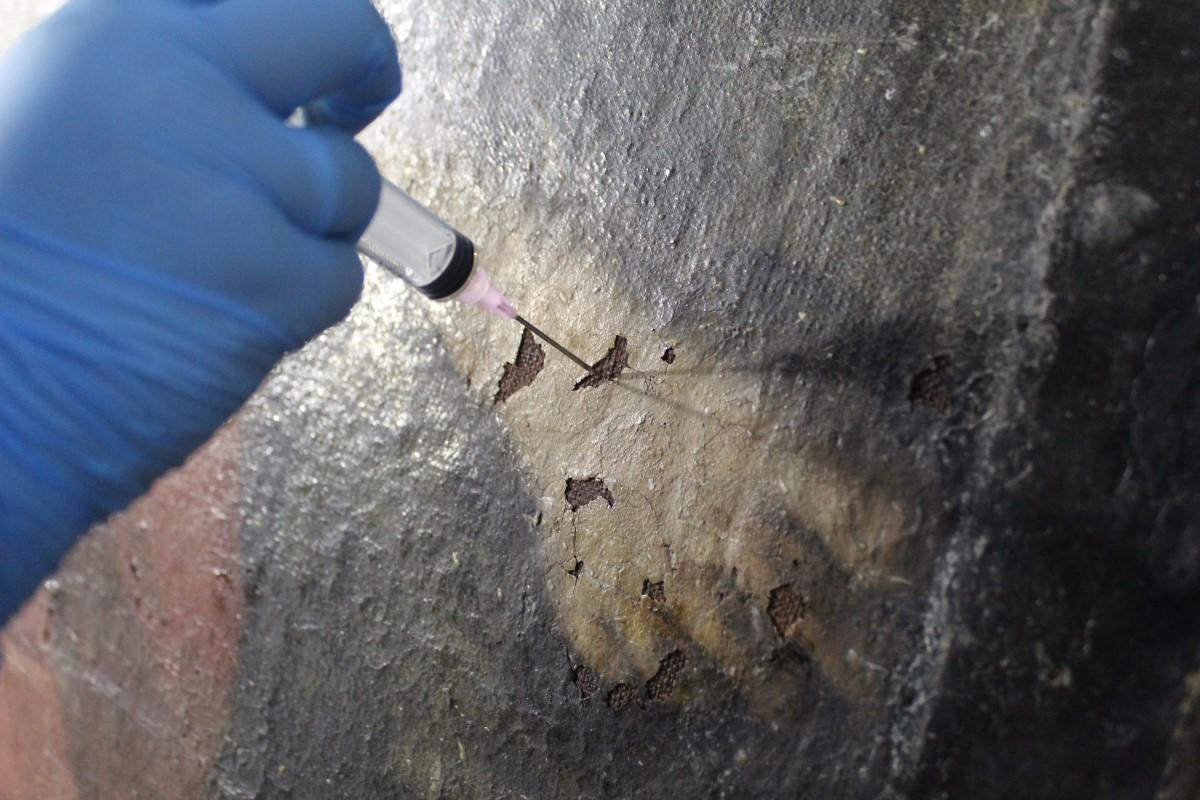
Details from the Our lady of Graces altarpiece taken during the initial stages of conservation and showing the poor state in which it was found. Photo: ASC Conservation Centre Ltd
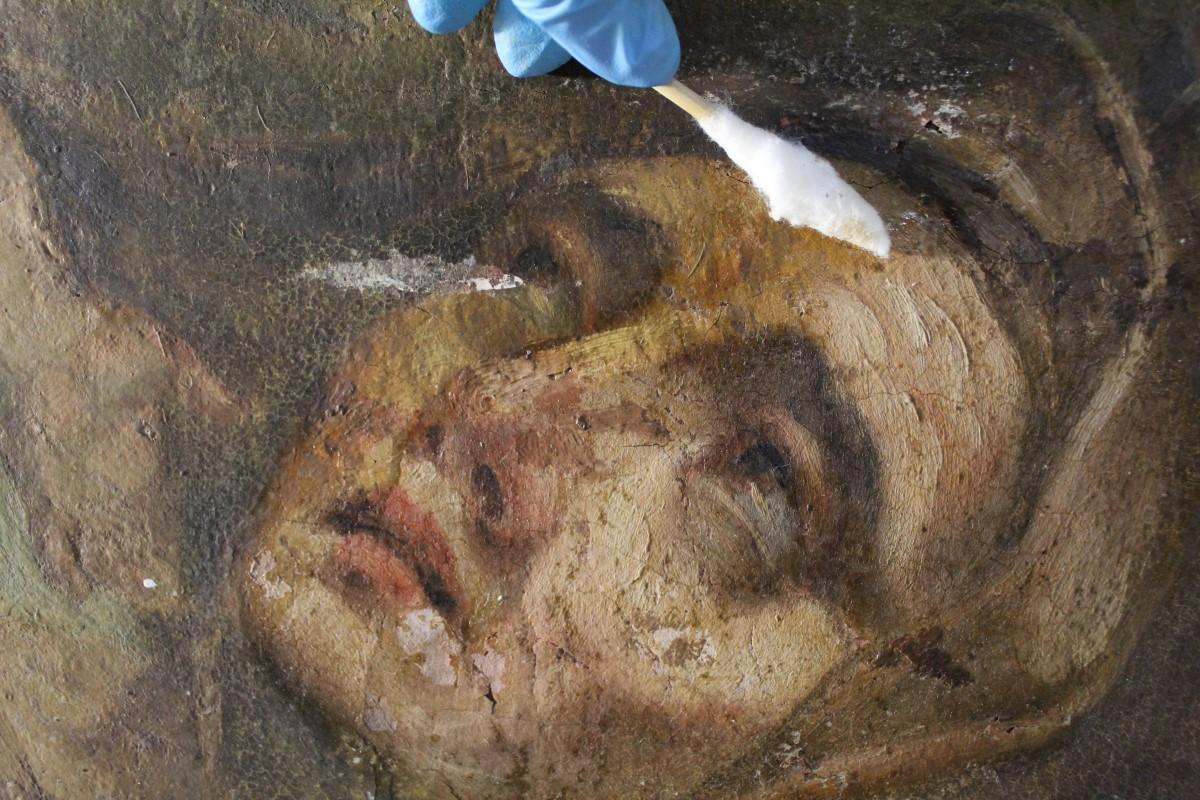
Details from the Our lady of Graces altarpiece taken during the initial stages of conservation and showing the poor state in which it was found. Photo: ASC Conservation Centre Ltd
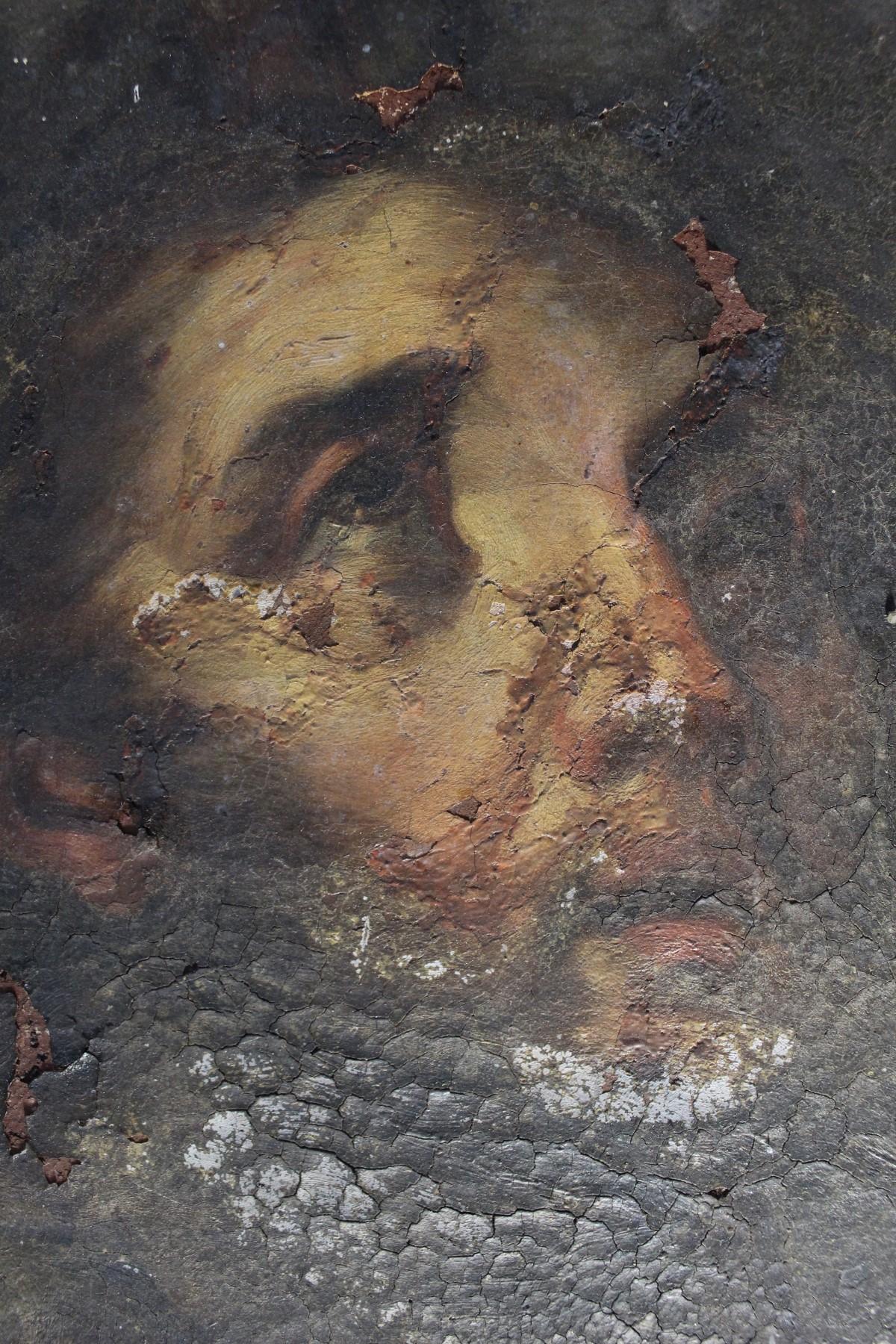
Details from the Our lady of Graces altarpiece taken during the initial stages of conservation and showing the poor state in which it was found. Photo: ASC Conservation Centre Ltd
While the Holy Trinity and Annunciation paintings were not as heavily retouched, both had a similar, thick and dark varnish that was hiding the original hues, as well as the sense of depth and various details. Structural repairs involved closing off canvas lacunae, overall stabilisation and consolidation to reinstate adhesion between the upper layers of the paintings and their canvas supports, as well as a strip lining procedure.
The latter involved the attachment of new strips of canvas to the paintings’ perimeter, eventually allowing their proper tensioning. In the case of Our Lady of Graces, the original oxidised canvas support required a lining treatment to fully stabilise the painting; so this was attached to a secondary canvas support, employing current methods and conservation materials. In all three cases, new stretcher frames were made as the older ones were too weak and deteriorated to be reused.
The final phases involved the integration of losses in the ground and paint layers. Compatible and reversible fillers were used, and chromatic integration of infilled losses was accomplished through the use of reversible varnish colours, thus reinstating full legibility.
Għaxaq parish church can now boast of another three significant altarpieces conserved to their full splendour.
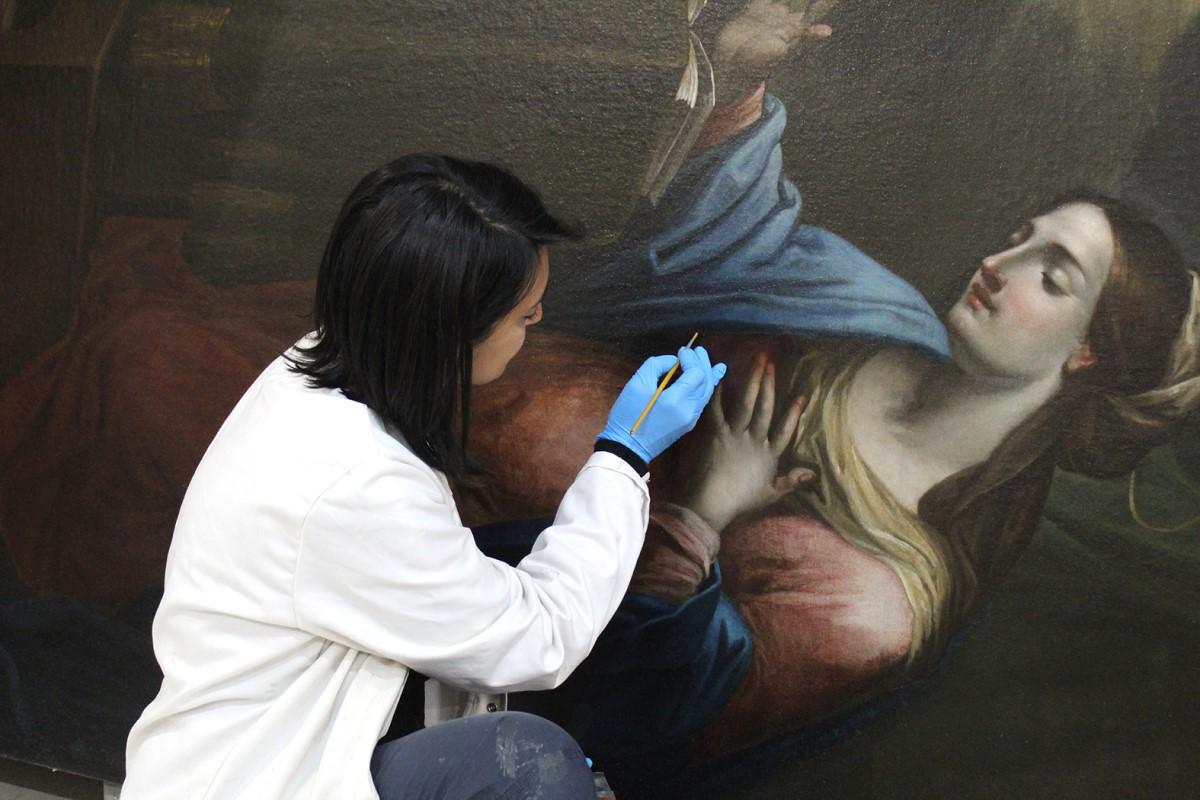 Conservation director Amy Sciberras carrying out the final retouching on the Annunciation altarpiece. Photo: ASC Conservation Centre Ltd
Amy Sciberras directs a team of conservators and has been entrusted with restoration projects of national and international importance. She is also the founder and director of the fine arts restoration company ASC Conservation Centre Ltd and may be contacted via www.amysciberras.com or e-mail info@amysciberras.com.
Rachel Abdilla is a master’s graduate in Art History focusing on Orientalism and postcolonialism; in 2023 she delivered a public lecture for the Turkish Embassy, and most recently shared her research at the Asian Conference on Social Sciences (ACCS) 2024.
Acknowledgments
This article draws on the publications of Professor Keith Sciberras and Nadette Xuereb.
The restoration project was entrusted to ASC Conservation Centre Ltd. by Għaxaq parish priest Fr Anton D’Amato who continued on the works initiated by Fr Andrew Schembri. This project was made possible by the Rural Development Programme for Malta 2014-2020 / the Gal Xlokk Foundation and local benefactors. Special thanks go to Administrative Secretary of the Archdiocese of Malta Michael Pace Ross, along with Joseph Bugeja, Rosario Mizzi and parish volunteers, for their invaluable contributions.
Conservation director and Founder Amy Sciberras would like to extend her gratitude to her dedicated team of conservators, including technical art photographers Manuel Ciantar and Suzanne Ciantar Ferrito.