Torn, burned and bloodied: the flags that defined Sette Giugno
Whenever we raise the Maltese flag we should bear in mind that we do so thanks to the blood spilt by our forefathers, who defended at all costs our right as their heirs to freedom and independence
The Maltese population was by no means unique in its aspirations during the 19th and early 20th centuries. Like its European contemporaries, it increasingly demanded self-government and political representation.
The 1802 Dichiarazione dei Diritti degli abitanti delle Isole di Malta e Gozo (Declaration of Rights of the Inhabitants of the Islands of Malta and Gozo) contains some of the early seeds of Maltese nationalism. There were other earlier arguments expressing aspirations for a greater measure of self-government.
These aspirations did not emerge in isolation but were shaped by a long historical experience defined by successive foreign rulers and a persistent tension between local identity and external control.
Malta’s past is often understood as a continuous struggle of negotiation, or rather negotiation of struggle between the island’s inhabitants and those who governed them. British rule, despite its administrative and economic transformations, formed part of this wider historical pattern.
It is within this context that the events of Sette Giugno must be situated – not as an isolated episode, but as a critical chapter in Malta’s evolving relationship with foreign rule and, in this case, imperial authority.
Collective Maltese memory tends to compact the events of Sette Giugno into a singular, familiar narrative: civil unrest sparked by rising bread prices, violent confrontations between crowds and British forces, and the tragic deaths of four Maltese men (with two other men losing their lives later on, and countless others injured).
It is also remembered, rightly, as a turning point that accelerated Malta’s path towards limited self-government. Yet such a summary, while accurate, risks overlooking the deeper symbolic dimensions that shaped the events themselves.
Alongside the aforementioned material factors, eyewitness accounts make several references to a continuous symbol being put to use during the turmoil – that of flags. Central to the narrative of the events that unfolded during the Sette Giugno riots was the role of flags. To dismiss flags as mere decoration is to misunderstand their historical significance. They function as repositories of both memory and identity.
The events of Sette Giugno demonstrate that flags were far more than passive symbols in colonial Malta
People can latch onto flags as representations of who they are, the nation they form a part of, and most importantly, the symbols they carry.
As Anthony D. Smith has argued, such symbols are stores of shared meaning which, during periods of turmoil, render abstract concepts like nationhood both visible and emotionally immediate. This dynamic was clearly evident in Malta in 1919.
Sette Giugno – despite the name – does not refer to a day of unrest. Rather, it is a period of tension that could be felt in the air and exploded over a weekend of clashes and violent outbreaks. But the unrest of June did not erupt spontaneously. It was preceded by months of growing tension, driven by economic hardship, political stagnation and widespread dissatisfaction with British rule. Calls for self-governance were repeatedly ignored.
Early signs of unrest were already visible in February 1919. During the first meeting of the Legislative Assembly, convened following Filippo Sciberras’s calls for constitutional reform, crowds gathered in Valletta, urging shopkeepers to close as a gesture of solidarity.
One establishment, A La Ville de Londres, refused to comply. Its owner, Bartoli Galea, not only kept his shop open but prominently displayed the Union Jack above it. When one considers the tense context colonial Malta was going through, this was perceived as a clear affirmation of loyalty to British rule, and was not well received by the crowd, which believed such a blatant display of affinity to the British coloniser to be treason.
The reaction was immediate. The shop’s window displays were destroyed, marking one of the first violent incidents of the period. This episode embodies in itself the importance of flags during periods of tension, in the sense that the target was not simply the business itself, but the symbol – the flag – it displayed. In a colonial context, the Union Jack represented more than a national emblem – it embodied imperial authority. And its attack signified a broader rejection of that authority.
By May 1919, tensions had escalated further. Student protests, led by figures such as Carmelo Mifsud Bonnici (Il-Gross), reflected mounting frustration over economic conditions and the slow pace of constitutional reform. During this period, symbols assumed an increasingly prominent role. Pamphlets circulated widely, and crowds began to gather around shared visual markers – colours, emblems and flags.
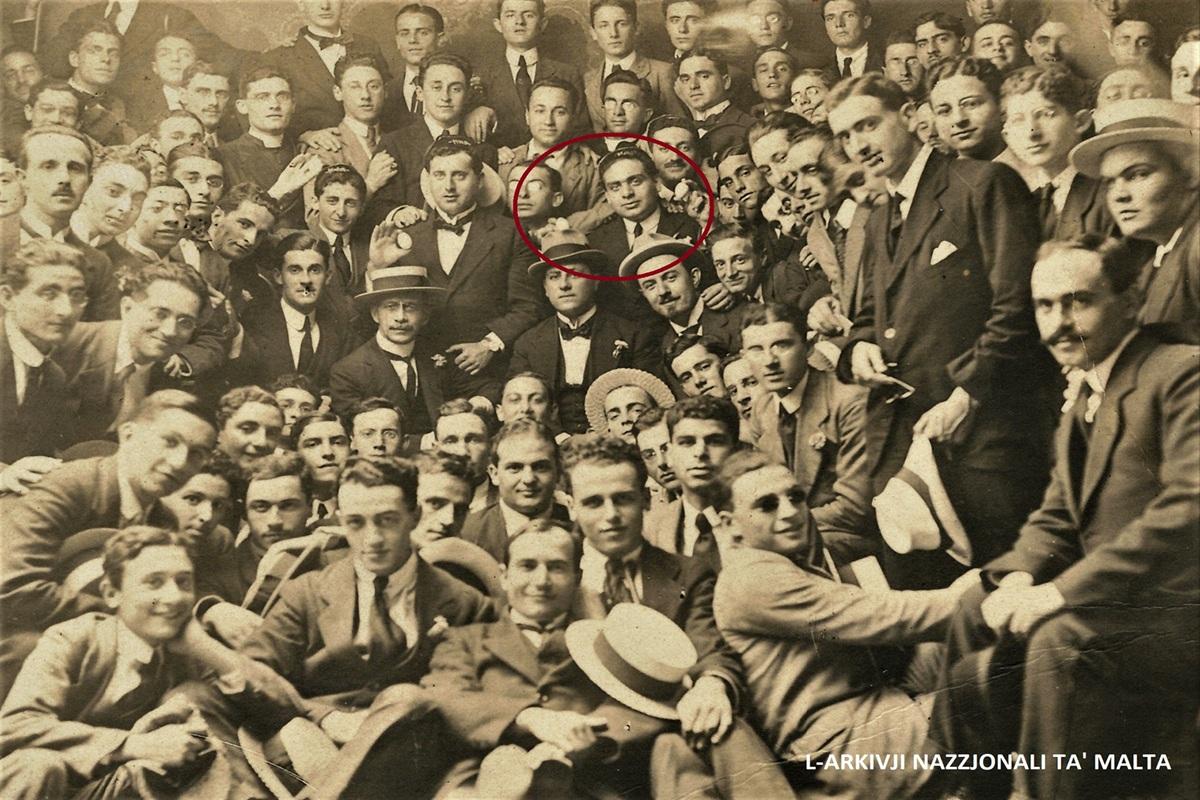 Group photo taken during the May 1919 student riots, including Carmelo Mifsud Bonnici (Il-Gross, circled). Several hold eggs to be thrown at Dr Francesco Azzopardi ‘Ċikku il-Ħmar’. Photo: National Archives of Malta
As Benedict Anderson has observed, such symbols enable the formation of an “imagined community”, allowing individuals to perceive themselves as part of a collective political identity. By early June, this sense of shared symbolism had become deeply embedded.
On June 7 itself, as the Legislative Assembly met at the Circolo Giovane Malta, crowds once again filled the streets of Valletta. Flags quickly became focal points of tension. The Union Jack reappeared above Bartoli Galea’s shop once more, this time incorporated into a hybrid Maltese flag design. The imprinting of the Union Jack at the centre of the Maltese flag set the crowd ablaze once again.
Elsewhere, the crowd directed its anger both at overt imperial symbols and at those Maltese perceived as aligned with colonial interests. At the Union Club, which was frequented by British officials, flags were torn down, thrown into the street, and in some instances burned. At the Liceo, a Union Jack was set alight alongside furniture. This was one of the earliest recorded acts in Malta of such direct symbolic defiance. These were not random acts of destruction, but deliberate gestures. In attacking flags, protesters were symbolically dismantling the authority they represented.
Alongside this rejection of imperial imagery, eyewitness accounts highlight the prominence of red and white – the colours associated with Malta – among the crowd. In the absence of an officially recognised national flag, these colours functioned as a form of proto-national expression.
It is interesting to note the origins of the colours of the Maltese flag. Any account of a moment in a nation’s history in which national consciousness asserts itself in the struggle for independence or statehood inevitably acquires a degree of myth-making, designed to sustain the flame of patriotism over time. It becomes a blend of fact and interpretation, in which historical events are intertwined with symbolic meaning, thereby endowing the narrative with enduring national significance.
Their origins are rooted in a blend of legend and history. One tradition links them to Roger I of Sicily, who is said to have granted the colours to the Maltese in 1091, though this account remains rather apocryphal.
Another associates them with St Agatha, whose symbolic connection to red and white – representing martyrdom and purity – has long been embedded in local devotion. These associations were later reinforced under the Knights of St John, whose red banner with a white cross helped consolidate these colours in Maltese identity.
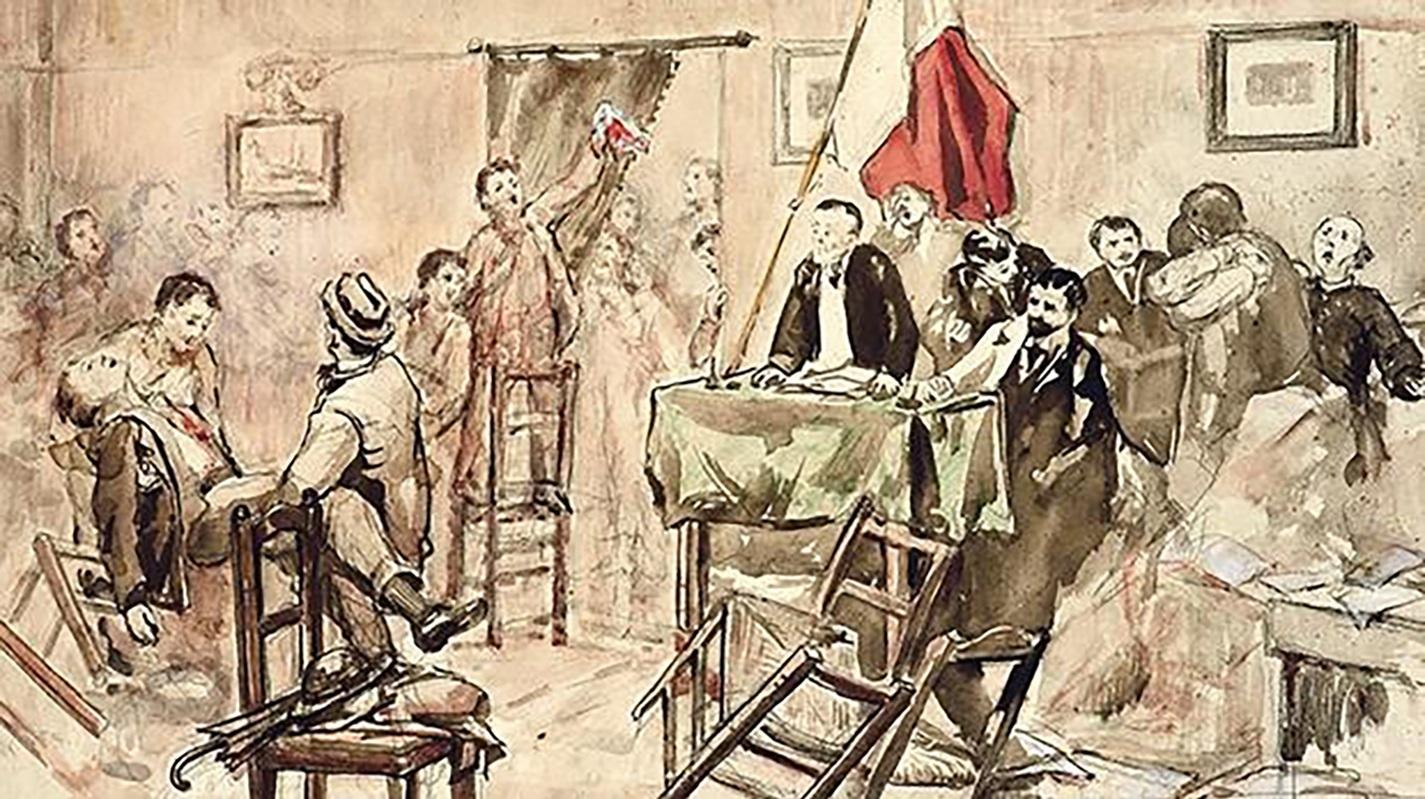 A sketch by Gianni Vella, who was present during the Legislative Assembly meeting when victims and injured individuals were brought into the hall from the crowded streets. Photo: Private collection
During the violence, these symbols took on a deeply personal significance. Gużeppi Bajada was reportedly carrying a Maltese flag when he was shot, and later died wrapped in its colours. Similarly, Lorenzo Dyer wore a Maltese flag as a scarf, accompanied by a red-and-white cockade.
Such details are far from incidental. They demonstrate how individuals actively embodied national symbolism even before Malta achieved political autonomy. In death, these colours acquired even greater resonance, as the victims were carried through the streets draped in red and white, transforming them into potent symbols of sacrifice and collective suffering.
In the days that followed, flags continued to shape public expression. With the public going through a period of mourning, flags were flown at half mast, casting the islands into a shared visual language of grief. Yet even in this, symbolism remained contested. Colonial authorities attempted to regulate funeral processions, discouraging the display of band club standards – important emblems of local identity. These efforts were resisted, underscoring the extent to which symbolic expression had become intertwined with political consciousness.
Equally powerful, however, was the use of absence as a form of protest. Satirical commentary in the newspaper Il-Ħmar, owned and published by a Guillermu Arena, criticised pro-British displays and those who had benefitted under colonial rule.
This sentiment found its clearest expression on July 19, 1919, when official “Celebrations of Peace” marking the end of World War I were widely boycotted. Streets remained undecorated and flags were notably absent. This silence was itself a statement. It signified a refusal to participate in a celebration from which many Maltese felt excluded. Despite their wartime sacrifices, demands for self-government had not been met. The absence of flags thus became a powerful form of political expression – a rejection not only of the event, but of the system it represented.
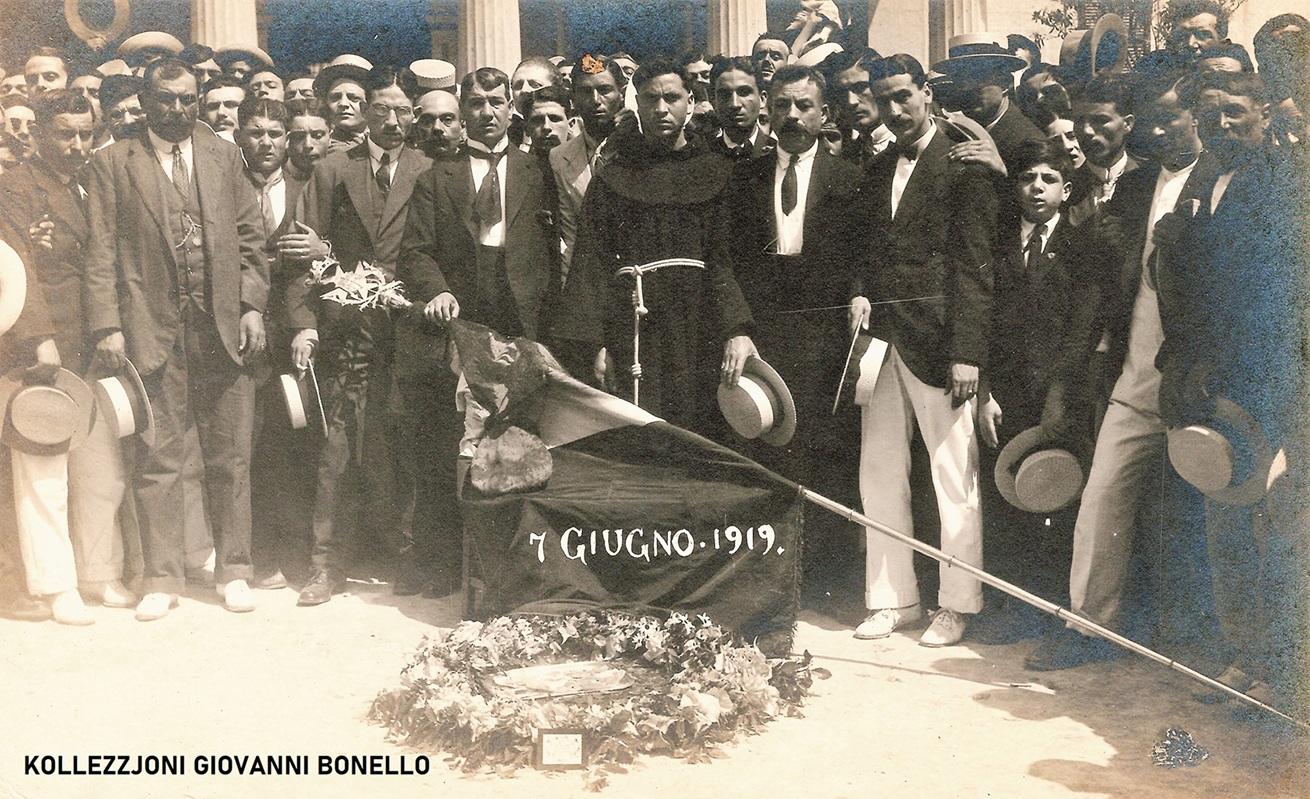 This photo, taken the day after Sette Giugno, shows the sombre mood of the mourners gathered in St George’s Square. The bloodstained cap of one of the victims, Lorenzo Dyer, was placed on the Maltese flag. Photo: Giovanni Bonello Collection
The present author has always been fascinated by the stories, accounts and retellings of Sette Giugno. Besides my distant connection to one of the victims – Lorenzo Dyer is related to me from my mother’s father’s side – the event has always struck a nerve in me, an almost guilt-induced nostalgia at my lack of participation in this period despite this being physically impossible for me.
My interest further developed when I became involved in the Fortunato and Enrico Mizzi Foundation (FEMF). I had the pleasure of viewing its archives numerous times, and on one particular visit there, I was honoured to see one of the aforementioned flags, which is found in the collection. Although no definitive documentation confirms that the Maltese flag preserved among the Mizzi family’s historical holdings was carried during the Sette Giugno, a strong body of circumstantial evidence supports this longstanding claim.
By 1917, Enrico Mizzi had firmly established himself as a leading voice in the push for responsible government, having even gained popularity among dockyard workers for defending their right to strike. It is therefore plausible that a bloodstained flag – potentially regarded as incriminating evidence by the colonial authorities – was entrusted to Mizzi by someone who feared retaliation by the colonial forces. His careful preservation of the flag shows that he might have intended to use it for political causes should the occasion arise.
Another question is why the British authorities did not confiscate it during the various house raids conducted on the Mizzi residence. This is perhaps because owning a flag at the time was not illegal.
The events of Sette Giugno demonstrate that flags were far more than passive symbols in colonial Malta. Whenever we raise the Maltese flag – be it at school, in a parade or in our own homes – we must keep in mind that we can do so thanks to the blood spilt by our forefathers, who at all costs defended our right as their heirs to freedom and independence.
Flags were active instruments of political expression, used to assert authority, resist the coloniser, construct identity and, most importantly within this context, articulate dissent. Whether raised, destroyed, worn or deliberately withheld, flags shaped the visual and emotional landscape of 1919. In this sense, the struggle for political representation was also a struggle over meaning: over who had the right to define Malta’s identity and how that identity should be experienced.
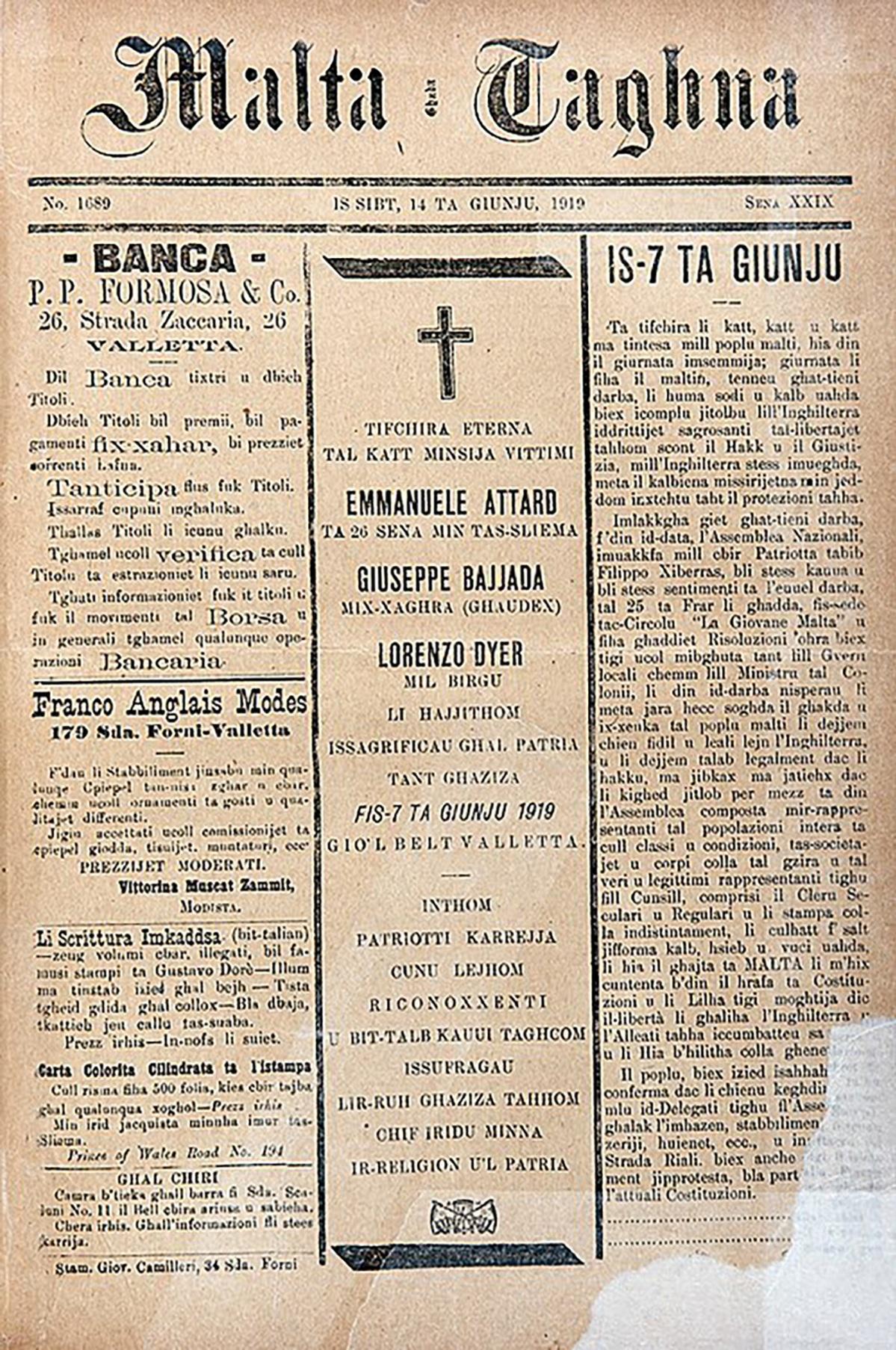 The front page of Malta Tagħna, June 14, 1919. Photo: National Library of Malta
Acknowledgements
Special thanks to FFEM president Richard Muscat for granting access to the foundation’s archives and to Joe Pirotta for his insight on the flag in the foundation’s possession.