Maria Zarb was hanging the washing. Then hell fell from the sky
Remembering the Luqa air tragedy which killed a resident and three crewmen
Maria Zarb had just finished hanging up the washing on December 30, 1952, when she was hit by a terrifying ball of fire. She suffered burns all over her body and died on New Year's day.
Zarb, 60, was the only civilian casualty of a Lancaster bomber crash on her hometown Luqa. Three crew members also perished, while one survived.
Their four-engined Avro Lancaster B.Mk.III had suffered failure of one of its engines on take-off. The pilot attempted a go-around to return to the airport, but the aircraft rapidly lost height. It hit a house on the outskirts of Luqa and then three more houses in St George Street, sending flames and debris into New Street.
Zarb's house was located between St Andrew's Street and New Street. A large part of one of the Lancaster's wings crashed into the property, spreading burning high-octane fuel as Maria was going down the wooden steps from the roof to the garden.
Aviation expert Richard Caruana gave a vivid account of the crash in a feature in Times of Malta in 2012.
He wrote that the tragedy took place in less than three minutes after the aircraft started its take-off run on Tuesday morning, December 30, 1952.
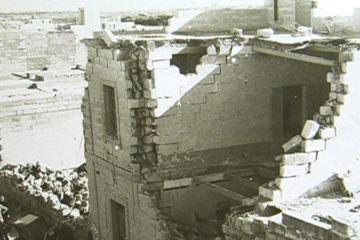 The devastation caused by the Lancaster bomber's crash.
The wing's main spar ended on top of a low roof, three of the four engines were scattered over a wide area: one in the street, another fell into a house, while the third was later found in a garden some 200 metres away.
Stone masons rebuilding a war-damaged house ran for their lives as they saw a big chunk coming their way; it was the complete tail unit that ended on the ground floor roof.
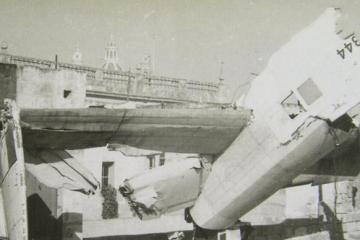 The tail section of the doomed Lancaster.
The heat from the first flash of burning high-octane fuel melted the solder in several water pipes while trees and their fruit in the surrounding gardens were scorched black. Poultry wandered around dazedly in some back yards, spattered with hydraulic oil.
Caruana said rescue workers were on the spot within minutes, with firefighters from RAF Luqa soon joined by those of the Malta Police.
Shortly afterwards, other teams from the Royal Naval Air Station (RNAS) at Ħal Far and Ta’ Qali (HMS Falcon and Goldfinch respectively), together with rescue men from the Admiralty Dockyard, arrived to provide assistance.
They struggled as best they could to control the flames while paramedics and specialists from the British services assisted by US Navy colleagues from FASRON 201 (based at Ħal Far) began to offer first aid to the victims.
A trail of destruction, some 275 metres long, could be easily traced from the path of the wreckage. Worst hit was the Seychells’ home, at 61, New Street, where the Lancaster ended its run. The façade fell off completely into the street, the hall’s roof caved in, and the aircraft’s cockpit section was later found to have fallen into the small back garden.
Konċetta Zarb tried to comfort her badly injured sister as best she could by dousing the flames with a blanket until Maria was quickly taken to St Luke’s Hospital. She succumbed to her injuries in hospital on January 1, 1953, at 4.30am and was buried in the Luqa parish cemetery.
Caruana wrote that Cpl Cecil F. Harrison, chief of RAF Luqa’s fire section, was among the first on the scene of the accident and immediately started to search for survivors. He found two of the Lancaster crew who had been thrown out of the aircraft on impact. Both were in critical condition, surrounded by burning debris.
Notwithstanding the heat, Harrison stayed on the spot, comforting the victims while shouting at the top of his voice until rescue teams found their way through the smoke and wreckage. For this heroic deed he was awarded the British Empire Medal (Military Division) by Queen Elizabeth II through a citation dated September 1, 1953.
Flt Sgt Crawford Logan, the Lancaster’s radio operator, was certified dead on the spot. The other three crew members were taken to hospital, where Flt Sgt Geoffrey Charles Glanville (who was flying the Lancaster that day) passed away a few hours later. Flight engineer Sgt Wilfred Morris died the following day. Pilot John C.E. Smith, who had been taken to hospital in serious condition, two days later was in ciritical condition but survived.
The funeral with full military honours of Flt Sgt Glanville and Flt Sgt Morris was held at the Mtarfa Military cemetery on Friday, January 2, 1953. The remains of Flt Sgt Crawford Logan were flown to Scotland where he was buried.
Subsequent demands for compensation became a matter of controversy, Caruana said, as the Royal Air Force insisted it would only pay ex-gratia compensation and nothing near to what was being requested.
Then Opposition leader Dom Mintoff, who represented most of those who suffered damage, harshly criticised the RAF for dragging its feet in adequately compensating the victims.
Eventually, the Claims Commission’s report awarded compensation in accordance with what the court experts had indicated while considering those presented on behalf of the victims as unverifiable.