UM researchers launch open-source brain-controlled web browser
Boggle is based on a well-established BCI technique known as steady-state visually evoked potentials (SSVEP)
For most individuals, browsing the web is second nature – using their browser with a mouse, touchscreen and keyboard. Even with assistive technologies such as eye trackers and adaptive switches, persons with severe motor impairments may still find this impossible.
Brain-computer interfaces (BCIs) provide a unique pathway for interaction, translating the brain’s electrical patterns into functional computer commands. This ability to use neural signals for control is leveraged by Boggle, a new BCI-native web browser that offers a fundamentally redefined experience for accessing the internet.
This technology is the culmination of years of empirical research by the multidisciplinary BrainWeb team. The project builds upon previous empirical work, including the postgraduate research of Alison Farrell at the Faculty of ICT.
The team integrated their expertise in human-computer interaction, signal processing and biomedical engineering to fully design and develop this technology. A key focus was ensuring technical feasibility, reliability, cost-effectiveness and accessibility for use outside of a laboratory setting.
By ensuring compatibility with a range of low-cost consumer-grade EEG headsets, Boggle establishes a reliable, accessible and cost-effective framework for web-based brain-computer interfaces
Boggle is based on a well-established BCI technique known as steady-state visually evoked potentials (SSVEP). When a person focuses on a visual element that flickers at a specific frequency, the brain’s visual cortex produces electrical activity corresponding to that same frequency. Boggle exploits this phenomenon.
Using an electroencephalogram (EEG) headset, Boggle continuously monitors electrical activity in the occipital region of the brain, where visual processing occurs. By analysing this data stream, the browser can determine which on-screen element the person is focusing on, in turn inferring and executing the intended action on the user’s behalf.
This principle underpins the entire browsing experience in a fully featured web browser, which allows users to navigate websites freely, interact with common input elements, open and manage multiple tabs, bookmark pages and so on. By ensuring compatibility with a range of low-cost consumer-grade EEG headsets, Boggle establishes a reliable, accessible and cost-effective framework for web-based brain-computer interfaces.
The team recently showcased Boggle at CHItaly 2025 in Salerno, where it received the Best Interactive Experience Award. The browser is openly available through the Human-Computer Interaction Laboratory’s GitHub repository. More information can be found here and the team can be contacted at [email protected].
Boggle is a deliverable of the BrainWeb project, funded by the University of Malta Research Excellence Fund (202403) and led by professor Chris Porter from the Department of Information Systems within the Faculty of ICT. The team consists of Daniel Calleja and Marie Buhagiar, the project’s research officers and core developers, alongside professors Tracey Camilleri and Kenneth Camilleri from the Centre for Biomedical Cybernetics and the Faculty of Engineering.
Photo of the week
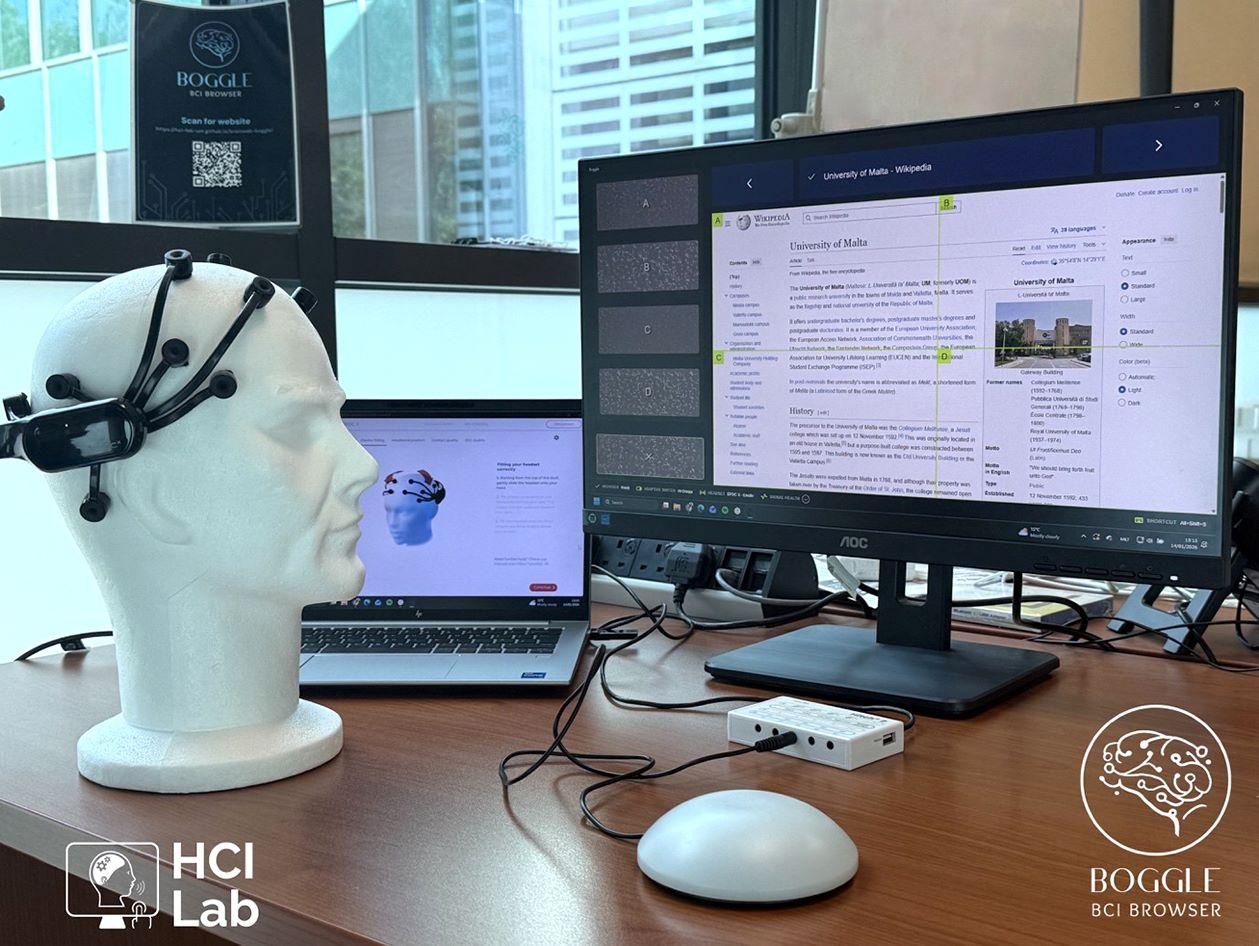 Photo: BrainWeb/HCI Lab
Boggle is an open-source BCI browser that allows users with severe motor impairments to browse the internet. Boggle uses steady-state visually evoked potentials (SSVEP): when a user focuses on a flickering target, the browser detects matching activity in the visual cortex via EEG and executes the intended web action.
Sound Bites
• Non-invasive brain-computer interfaces can be greatly improved thanks to a new liquid ink that doctors can use to print tattoos onto a person’s scalp to measure brain activity. This is a promising alternative to the cumbersome, fragile and highly sensitive hardware currently in use for non-invasive BCIs.
• Knowing the word you want to say but being unable to express it can be deeply frustrating and stressful. People with language disorders, such as Broca’s aphasia, a form of expressive aphasia, may struggle to communicate through speech or writing. While speech therapy remains essential, brain-computer interfaces are being explored as a supporting technology to aid communication by converting brain signals into spoken words.
For more soundbites, listen to Radio Mocha www.fb.com/RadioMochaMalta/.
DID YOU KNOW?
• SSVEP-based BCIs detect patterns in the brain’s electrical activity produced when a person intentionally focuses on a visual stimulus on the screen.
• Motor imagery BCIs rely on a person imagining specific movement, such as moving a hand or a foot. The BCI detects brain activity associated with movement, even though it’s imagined.
• Speech imagery BCIs aim to interpret brain activity that occurs when a person imagines speech. Although the concept is promising, achieving reliable results is challenging. Brain signals associated with imagined speech are complex, highly individual and very difficult to capture using non-invasive equipment.
• P300 BCIs typically rely on a brief electrical response in the brain triggered when a user notices something meaningful or unexpected. This usually happens about 300 milliseconds after the fact, known as the P300 response.
For more trivia, see: www.um.edu.mt/think.