University develops app for childhood speech diagnosis
New digital tool set to revolutionise assessments
Hundreds of children with speech difficulties will soon benefit from a new digital assessment tool being developed at the University of Malta, aimed at making diagnosis faster, more accurate and more engaging.
“Between 4,000 and 6,000 children, between the ages of two and six, will be benefitting from the tool every year,” said principal investigators Prof. Helen Grech and Prof. Chris Porter.
The year-long €45,000 research project is led by Grech, from the university’s Department of Human Communication Sciences and Disorders within the Faculty of Health Sciences, and Porter, from the Department of Information Systems within the Faculty of Information and Communication Technology.
Their goal is to digitise a scientifically validated and reliable Maltese-English speech assessment – developed and standardised by Grech together with Barbara Dodd and Sue Franklin – and transform it into an interactive app called the Electronic Maltese-English Speech Assessment (eMESA).
From flashcards to digital platform
At present, speech-language pathologists (SLPs) in Malta assess children’s speech using manual picture-naming tasks designed to elicit all speech sounds in Maltese and English. The process typically requires one or two 45-minute sessions.
For many clinicians, the post-session work alone can take between one and two hours, involving phonetic transcription, scoring and analysing the child’s responses before reaching a differential diagnosis to identify which sub-type of speech disorder the child has. The SLP would then select the intervention programme that is most suitable and effective for the specific child.
The new app will automate much of this process and make it more game-like for the children, ensuring stronger engagement and making it quicker to reach the diagnosis. Once the session is completed, the system will immediately process the data, generating results for the SLP to review and confirm.
“We took a process that is typically done manually and reimagined it for the digital era,” Grech said. “By working together and with the support of our students, we developed a prototype that proved the concept.”
Porter added that the team focused on human-computer interaction principles to gamify the experience and make it more engaging for children, while ensuring the tool remains clinically robust.
Addressing a widespread need
Around 11% of Maltese children aged between two and six – roughly two in every classroom across Malta and Gozo – are found to have atypical speech patterns requiring intervention by a speech-language pathologist.
Speech sound difficulties vary in severity. Some children experience delays in speech acquisition or are difficult to understand outside the home. Others are found to have more complex subtypes that affect how they perceive, plan and produce speech.
One of the most severe forms is Childhood Apraxia of Speech (CAS), a rare speech sound disorder.
Before therapy begins, each child must undergo a detailed assessment to identify the specific subtype of speech disorder. If intervention does not match the child’s needs, it may prove ineffective, Grech said.
“The earlier the intervention, the better,” Grech said. “Speech and language difficulties impact learning, communication and social interaction. There may also be behavioural repercussions as a result of speech unintelligibility.”
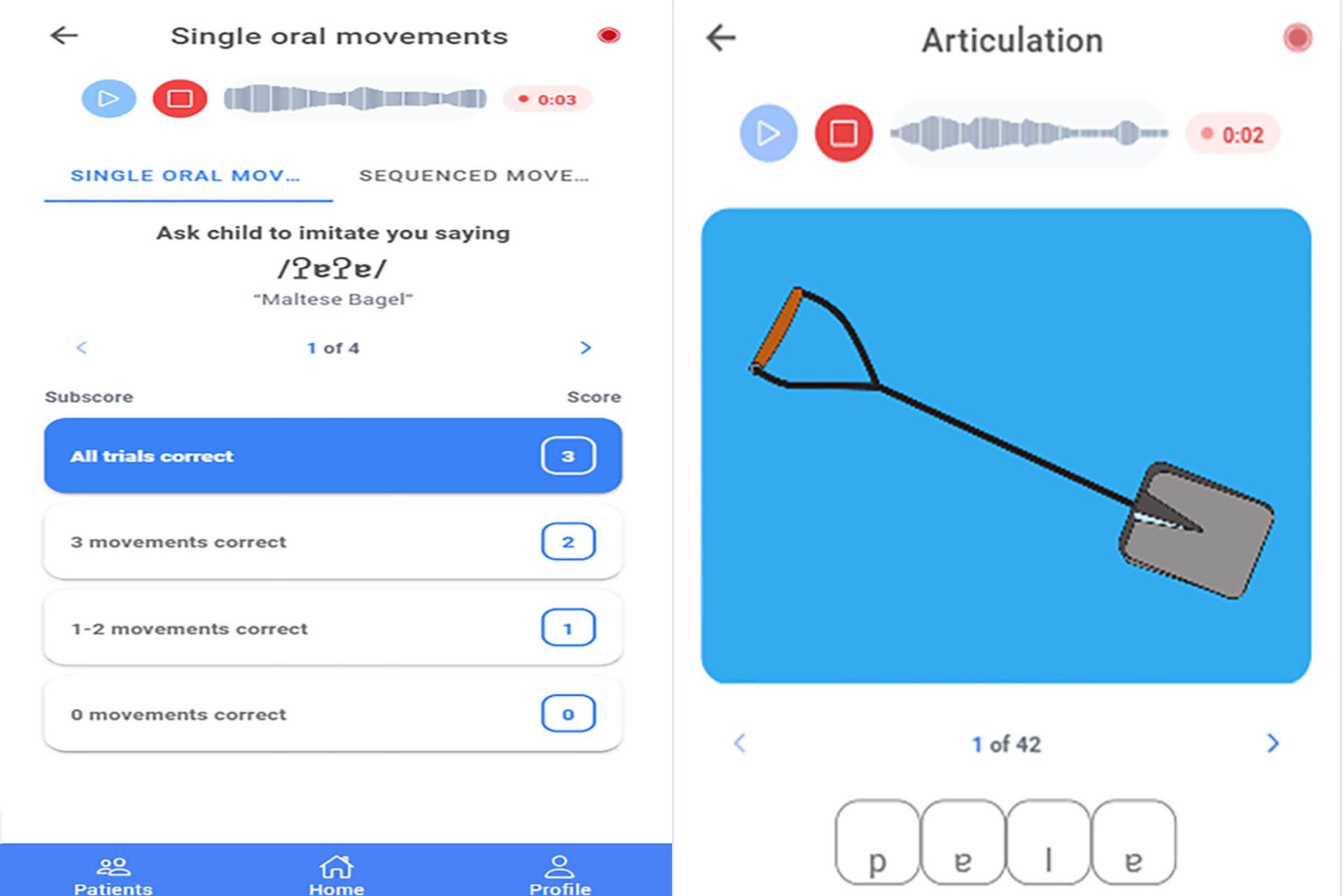 Screenshots from the Electronic Maltese-English Speech Assessment (eMESA) app, that is in development stage.
Built in Malta, adaptable beyond
Porter explained that the prototype has already been validated and the team has now secured funding to develop a more stable and robust version in collaboration with local game development company Flying Squirrel Games.
The application is designed specifically for monolingual and bilingual Maltese children but its framework can be adapted to other language pairs. With more than two-thirds of the global child population growing up in multilingual contexts, the team believes the tool has strong international potential. There has already been an interest by European researchers and clinicians in adapting this software for other language contexts.
Porter adds that plans include integrating speech and language technology to support phonetic transcription and further automate the process.
The project is funded through the Research, Innovation and Development Trust (RIDT), thanks to the support of GO and Foster Clark. The app will be made available free of charge, or at a minimal cost, to speech-language pathologists.