Your vote doesn’t stop at ‘1’
New site reveals what happens next
At the polls on election day, Maltese voters fill their ballot with numbers according to their preferred candidate, placing a number ‘1’ next to their favourite, ‘2’ for their second choice, then ‘3’, ‘4’ and so on.
The system, known as the single transferable vote, is simple enough at the ballot, but many have no idea how those votes are calculated when they get to the counting hall in Naxxar.
A new website – Vot.mt – aims to explain just that.
Under the country’s electoral system, voters elect five MPs from each of Malta’s 13 districts. Corrective mechanisms ensure proportionality according to parties and gender.
The website simulates real past elections for every one of Malta’s 13 districts since 2008.
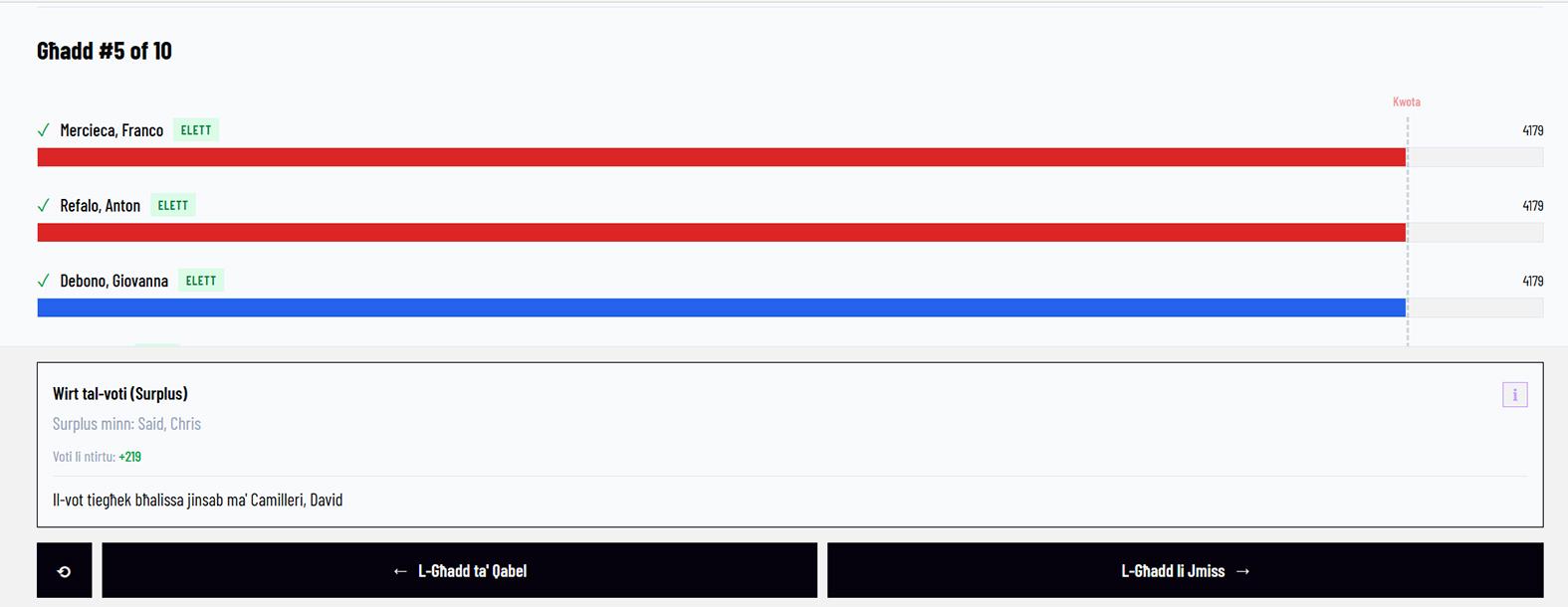 A screen grab of a simulation of the 2013 election in the Gozo district.
The site took the data from the electoral registry, extracting how each person got elected, with every vote transfer.
On the website, users can choose any district from any of the last four general elections. They are then faced with a ballot not unlike what voters fill in on election day. Users can then fill it in, ranking their candidates based on order of preference.
Once that is done, the simulation begins. Users can see how their vote is transferred from one candidate to another.
Simulations are available from 2008
“Some seats have been decided by no more than a handful of votes,” said David Grech, who compiled the data used in the website.
For example, in 2013 the PN were favourites to win three seats out of five in the Gozo district, but Justyne Caruana was able to narrowly secure a third seat for Labour by just nine votes – due to cross-party voting, Grech said.
In that same year, the PN’s Claudette Buttigieg lost a seat by nine votes to Labour’s Edward Zammit Lewis.
Grech was approached by website developer Alex Portelli with the idea of building the simulator a few months ago.
Together with designer Andrea Delicata, the trio launched the website on Thursday afternoon.
Grech said the simulation shows that the best way to maximise your vote is by voting for as many candidates as possible.
“If you support one party and vote for all its candidates, carrying on voting for candidates from other parties can also make a difference and decide who is elected.”
“Even if they are not from the party you support, they still represent you in parliament,” he added.
While the simulations are only available from 2008, the team behind Vot.mt want to eventually expand their database all the way back to 1921 – the first year when the single transferable vote was used in Malta.