In pictures: When devotion leaves its mark
400-year-old wooden crucifix at Holy Crucifix chapel, Jesuits’ church, Valletta, conserved
The church of the Circumcision of Our Lord, known as the Jesuits’ church, in Valletta, forms an integral part of the Collegium Melitense – now the University of Malta’s Valletta Campus – founded at the close of the 16th century as a centre of education, mission and pastoral formation, embodying the spirit of the Catholic reform.
Conceived within the intellectual and spiritual currents of the post-Tridentine Church, the complex united architecture, liturgy, preaching and material culture in the service of formation and devotion. Within this setting, chapels were not ancillary spaces but carefully articulated loci of prayer, memory and catechesis, each responding to specific devotional needs and patronage networks.
Among these, the Holy Crucifix chapel occupies a distinctive place, the first beyond the transept on the left side of the church. As Michael Galea states in The Jesuits’ church in Valletta (2004), the chapel was granted by notarial deed by Ambrosio Xeberras on January 20, 1633 to the noble Xara and Bonici families.
The chapel became both a funerary space and a focal point of popular devotion. In keeping with the devotions of the period, the chapel was conceived as a lipsanotheca, a repository of holy relics of so-called catacomb saints, thereby giving tangible expression to the Catholic doctrine of the communion of saints.
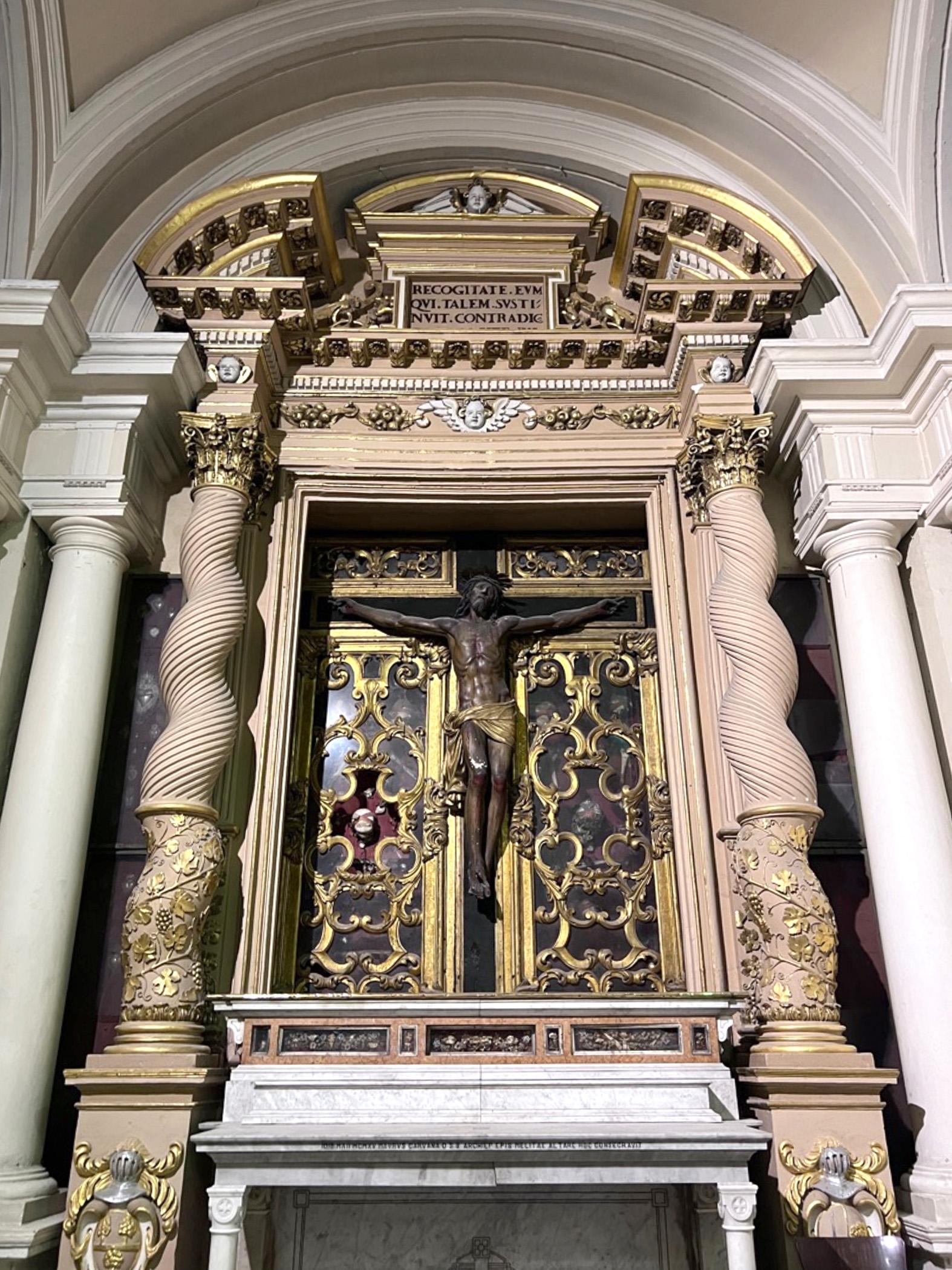 The Holy Crucifix chapel before restoration.
The present marble altar, dated 1911 and donated by Rev. P. P. Sciberras, reflects later phases of embellishment and most likely replaced a 17th-century reliquary altar similar to those in other chapels in the same church. The lunettes by Giovanni Nicola Buhagiar – depicting the Adoration of the Magi and the Presentation in the Temple – anchor the chapel visually within the baroque narrative cycle of God’s incarnation and sacrifice.
At the heart of the chapel stands the 17th-century wooden crucifix, long venerated by the faithful and now the subject of an ongoing conservation project. Carved with a restrained realism characteristic of Catholic reform spirituality, the crucifix was conceived not merely as an artistic object but as a devotional instrument, intended to foster affective meditation on the suffering yet glorified Christ.
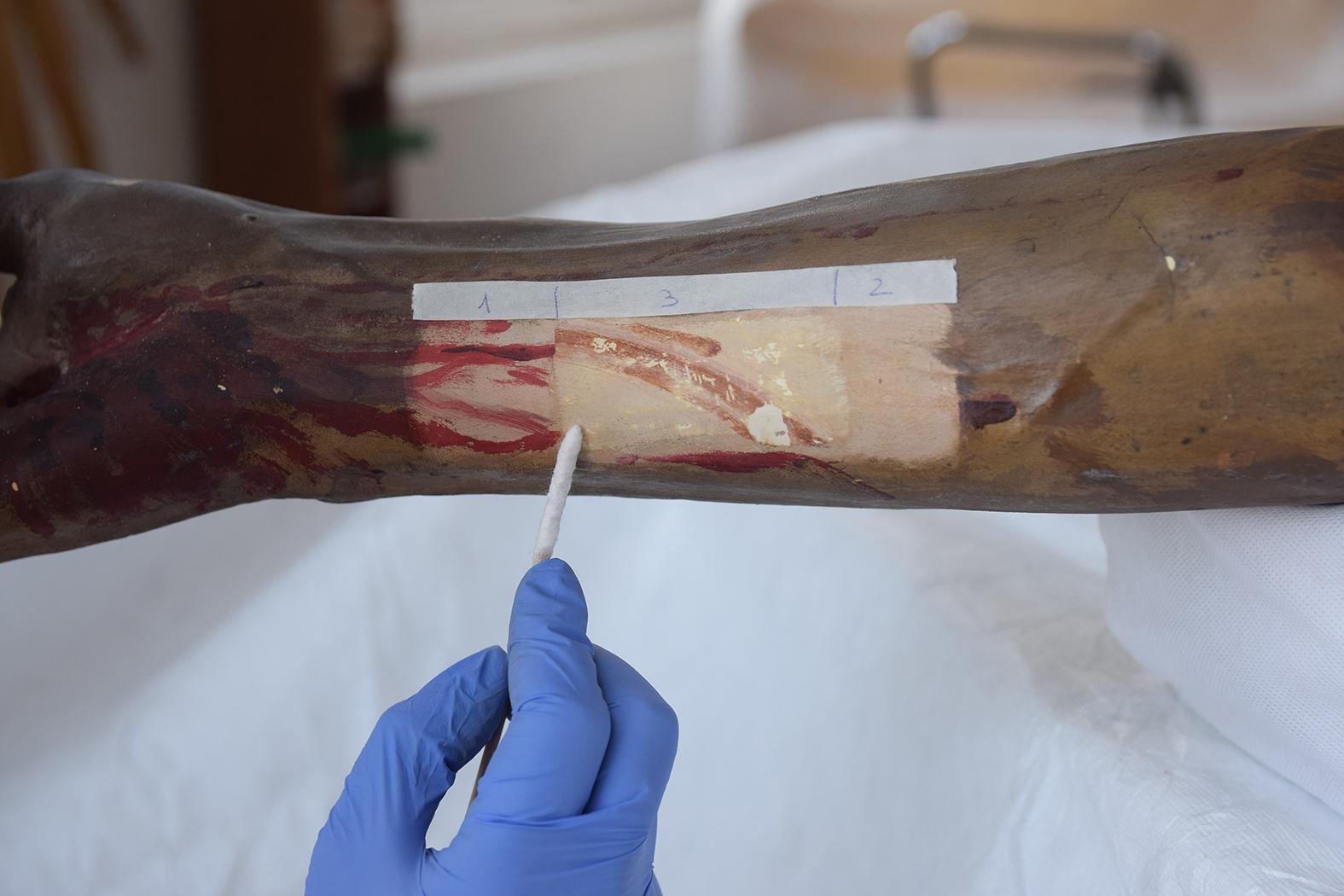 Initial cleaning tests carried out to study the distinctive polychrome layers.
The crucifix belongs to the Cristo vivo typology, closely aligned with the crucifixion imagery of Guido Reni and informed by the Christus Victor paradigm. Reni particularly developed this iconography in his Roman Crucifixion for San Lorenzo in Lucina (c. 1616-1617) and in the later Crucifixion of the Capuchins in Bologna (1619).
This balance between artifice and realism was crucial in an object intended for prolonged contemplation rather than dramatic narrative effect
Depicted with his head gently raised and the arms fully extended, Christ is presented as conscious and sovereign, reigning from the cross in a visual language that resonates strongly with the Johannine theology of exaltation and glorification through crucifixion.
Such iconography situates the sculpture firmly within a post-Tridentine visual theology that privileged triumph through sacrifice rather than physical collapse. Its elongated proportions, serpentine stance and controlled sweetness reveal a sculptor conversant with late mannerist idioms yet attentive to anatomical correctness and devotional clarity. This balance between artifice and realism was crucial in an object intended for prolonged contemplation rather than dramatic narrative effect.
In the post-Tridentine period, the Society of Jesus emerged as one of the principal promoters of the cult of saints and relics. Alongside the Oratorians, the Jesuits capitalised on the rediscovery of the Roman catacombs and the circulation of corpi santi, transforming these remains into potent symbols of continuity with the early Church. By disseminating Roman relics across mission territories, the Jesuits forged visible and devotional links with the centre of the Church – Rome.
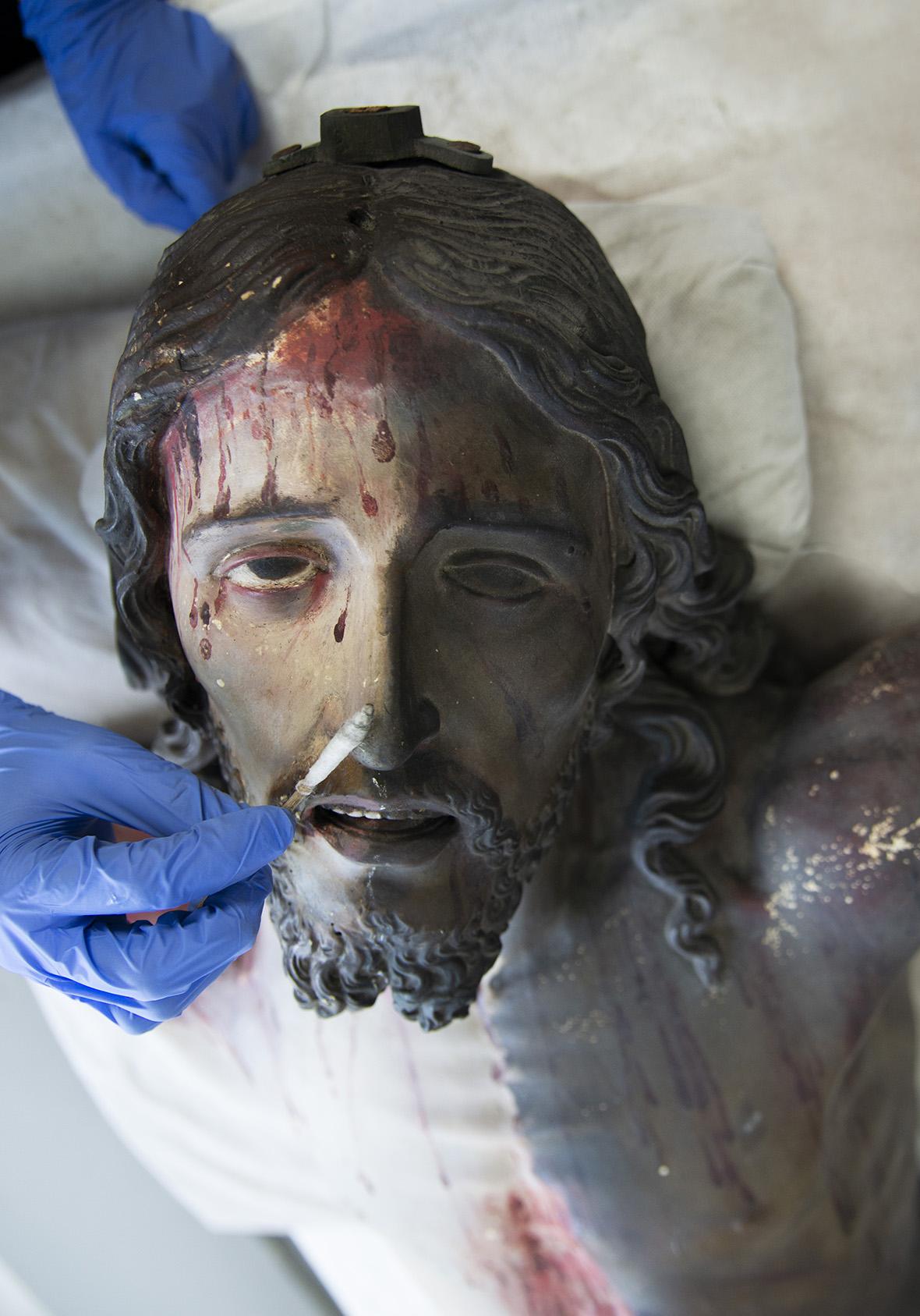 Detail of Christ’s face, half cleaned, revealing the original polychromy.
Within this layered context, the crucifix must also be read in dialogue with the baroque-style reliquary that envelopes it, fully expressive of the cultic significance of relics in the early modern period. Such arrangements reflected the Catholic reform’s emphasis on tangible signs of sanctity, encouraging the faithful to contemplate the mysteries of salvation while fostering an intimate connection with the communion of saints.
Conservation
For centuries, the faithful have approached this crucifix not only with prayer but with light. Candles and oil lamps have long been lit before sacred images, forming part of everyday devotional practice inside churches. But they also leave traces.
At first glance, the sculpture appeared dark, almost black, leading many to assume this was its original appearance. However, preliminary tests suggested that the discolouration was not a polychrome layer but centuries of accumulated soot.
Whenever candles and oil lamps burn, they release microscopic carbon particles and greasy residues into the air. In enclosed spaces, these settle onto nearby artworks. Mixed with dust and humidity, they form a stubborn grey-black film that dulls colours and obscures detail. Over time, paint surfaces that were once luminous can appear flat and sombre.
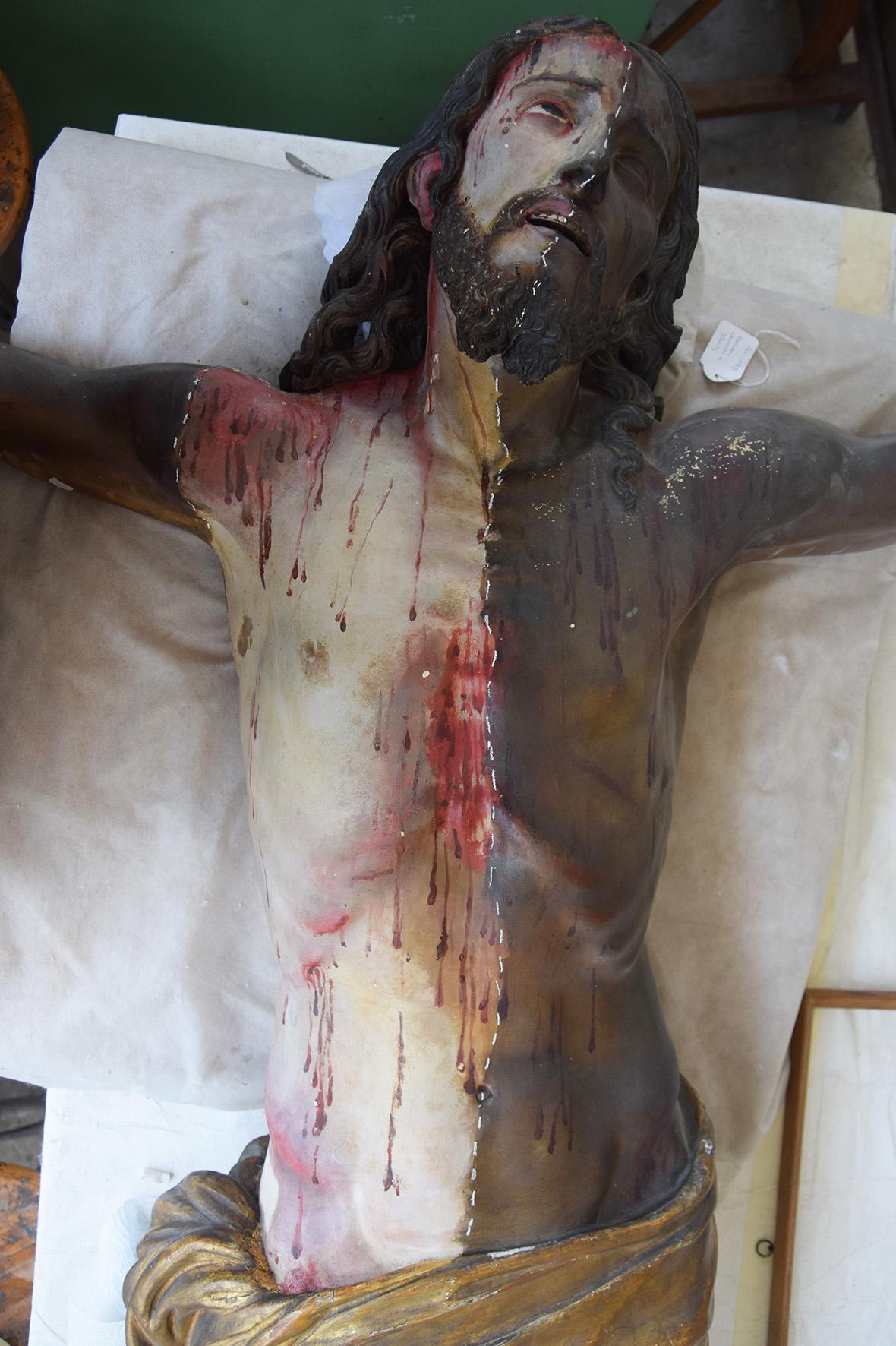 Detail of the crucifix during cleaning, showing the contrast between treated and untreated areas.
In this case, Christ’s flesh tones had darkened completely. The modelling of the body was flattened and the expression of the face was barely legible. Careful cleaning tests using controlled solvents confirmed that this discolouration was not original paint but deposits from devotional practices.
As the soot was gradually reduced, the transformation was immediate. The flesh tones re-emerged, shadows regained depth and the gilded loincloth executed in traditional water gilding with real gold recovered its brilliance. It was as though the figure was slowly coming back to life.
Flesh tones re-emerged, shadows regained depth, the gilded loincloth… recovered its brilliance. It was as though the figure was slowly coming back to life
Cleaning tests also revealed a more complex history. Beneath the surface lay not one but two distinct decorative campaigns. These tests, undertaken in various areas of the sculpture, revealed that traces of the original 17th-century polychromy survive; however, this earliest layer proved to be extremely fragile, heavily abraded and largely impossible to uncover without undue risk. Overlying it, by contrast, was a coherent and well-preserved 19th-century repaint.
This later intervention cannot be understood only as an attempt at repair but, rather, as a conscious reinterpretation of the sculpture’s appearance. The flesh tones were rendered with greater chromatic intensity, the modelling was accentuated and the depiction of the wounds – most notably the blood – was markedly intensified.
As noted in consultation with the project’s art historian, Prof. Keith Sciberras, such features and technical considerations are consistent with 19th-century devotional aesthetics and heightened emotional engagement through a more explicit visualisation of Christ’s suffering. The sculpture was thus visually recalibrated to correspond to the sensibilities and devotional expectations of a later period.
In light of these findings, and given the fragmentary condition of the original polychromy, the decision was taken to preserve the 19th-century layer as a historically significant phase in the object’s material biography. Contemporary conservation practice recognises that devotional artworks are not static entities but are shaped over time by changing sensibilities, reception and interpretation; each intervention therefore constitutes an integral part of their historical narrative. However, later overpaintings and oxidised coatings that obscured both historic layers were carefully removed.
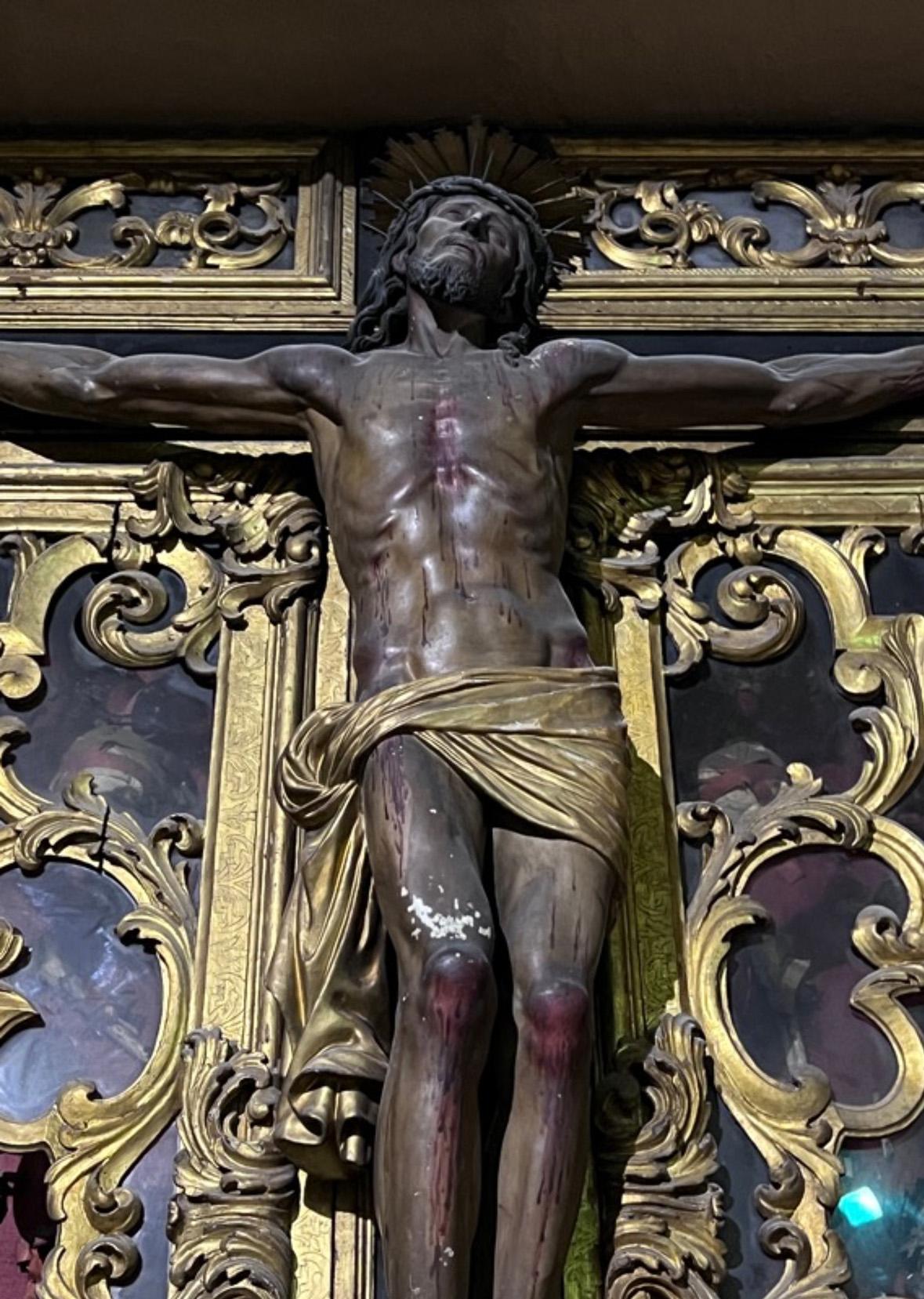 Detail of the crucifix and reliquary, with an ornate gilded enclosure at the rear housing the relics.
The crucifix has now been fully cleaned and the project has entered the final stages of retouching, in which losses are reintegrated using reversible materials to ensure the sculpture can be read clearly without compromising its authenticity.
Although candles and oil lamps will no longer be used in close proximity to the sculpture, the risks to such artworks remain. Fluctuations in humidity, dust accumulation and natural ageing continue to affect exposed wooden and polychrome surfaces. Regular conservation and maintenance are therefore essential to prevent gradual deterioration and the need for more invasive interventions in the future.
The conservation of the 17th-century wooden crucifix and the artworks of the Holy Cross chapel is made possible through the generous support of Tumas Group Ltd. This conservation project forms part of a scientific research project that is directing the conservation of the whole Jesuits’ church complex. It thus goes beyond mere technical intervention, aiming to renew a devotional focus rooted in the Catholic reform that inspired these sacred objects.
It invites both the faithful and visitors to let the beauty of these artworks elevate their hearts to God, who is beauty itself.
By preserving its artistic heritage, the Church maintains a living testimony to a community where art, relics and rituals continually speak of redeemed suffering and sanctified presence.
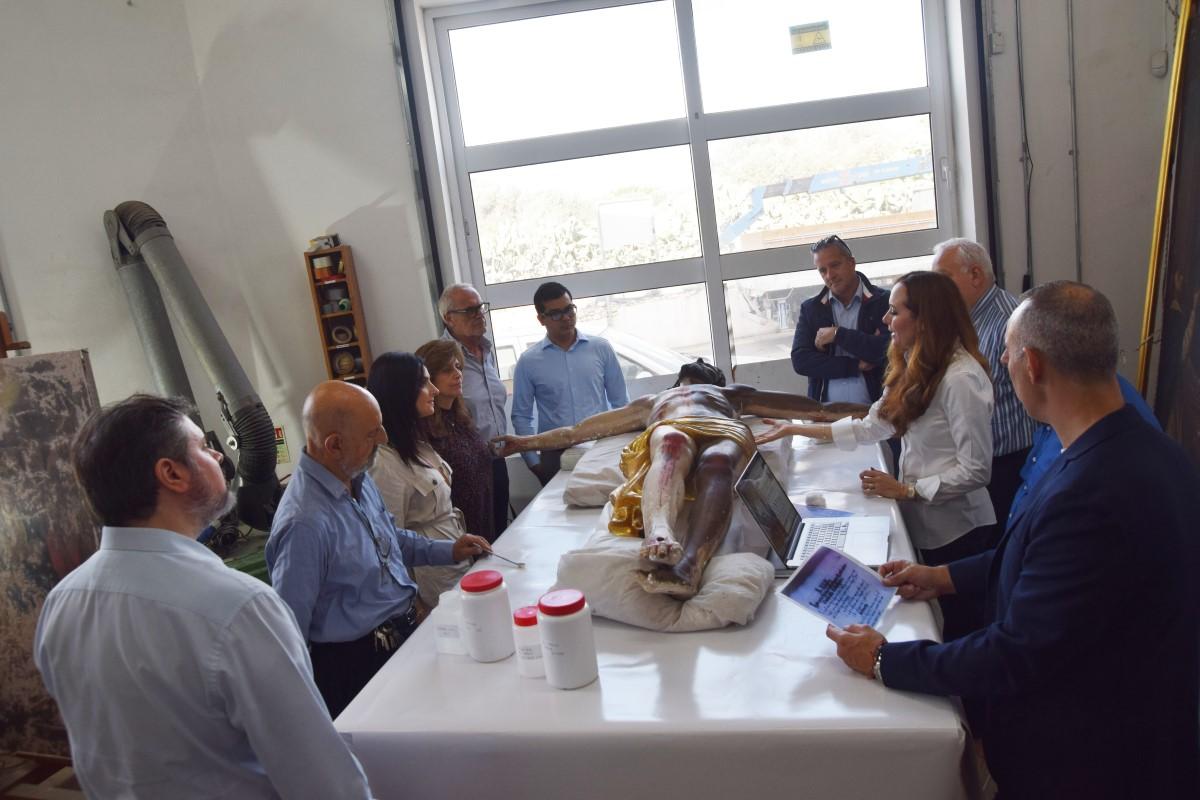 Directors and employees of the Tumas Group during a visit to the conservation laboratory to follow the progress of the ongoing restoration of the Crucifix.
The inauguration of the restored crucifix is being celebrated with the world premiere of the oratorio Opera Caritatis by Alex Vella Gregory on Thursday, March 12, at 7.30pm at the oratory of the Onorati at the Jesuits’ church, Valletta. The work is based on the Seven Acts of Mercy and involves soloists from the Opera Nova Project. Admission to the concert is free and no booking is required. For more information, visit www.jesuitschurchfoundation.org.