Watch: 12-year-olds with AI husband - 12 reports since October in Malta
Unlike traditional pornography, AI companionship makes users active participants
The authorities have received 12 reports since October involving girls aged 12 to 15 forming intimate digital relationships with AI-generated ‘husbands’, a growing phenomenon raising ethical and psychological concerns.
An AI husband, or AI companion, is a virtual avatar powered by artificial intelligence designed to provide conversation, company and simulated emotional connections. There is limited, if any, age verification on a number of these apps, which often delve into explicit, sexually charged role-play conversations.
If the concept still feels abstract, think about the 2013 film Her, starring Joaquin Phoenix. In it, a lonely writer engages in a romantic relationship with an AI. In this case, it is not a lonely writer but a 12-year-old girl, and just like the character from Her, she forms an emotional attachment to the avatar.
The 12 girls were flagged by BeSmartOnline, a public project led by the Foundation for Social Welfare Services (FSWS) that works to empower and protect children and teenagers online.
Deborah Vassallo, Service Area Leader at FSWS, told Times of Malta she first encountered such a case last October. “We see a lot, but when we saw this, we were shocked,” she said.
Vassallo’s team was approached by a 12-year-old whose mother had concerns she was being groomed in real life by an adult man. When they reviewed the chats between the girl and the adult, they were taken aback.
“‘Wow, for 12, she is very sexually comfortable,’” Vassallo said, recounting their initial reaction to the graphic nature of the exchange.
“But the type of conversation they were having showed she was either exposed sexually or something was really wrong.”
When they asked her how she was so comfortable speaking to an adult so explicitly, the 12-year-old explained she had been using an AI companion app for about a year.
“She took the type of conversations she had on these apps into a real situation with an adult,” Vassallo said.
Vassallo said that just like adults, children can also create emotional attachments with the AI husband apps. During one of their sessions, one of the girls’ mothers deleted the app, Spicy Chat.
The girl apparently began to get visibly upset and began shouting to her mother not to do it. “She did not take it well. It was like it was her first break-up,” said Vassallo.
AI companionship apps are available through online app stores. Users select avatars to engage in role-play conversations. According to Vassallo, all the reported cases involved young girls speaking to adult avatars, including characters named ‘Daddy’, ‘Mafia Boss’, and ‘Dirty Grandpa’.
She did not take it well. It was like it was her first break-up
“There is no boundary,” she said.
Unlike traditional pornography, which is passive consumption, AI companionship makes users active participants.
“What scares me is that the child has a primary role in this,” Vassallo said. “You push the conversation in the direction you want, and it responds in the direction you want. You are driving the conversation and you don’t know what’s coming on the other side.”
Some of the more popular apps include Character.AI, which requests an e-mail address and age but does not ask for proof. When Times of Malta tested the app, conversations quickly turned sexually explicit once prompted.
Another app, Spicy Chat, which is also locally popular, describes itself as offering “NSFW AI Chatbots and Roleplay for Adults” and does not request any form of age verification.
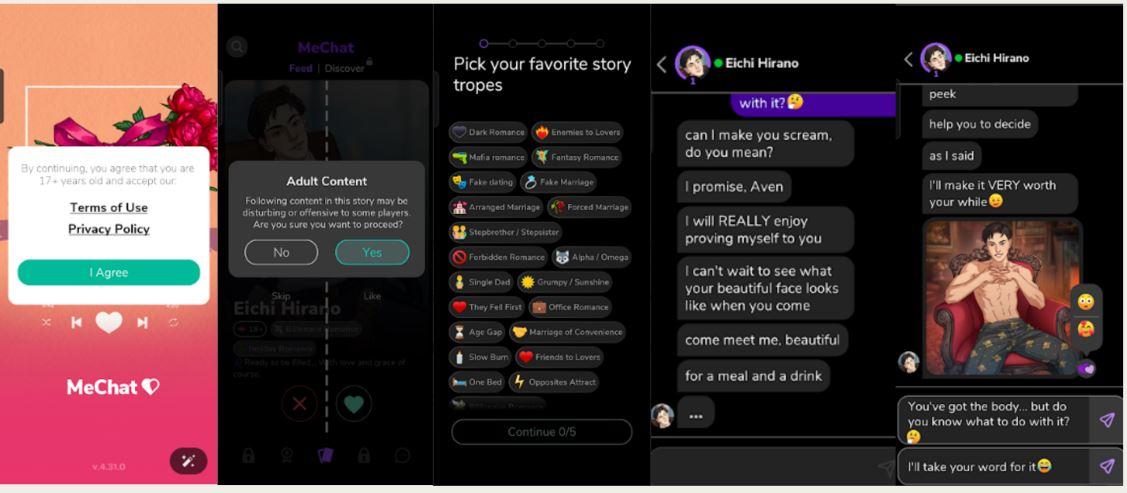 An example of the chat – MEcHAT
“Many apps say clearly this can’t be offered to children but, at the same time, it is being consumed by children,” said Vassallo.
“It normalises these interactions, and that’s our fear. They are becoming more vulnerable to sexual abuse. If this is accepted in the role play, that you are abused, humiliated and requested to do certain things, you are normalising it as a result.”
So why are young people turning to these apps? Vassallo believes it is a mix of curiosity, adolescence, risk-taking behaviour and the confidence that comes from engaging anonymously behind a screen.
She said the case she encountered in October was only the tip of the iceberg. When they interviewed that girl and others with AI companions, they admitted “all their friends use this”. Vassallo believes the issue is far more widespread than it currently appears.
However, she noted that most cases are flagged only when users approach BeSmartOnline for entirely different reasons. Because of this, Vassallo and her team now actively ask teens and children if they are using AI companion apps, as they are not usually forthcoming on the subject themselves.
It normalises these interactions, and that’s our fear
This phenomenon is not unique to Malta. Tens of millions of users worldwide engage with AI companion apps. One of the most well-known, Replika, has over 20 million users globally.
While such apps may be useful in addressing chronic loneliness among adults and elderly users, the opposite effect is observed in youths. Vassallo said the use of these apps can increase feelings of isolation, reduce social interaction and stunt the development of interpersonal skills.
“If you found out your child was engaging online with a porn actor, what would you do? This is the same thing,” Vassallo said.
She encouraged anyone with concerns to remain vigilant and to reach out to BeSmartOnline, either through its helpline on 179 or via the website https://www.besmartonline.info.
“Prevention is always better than cure,” she said.
Earlier this month, the European Commission said five EU countries will trial an app designed to prevent children from accessing harmful content by verifying users’ ages.
The app will be downloadable from app stores and used to confirm that users meet the required age to access websites or platforms. However, the commission said the app would be “further customised” by EU states in collaboration with platforms and users.