Watch: A rare visit to Filfla to see the damage inflicted by Storm Harry
The islet’s towering eastern side felt the full force of January's storm
When Storm Harry battered Malta with record-breaking waves in mid-January, photos emerged online of the islet of Filfla with what seemed like a sizeable chunk missing from it.
After the storm passed, the Environment and Resource Authority (ERA) scheduled a boat trip to Filfla to assess what had changed and invited Times of Malta along for a rare opportunity to see the islet up close. However, unfavourable weather throughout February and March meant the inspection had to be repeatedly postponed, until conditions improved enough to allow the trip to take place last Thursday morning.
After stopping to retrieve a large barnacle-encrusted pallet posing a hazard to boats, a RIB belonging to the ERA’s compliance and enforcement unit arrived at Wied Iż-Żurrieq to pick up the authority’s deputy director, Alex Camilleri, before heading to the islet.
As the boat sped towards Filfla, Camilleri explains it is not unheard of for pieces to break off the islet. “Filfla has a particularly unstable geological makeup. When its layer of soft clay becomes saturated with water or is smashed by waves, it moves and changes shape, undermining the above layer of upper coralline limestone and causing it to crack and eventually tumble or slide down. This is what creates its unique craggy landscape. Upon closer inspection, this appears to be what happened to the islet’s towering eastern side, which felt the full force of Storm Harry’s power.
“The rock face at the top was already cracked but still standing but it seems there was some movement and part of it slid down, which, in turn, created more debris at the bottom.” This, Camilleri pointed out, was a continuation of a process that had been happening for millennia.
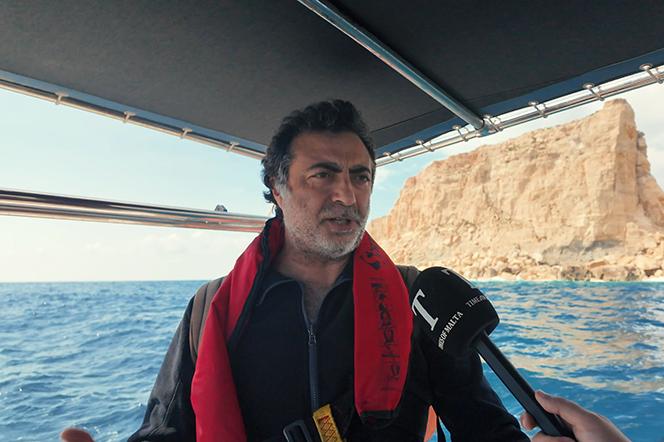
ERA deputy director Alex Camilleri.
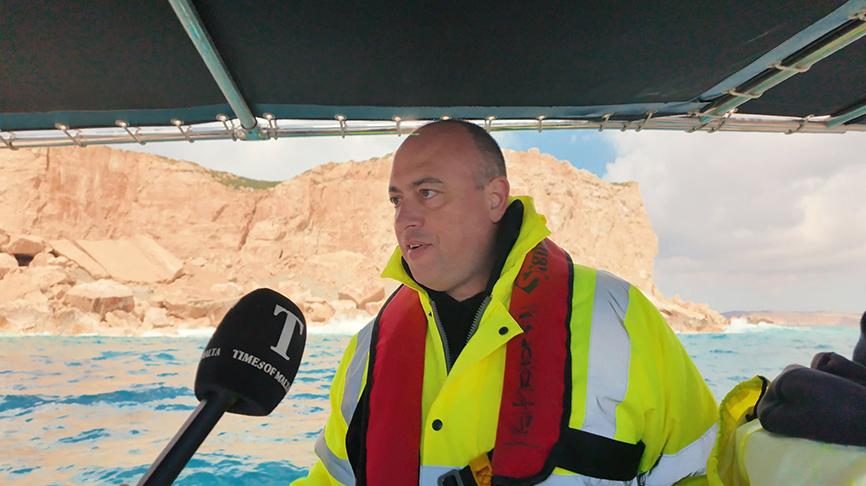
Enforcement unit team leader Alfred Sharples. Photos: Antoine Farrugia Lauri
He said the process was “accelerated” when the islet was used for live-fire exercises by the Royal Navy and the Royal Air Force until 1971. “The bombs probably destroyed a spring that was documented during the time of the Knights,” Camilleri said, pointing out shrapnel damage that is still visible on the cliff face.
So, will the iconic islet one day disappear completely?
“Yes, it’s likely that will eventually happen but none of us will be around to see it.”
As the boat circled slowly around the islet, flocks of seabirds took to the sky from the sheer cliffs they call home, which has been a nature reserve since 1980.
“The most noticeable are yellow-legged gulls but there are also large populations of Scopoli’s shearwaters and European storm petrels, which, in fact, are known as Kanġu ta’ Filfla, while egrets like to rest on the biggest shoal near Filfla, known in Maltese as Ix-Xutu l-Kbir. The islet’s isolation means that some species present on the islet have evolved separately from their cousins on the mainland. “The Filfla lizard appears noticeably different from wall lizards that are themselves native to Malta.”
Driving the boat were two members of the ERA’s enforcement and compliance unit, which ensures that environmental laws and permits are followed.
Team leader Alfred Sharples noted that the regulator patrols the surrounding area every week. “The one-mile radius around Filfla is a protected zone under a conservation order. You can’t drop anchor, swim, dive or fish.”
Because the islet is remote, enforcing the rules can be challenging. “We’ve had cases when people have climbed onto the islet out of curiosity after anchoring, or to harvest mussels, after anchoring nearby.” Speaking about the regulator’s work as a whole, the ERA official said the previous summer had been a busy one. “We start in the morning with inspections on fish farms to make sure they are operating as they are supposed to.
“We visit marine protected areas, checking for noise and light pollution, and make sure the moratorium on harvesting sea urchins is enforce.” The ERA official called on the public to help the regulator in its work. “We can’t be everywhere, so we appeal to people to report illegalities and, of course, would appreciate if illegalities did not occur in the first place.”