Watch: His father killed his mum after abuse, illness. His book seeks justice
Author Karl Schembri tells Times Talk his new novel is inspired by his real-life story
When Karl Schembri was a boy, his father carried a dark and unspoken history – years of sexual abuse at the hands of a priest.
The trauma left deep scars, and as an adult, his father’s mind began to unravel. The voices that haunted him eventually drove him to commit an unthinkable act: the murder of Schembri’s mother.
Schembri, an author, journalist and activist, has now finally broken a decades-long silence through a novel published this week. He told Times Talk that this is his way of achieving justice for a human tragedy that the authorities systematically overlooked for years.
Eħlisna mid-Deni (Deliver us from Evil) is a work of fiction with a plot that is quite simple: a man kidnaps an old, widely revered priest, ties him to a chair and forces him to listen to his life story.
That story is heavily inspired by Schembri’s real-life family tragedy, and the book serves as a reckoning with a family trauma that began with clerical sexual abuse and culminated in the murder of his mother in a moment of insanity by his mentally ill father 20 years ago.
“For a long time, I couldn’t put my story into words. I didn’t even know where to begin. My dad killed my mum – how do you even begin to explain that?”
The fictional kidnapper talks to his father’s abuser throughout the book – a story which, in many ways, mirrors the story of Schembri’s own father – a highly intelligent, well-read man with multiple university degrees who was sexually abused by a priest when he was a young boy.
The roots of the tragedy trace back to a time when speaking out against a priest was “unthinkable”, Schembri told Times Talk.
“When my father tried to speak to his family, they wouldn’t believe him. And the Church was much more powerful then, which enabled much more to go under the radar.”
Schembri learned of the abuse after he discovered letters his father had written about that time, and when asked, his father confirmed the truth.
“His case was never believed, never even became a case, and justice was never done,” he said.
“The Church, for many years, suppressed these cases and reassigned problematic priests across different roles to silence the scandal. Worse still, some were transferred into positions with direct access to children, even when their abusive potential was known, an act nothing short of diabolical.”
Mental illness made matters worse
Schembri’s father grew up and began to struggle with debilitating mental health illnesses, namely paranoia, schizophrenia and bipolar disorder.
He would hear voices, experience manic highs where he felt “invincible” and paralysing lows driven by paranoia.
“Once, during one of his highs, he told me: ‘I’m not going to die’,” his son recalled.
And in that moment, he truly believed it, Schembri explained, and no matter how much his family tried to tell him otherwise, the obsessive thoughts were too strong to overcome.
Schembri revealed the absurdity of this reality in his book, explaining how difficult it is for family members, especially children, to deal with their relatives struggling with severe mental illnesses.
He cannot definitively state that the sexual abuse caused his father’s mental illness, but he is certain of its impact.
“And the abuse was inherited down generations and affected me as well.”
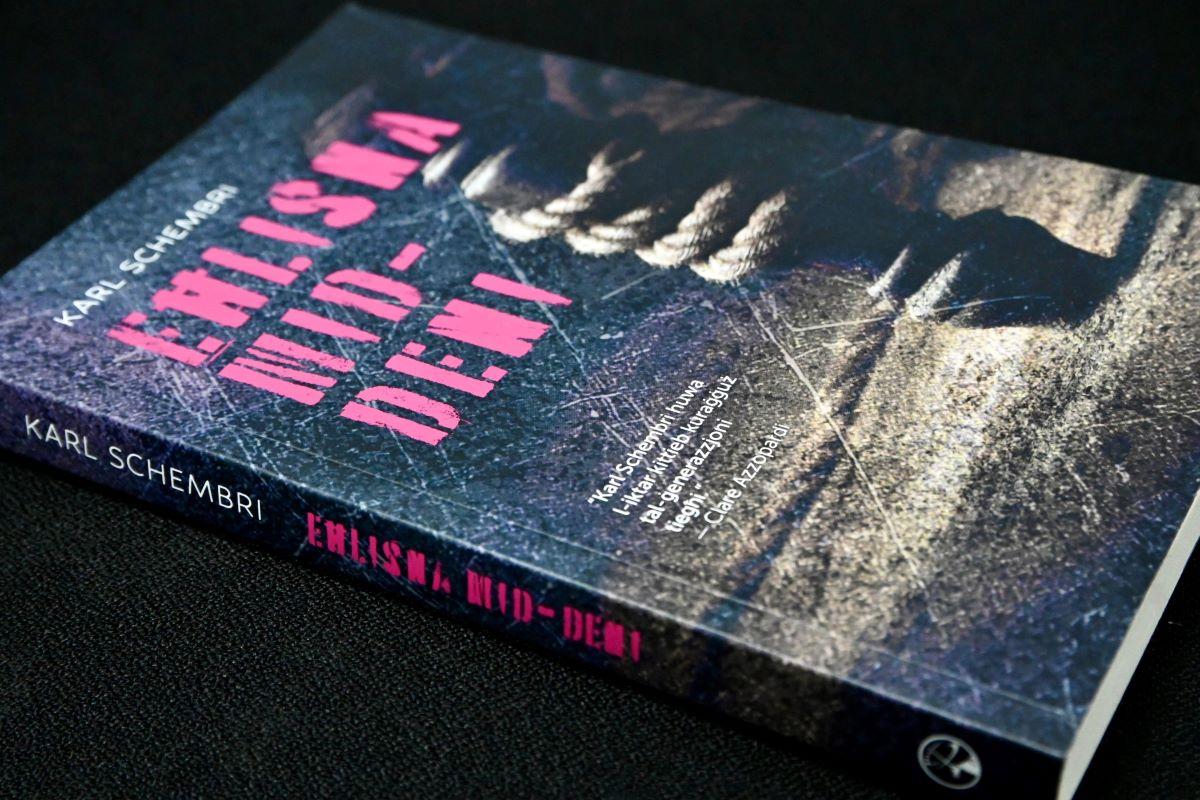 Schembri’s novel, Eħlisna mid-Deni, will be launched this evening. Photo: Jonathan Borg
But many people knew him as an intelligent man, and many clients trusted him with their money.
“You’d meet him at his best, and you’d have great conversations about Church history, or the Roman Empire, and you’d never believe anything is wrong. But at other moments, he would be very down.”
The murder
In his new novel, Schembri’s fictional kidnapper reads out an excerpt of a psychiatric report to the kidnapped priest. Schembri said he copied it word for word from his own father’s psychiatric report at the time of the murder.
In the report, he says: “When I would see family members wearing black, for me it meant my wife should be dead. Before the accident, I saw a man walk by, wearing black and a white cross – to me, that was a sign of mourning and a sign that I had to kill her.”
When I would see family members wearing black, for me it meant my wife should be dead- Karl Schembri's father
The heavy, graphic and sometimes disturbing descriptions in Schembri’s novel are stark.
“That was the most tragic conclusion of what was tormenting him, that he couldn’t escape,” Schembri reflected.
“Why her? Perhaps it’s because she was the easiest victim. She was the closest person to him, who would take care of him, worry about him. There’s no rational reason. It was a moment of insanity.”
Seeking justice beyond the courtroom
Schembri said the system failed his family twice: first in the care of his father and again in the ensuing court process.
“During the entire court case, it was as if my sister and I were nonexistent,” he recalls.
“It was a process between the police, the psychiatrists, the AG, the judge… my sister and I weren’t part of the equation.”
Even worse, despite the psychiatric report certifying his father as mentally ill, the attorney general insisted he stand trial by jury.
“That was part of the cruelty of the case,” Schembri says.
“It’s a court of law, not a court of justice. It’s concerned with the lines of the law, with getting it right and keeping by the book. It’s not concerned with the essence of the tragedy.”
This novel is his way of telling the story that was never truly heard in court, he said. It speaks for the many years he and his sister were not allowed to speak.
The book is also a way to raise awareness, he said, specifically tackling the persistent stigma tied to severe mental illnesses and highlighting the daily struggles and resilience of family members who must survive.
The book also describes the strange experience of a young boy visiting his father at Mount Carmel Hospital.
On one hand, he was the son of the victim – the person everyone readily empathises with.
On the other hand, he was the son of the murderer – the person toward whom society offered no empathy. He recalls his emotions swinging violently: from the urge to be physical, wanting to punch his father, to moments of empathy or the desperate need to ask, simply, why he had killed his mother.
Investigating abuse
Schembri went on to become an investigative journalist for The Malta Independent, during which time he investigated and revealed a major case of clerical abuse in a children’s care home.
However, he sees his novel as serving a different purpose. This is not a journalistic expose, nor an autobiography, he said.
“I wrote it as a novel because I believe literature can expose the truth more than facts,” he said.
“I believe a work of fiction has the potential to be truer than reality, especially when it exposes you to the emotions of human tragedy that the news stories, the history books and the statistics don’t give you.”
Schembri’s father died in 2013. The priest who abused him also died years ago, having faced no consequences, Schembri said.
“There’s still a street named after him,” he notes grimly. “He still enjoys the status of a priest who did a lot of good.”
In the past, several victims accused the Church of complacency, alleging that authorities covered up abuse and reassigned problematic priests to avert scandal. However, over the past decade, the Church has adopted a much firmer stance on abuse, exemplified in Malta by the establishment of a safeguarding commission.
Schembri’s novel, Eħlisna mid-Deni, will be launched this evening at the Malta Book Festival and will be available in all bookshops.