Watch: ‘I saw hell’: Survivors recall Vulcan crash over Żabbar 50 years ago
On October 14, 1975 a massive RAF bomber exploded in mid-air
On the afternoon of October 14, 1975, the peace and quiet of Żabbar were shattered by an explosion in the sky above the town.
Minutes earlier, an Avro Vulcan V.2 bomber had attempted to land at RAF Luqa but overshot the runway, making a hard landing that sheared off its undercarriage.
The huge plane bounced around six metres back into the air before hitting the runway again. Instead of crash-landing, the pilot managed to get the plane back in the air and climbed to try and circle back for another approach.
But the impact had also pierced a fuel tank, causing a fire in the starboard wing. Realising it was too late, the pilot and co-pilot ejected, before an explosion killed the remaining five crew members who could not bail out, and sent a rain of metal and highly flammable aviation fuel down onto Żabbar’s main street before coming down in a field on the outskirts of the town.
In the days leading up to the 50th anniversary of the tragedy, Times of Malta spoke to various eyewitnesses who were hurt or had near misses that day.
While the tragedy claimed a single life on the ground – 48-year-old Vincenza Zammit – dozens were injured by falling debris. One of these people was eight-year-old Kevin Falzon.
“In those days the school break was around noon. We’d go home for lunch and then head to a square to play. At around 1pm that day we saw a plane engulfed in flames coming from the direction of the airport. Then, it exploded,” Falzon said.
He described how, in the ensuing panic, everyone ran in different directions.
“One Alfred Zarb, who is no longer with us, told me to take shelter in his home. But before I could, I was hit in the head by a piece of the plane.”
 Kevin Falzon, who was eight years old when he was struck on the head by a piece of the falling plane. Photo: Jonathan Borg.
Zarb and another man scooped Falzon up from the ground and raced to a doctor in Vittoriosa, who told them to take him straight to hospital.
“I don’t remember anything after that. I was in a coma for three days, and after that spent another 39 days in hospital, so I missed what happened in Żabbar in the days that followed,” said Falzon, referring to the procession with the statue of Our Lady of Graces that was carried out to give thanks to God for saving the locality from what could have been a much worse disaster.
The 58-year-old butcher, who still bears the scar from his head wound, says that while he did not suffer any lasting complications, he still reflects on the incident whenever October 14 rolls around.
“Especially this year, younger people are very curious about what happened to me.”
‘Faith in Our Lady of Graces increased greatly’
Lilian Darmanin, who now volunteers at the Żabbar Sanctuary Museum, which has an exhibition dedicated to the incident, was luckier than Falzon. Two weeks prior to the crash, she had given birth and was still housebound.
“My sister was visiting me and I asked her if she could take me to my father’s house, with whom she lived on a side street off Sanctuary Street.
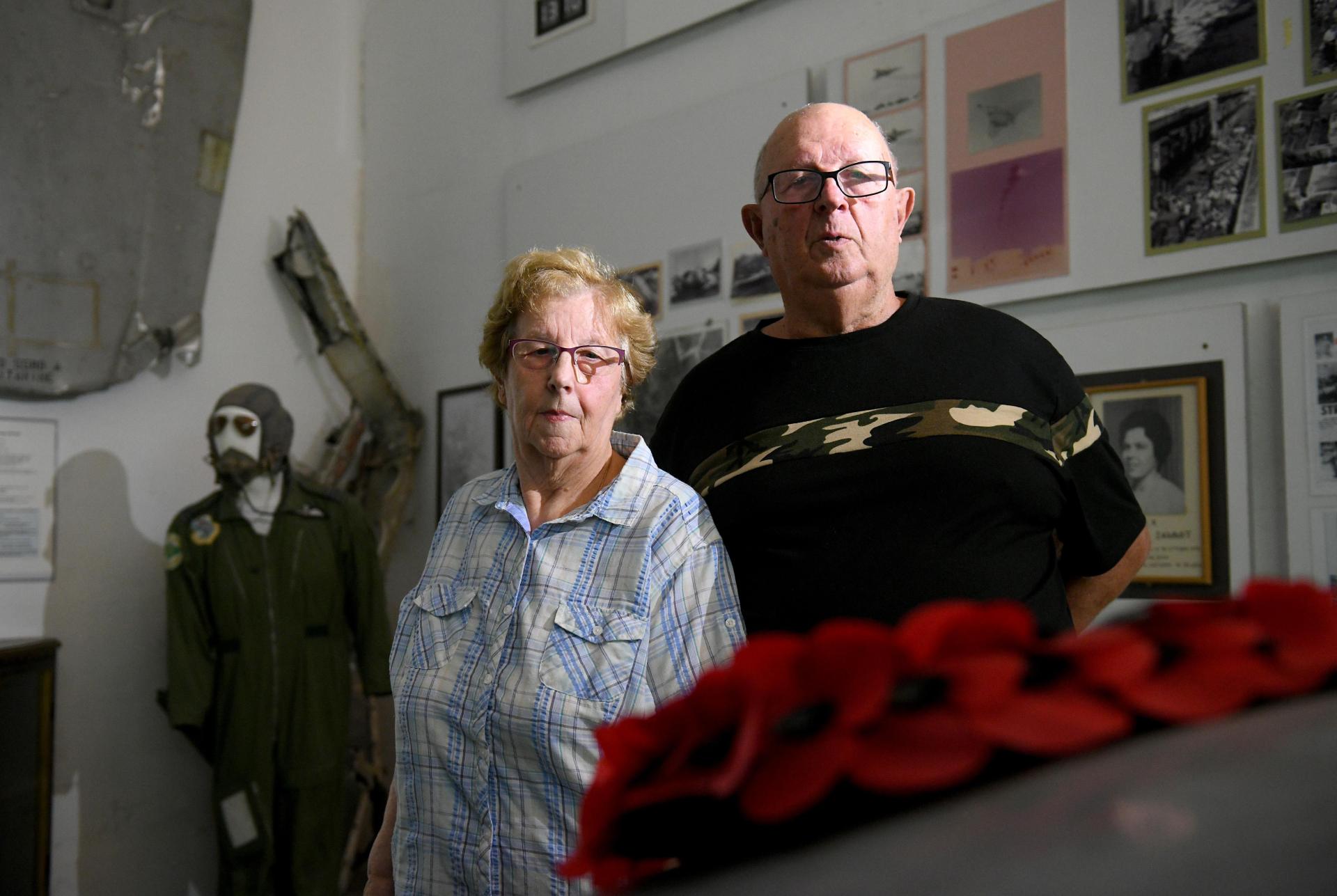 Lilian Darmanin, an eyewitness who now volunteers at the Żabbar Sanctuary Museum, and her brother Charles Magro.
“As soon as we entered the house we heard a huge explosion. Dad thought it was a gas cylinder. We went into the backyard and saw the plane on fire in the sky. We went into the street and everywhere you looked, there were people running and screaming.
When Darmanin attempted to return to her home near the village primary school, where another piece of debris had landed, she was met with a street engulfed in flames. The fuel that fell from the plane had ignited and set fire to homes and vehicles.
“When I got back home I said, ‘I saw hell today.’ It really was hell – the entire street was on fire.”
Darmanin said the town’s inhabitants interpreted the fact that only one person died as a miracle.
“Faith in Our Lady of Graces increased greatly. It was a tragedy, but it could have been much worse.”
 .
.Darmanin’s older brother, Charles Magro, also thought the first explosion was caused by a gas cylinder, as a similar incident had occurred six months earlier.
“After the second explosion, I realised this was no gas cylinder. I ran out of our store and saw the plane on fire. The first piece of debris that I saw fell in the direction of my aunt’s house. But before I could run in that direction, another piece fell close to the store, near my house. As I was running there, my wife greeted me and said a large piece had fallen in our home,” he said.
The piece of debris was almost the same size as the backyard yet caused no significant damage. It was later recovered by British personnel.
“They asked if we had any expenses but I told them we had none. I did keep a piece of the plane for myself as a memento, though.”
What caused the crash?
An inquiry into the crash found that the pilot, Flight Lieutenant G. R. Alcock, had handed over the responsibility for conducting the final approach to his co-pilot, Flying Officer E. G. Alexander.
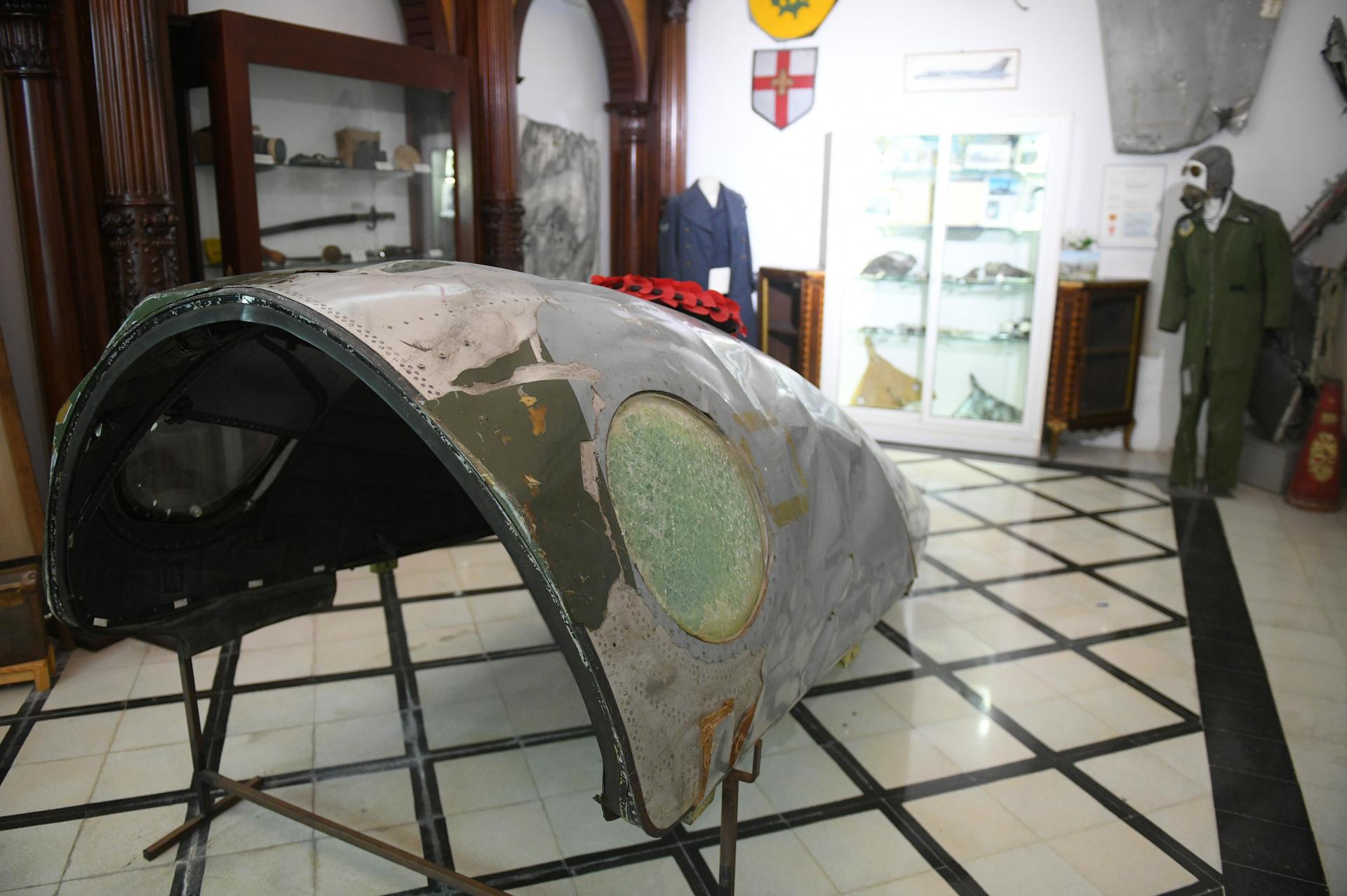 The Żabbar Sanctuary Museum houses an exhibition on the crash, which includes pieces of the plane and several photos taken on the day. Photo: Matthew Mirabelli.
However, Alexander had not been adequately briefed on the problems that arose when landing on a short, sloping runway like Luqa’s. The report described the tragedy as “an avoidable accident in which a serviceable aircraft was flown into the ground killing all rear crew members.” It described Alcock’s handling of the aircraft as negligent.
A series of events to commemorate the crash will take place in Żabbar on Tuesday, including the unveiling of a new monument on Sanctuary Street, a parade and a fly-past by an RAF Typhoon jet. Archbishop Charles Scicluna will co-celebrate a mass at the parish church.