Malta student rocket team makes top 10 despite motor disaster
Maltese team had to compete as novices with a conservative budget of €4,000
On the eve of their debut at a European rocketry competition, Malta’s first university rocket team faced a major setback – their motor exploded.
In the following 48 hours, the 26 students rebuilt the engine from scratch in Portugal, determined not to miss their chance to compete.
The University of Malta’s Rocketry team is the first Maltese team to enrol in the European Rocketry Challenge (EuRoC). The competition, held in Portugal, hosted 29 teams, drawn from universities across Europe.
Their challenge is to launch their rocket to three or nine kilometres, depending on the category.
Led by co-founder Ryan Grech, Malta’s team spent about six months getting the completely student-made rocket ready for the competition.
Being the team’s first attempt at this competition, they were up against heavyweight teams established decades ago with budgets amounting to over €100,000.
The Maltese team had to compete as novices with a conservative budget of €4,000, the smallest budget of all the teams.
The day before they were supposed to head off for the competition, the team carried out a static fire test on the rocket motor to evaluate its performance before the competition. Things did not go to plan, and the team experienced a catastrophic failure at launch.
“In other words, the entire motor exploded and the case launched approximately 250 metres in the air,” Grech said.
The team then contemplated calling off the trip, but they chose to go anyway and attempt to build a new motor. This meant that, in the space of two days, they had to source parts in a foreign country, design a new motor and build it.
“We decided to split into three teams to make this work. A few people got into the van we rented and drove around different villages and eventually to Lisbon to source parts. A few others were tasked with speaking to other teams and asking for help. While around 20 of us remained at the Airbnb designing a new engine,” he said.
Through sheer determination, help from other teams and a bit of luck, the team were able to build a new motor.
“The officials approved it [for a static fire test] but gave the motor a 10 per cent chance of success,” he said, adding they only had enough time and resources to carry out a static launch test.
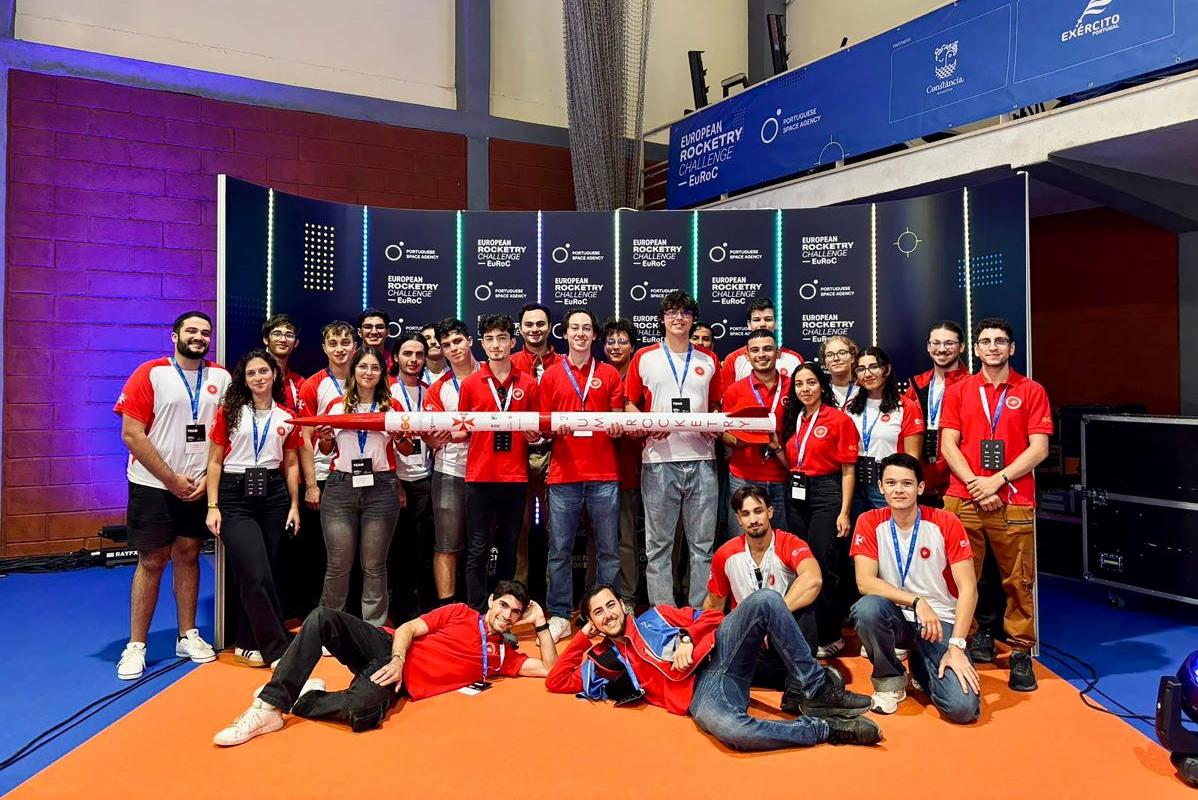 The team at EuRoC holding the rocket. Photos: University of Malta’s Rocketry Team
‘We thought it exploded again’
The time to carry out the static fire test arrived and the motor was set up in a concrete test stand to hold it in place.
The team stood at a safe distance, and as the launch began, the motor took off and “punched through 300kg of concrete”.
“We saw the motor fly out of the stand and land about 600 metres away. We thought it exploded again,” Grech said.
Despite their concerns, the motor appeared to be still intact. It was the stand that failed.
“It passed the review, so we could theoretically have launched the rocket. Unfortunately, we did not have enough time or resources. The motor was only single-use,” he said.
Malta’s team placed eighth out of 29 for the team award.
While other teams had trailers to transport all their equipment, the Maltese team picked up their motor and began an hour-long walk to the end of the military base, until another team eventually offered them a lift.
“Next year we’re definitely going to launch our rocket. We now know what design works,” he said.