Malta's migration 'irony': It asked for help, but must now help others
Home Affairs Minister says Malta will receive support if migration pressures return
Malta is obliged to show solidarity to other Mediterranean countries under pressure from irregular migration, Home Affairs Minister Byron Camilleri has said.
“Malta, along with other member states, does not have a choice [but to engage in solidarity according to the EU Migration Pact]. And this was a good decision that Europe made,” Camilleri said.
The minister was speaking ahead of the ninth MED5 summit on Saturday, convened in Cottonera at Fort St Angelo.
Malta, Cyprus, Greece, Italy, and Spain are all taking part in the summit and will discuss implementation of the EU Migration Pact.
Also present are the European Commissioner for Internal Affairs and Migration, Magnus Brunner, and a representative from Denmark, which currently holds the Presidency of the Council of the European Union.
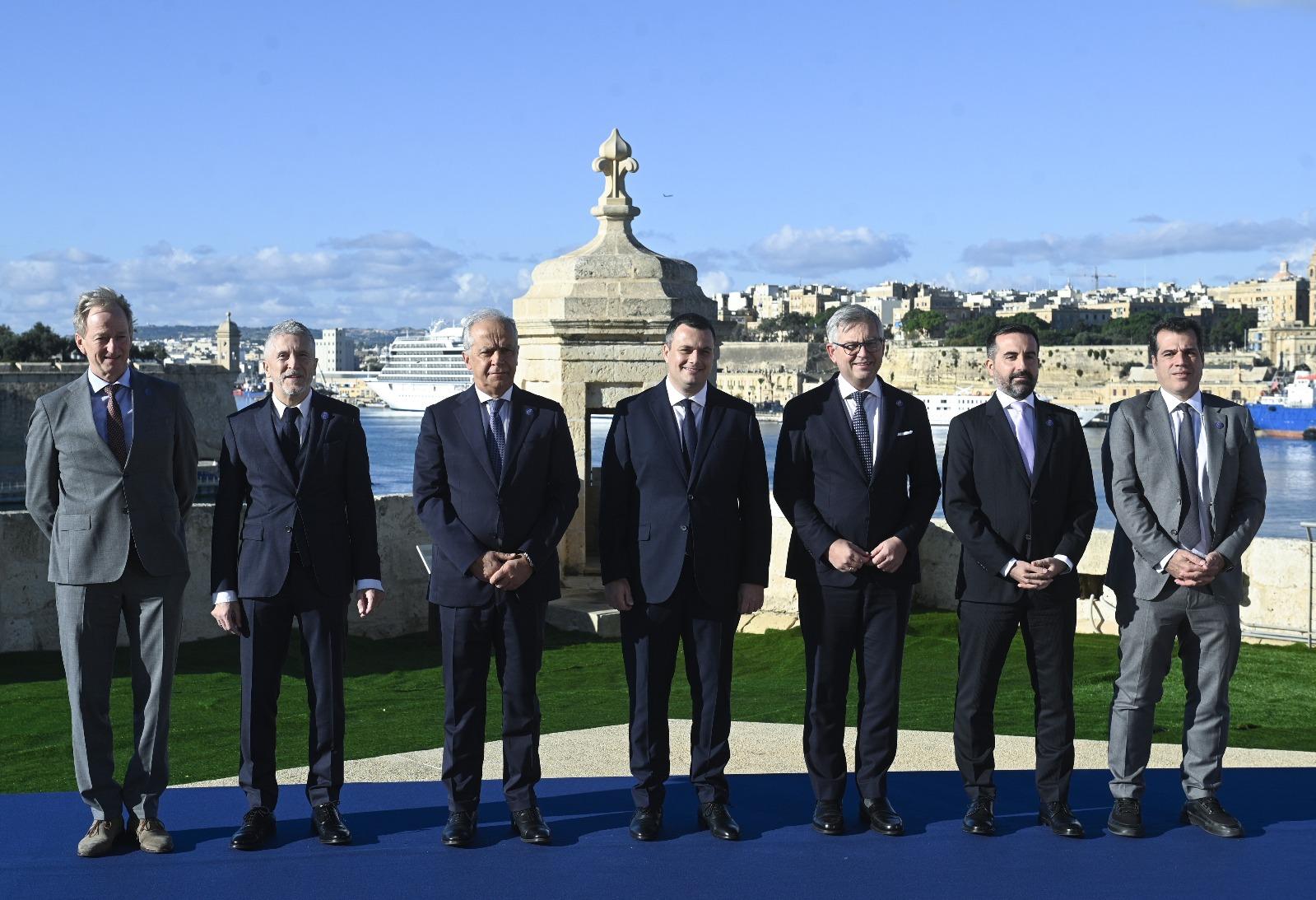 From left to right: Denmark's Henrik Ankerstjerne, Spain's Fernando Grande‑Marlaska, Italy's Matteo Piantedosi, Byron Camillleri, Commissioner Magnus Brunner, Cyprus' Nicholas A. Ioannides, Greece's Thanos Plevris. Photo: Matthew Mirabelli
The EU's migration pact aims to introduce an annual solidarity pool that allows member states under migratory pressure to receive aid from other EU countries to share the burden.
Solidarity contributions can be provided through the relocation of asylum seekers to another member state, financial contributions, or alternative measures. EU member states must now meet at European Council level to vote on the establishment of the Annual Solidarity Pool for the pact.
The pact is set to be implemented in June 2026.
Malta's 'ironic' situation
In a recent report by the European Commission, Cyprus, Greece, Italy, and Spain were deemed eligible for this aid, as they were classified as being under immediate migratory pressure.
Malta has historically been one of Europe's loudest voices in calling for solidarity payments. But irregular migration numbers have plummted in recent years and the country is now no longer considered under pressure and will not qualify for aid, Camilleri told parliament two weeks ago.
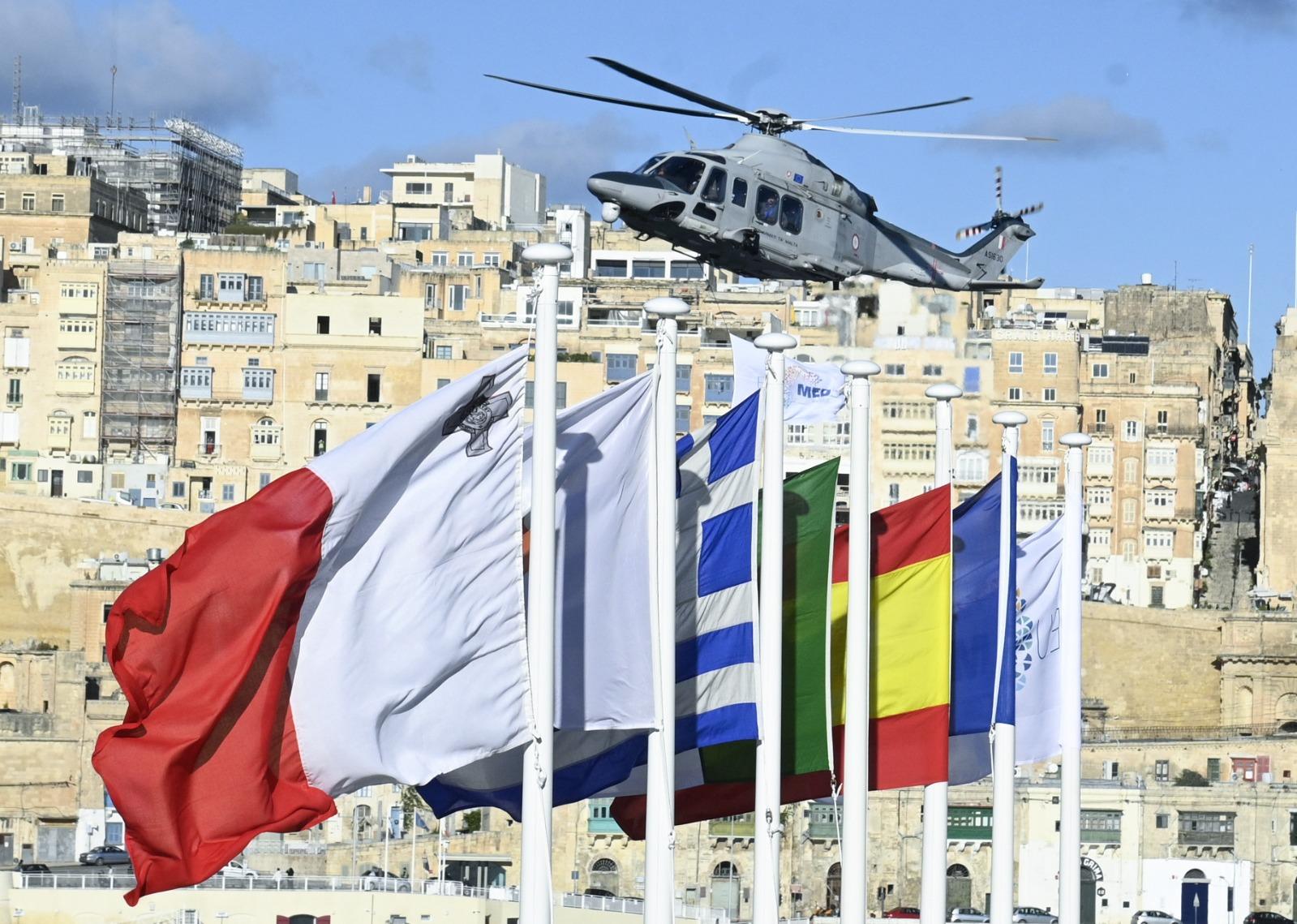 A helicopter carrying a MED5 flag flew-by to greet the ministers. Photo: Matthew Mirabelli
When Camilleri was asked about this ahead of the summit, he acknowledged the “irony” of the situation, noting that although Malta called for a burden-sharing mechanism for several years, the country is “no longer in an irregular migration crisis.”
“Should the time come when we need to make use of it, given our ongoing vulnerability stemming from our small size and close proximity to Libya, we need there to be solidarity when we ask for help,” he said.
The Minister added that Malta has changed the way it handles irregular migration and is now stricter, adopting a "who deserves [asylum], deserves it, and who doesn't, doesn't" mentality.
The number of irregular migrant sea arrivals dropped from 2,281 in 2020 to 238 in 2024—approximately a 90 per cent decrease. This occurred after Malta signed a secretive migration coordination deal with Libya five years ago.
Data also show that interceptions by the Libyan coastguard have surged by 230 per cent. The Libyan coastguard is a collection of militias, sanctioned by the Libyan government, that have long been accused of human rights abuses.
Push to return 'illegal' migrants
Speaking to journalists prior to the summit, EU Commissioner Brunner said that the ministers would be discussing the implementation of this “firm but fair” pact.
“There are some missing pieces, like returns. We presented a return regulation, which we will be discussing today. Only one out of five people who are illegal in the European Union are returned,” he said.
Days before the summit, Brunner told Times of Malta that Malta’s relationship with Libya is key to the European Union building a stronger relationship with Libya to reduce irregular migrant crossings.