Watch: Sciortino’s unbuilt monument revisited in new documentary
It was conceived as a memorial to the unknown soldier and intended to be built on the outskirts of London
An ambitious war memorial conceived in the aftermath of World War I, but never realised, has been brought back into public discourse through a new immersive video-documentary and scholarly publication by Conrad Thake that reassess the artistic vision of Antonio Sciortino.
While Sciortino is widely recognised as one of Malta’s most important sculptors of public monuments, this renewed focus on his unrealised Temple of the British Empire to the Unknown Soldier reveals a lesser-known yet crucial dimension of his legacy.
The project was revisited during a recent event held at the Church of St Catherine of Italy in Valletta, where Professor Conrad Thake launched the short video-documentary The Memorialisation of the Loss of Human Life in War – Revisiting Antonio Sciortino’s ‘Temple of the British Empire to the Unknown Soldier’.
The screening was followed by an interactive discussion with Thake as project creator, film director Martin Bonnici and Mark Sagona, Head of the Department of Art and Art History at the University of Malta.
Speaking at the event, Thake emphasised that Sciortino’s temple project has long been overshadowed by his sculptural output.
“Sciortino’s sculptural works and public monuments have been extensively researched and studied,” he said. “However, a lesser-known facet of his career is his interest in architecture, particularly this unrealised project, which occupied him for several years and generated hundreds of sketches, drawings and a scale model.”
Conceived as a monumental memorial to the unknown soldier and intended to be built on the outskirts of London, the project reflected the profound trauma of World War I and the desire to commemorate mass loss on an unprecedented scale.
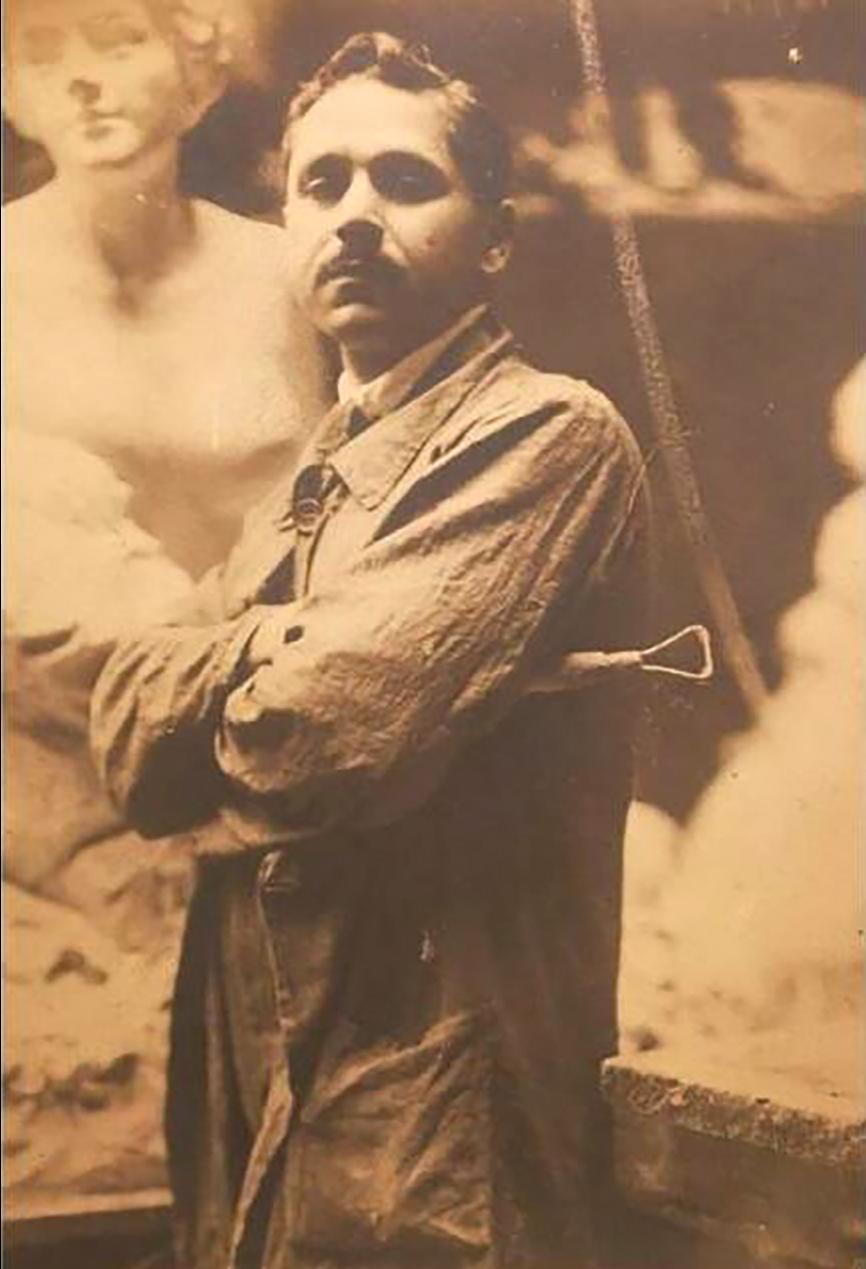 Antonio Sciortino, aged 30, in his studio in Rome. Photo: Wikimedia Commons
Despite Sciortino’s determination, the proposal was rejected by the British authorities. He subsequently modified its conception and actively promoted it in the United States, though the vast cost and scale of the project made its realisation highly unlikely.
“The prospect of ever realising the project was virtually non-existent,” Thake noted. “Sciortino’s bold concepts were destined to languish in the form of a grand architectural vision on paper and a tantalising plaster model of what could have been.”
Rather than treating this unrealised scheme as a historical curiosity, Thake’s research places it at the centre of a broader discussion on war memorialisation and collective memory. This approach is also reflected in his publication, Invention, Quotation, and Beyond – Antonio Sciortino’s Project of the Temple of the British Empire to the Unknown Soldier, which was launched during the event by Godwin Vella on behalf of Heritage Malta.
 Conrad Thake’s new publication on Antonio Sciortino’s project.
The video-documentary reinterprets Sciortino’s designs through digital technology, transforming them into an immersive experience that allows viewers to encounter the monumental complex both externally and from within.
“Sciortino’s project, as expressed in his testimonial, drawings and model, was reinterpreted digitally as a manifestation of ‘war poetry’ for meditation and reflection,” Thake explained. “The use of virtual reality enables the viewer to interact and relate intimately with his grand conception.”
Produced by Studio Seven Ltd and Stargate Studios (Malta), the documentary was funded by Arts Council Malta with the support of MUŻA, Heritage Malta, and the University of Malta. Attendees were also invited to view Sciortino’s original gypsum plaster scale model at the Sciortino Gallery at MUŻA, offering a rare opportunity to engage directly with the physical remnants of the project.
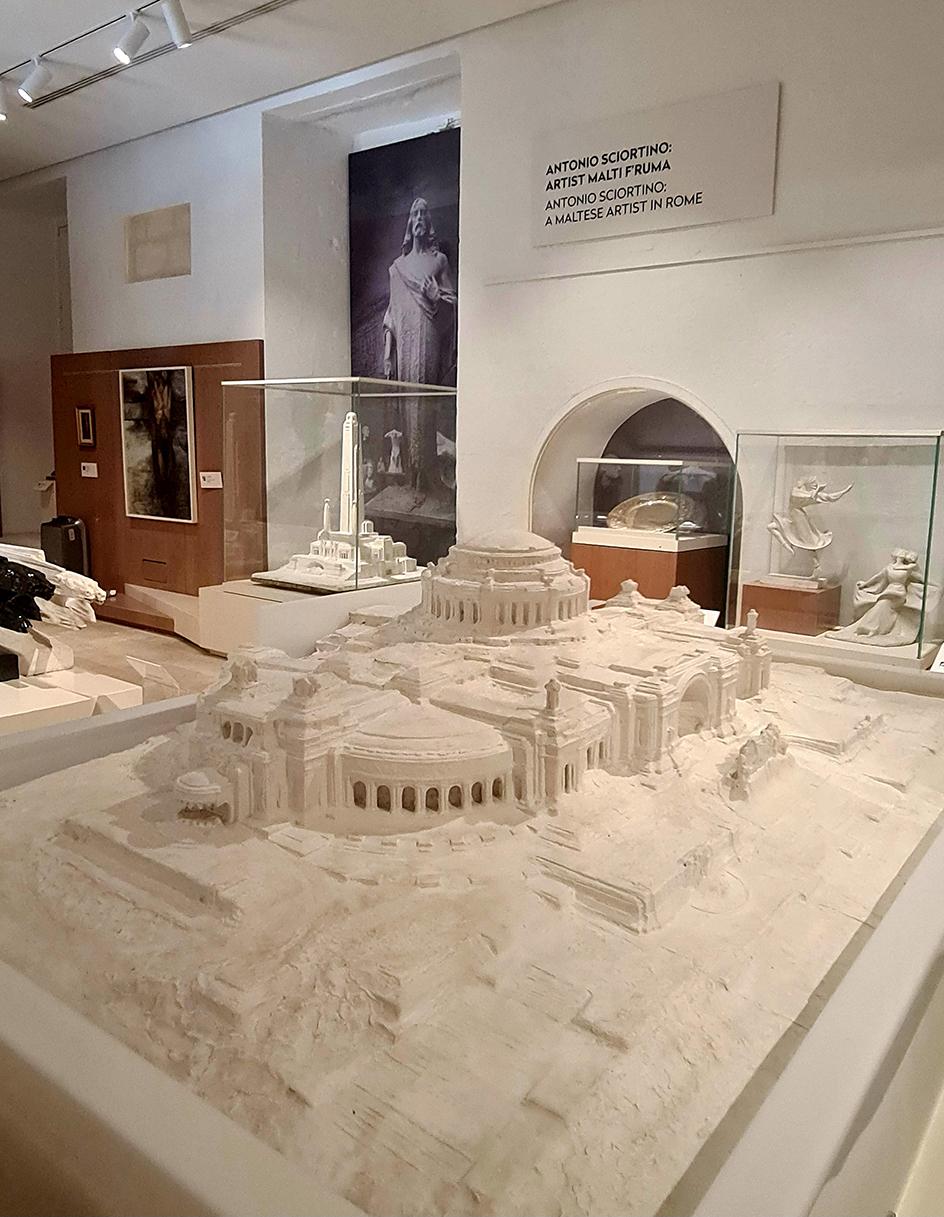 Sciortino’s original gypsum plaster scale model at MUŻA.
The contemporary relevance of Sciortino’s vision forms a central theme of the documentary. “More than a century later, Europe finds itself once again experiencing war, with the tragic loss of human lives being a daily reality,” Thake observed, referring to the ongoing conflict in Ukraine. “This prompted us to reconsider Sciortino’s project within today’s societal context.”
He added that the project raises fundamental questions: “How relevant are physical monumental memorial complexes in a society dominated by digital media, technology and artificial intelligence? Has the heroic idea of physical memorialisation been rendered obsolete, or is there still scope for remembrance in new forms?”
By combining historical scholarship with digital reinterpretation, the initiative positions Sciortino’s unbuilt temple as a timely reflection on loss, memory, and the evolving language of commemoration – demonstrating that even monuments that were never built can continue to speak powerfully to the present.