Watch: The dogs trained to locate missing persons
Volunteers meet weekly to prepare their dogs for emergency situations
In Pembroke, a woman dressed in high-visibility protective clothing looks on as her energetic terrier Lilly launches herself into the undergrowth, barking excitedly as she sets off in pursuit of her prize.
But Lilly is not chasing a ball, treat or another animal; she is looking for a person hidden somewhere in the area, honing her skills to be ready for the real thing.
Because Lilly and her owner, Andreea Chirita, are members of the Order of Malta Canine Search and Rescue Team, a group of volunteers who offer help to the public and the emergency services in locating missing persons.
“She’s good at tracking, but also at area searches,” says Chirita.
“Lilly’s a Jagdterrier – a German hunting terrier – so she’s very loud and very energetic... and as you can see, she’s also very demanding,” she laughs.
Chirita is one of around 20 dog owners and other volunteers who make up the team, which meets regularly for training sessions and mission drills.
Recent fieldwork has seen the unit assist the police in missing persons, including in searches for 36-year-old Jan Pace, who was found dead in Pietà last month, as well as British pensioner Michael Clarkson in March who was reported missing and then found.
Times of Malta joined the team in Pembroke as they put their dogs to the test in a series of staged rescue exercises undertaken that day in collaboration with NGO Emergency Fire and Rescue Unit.
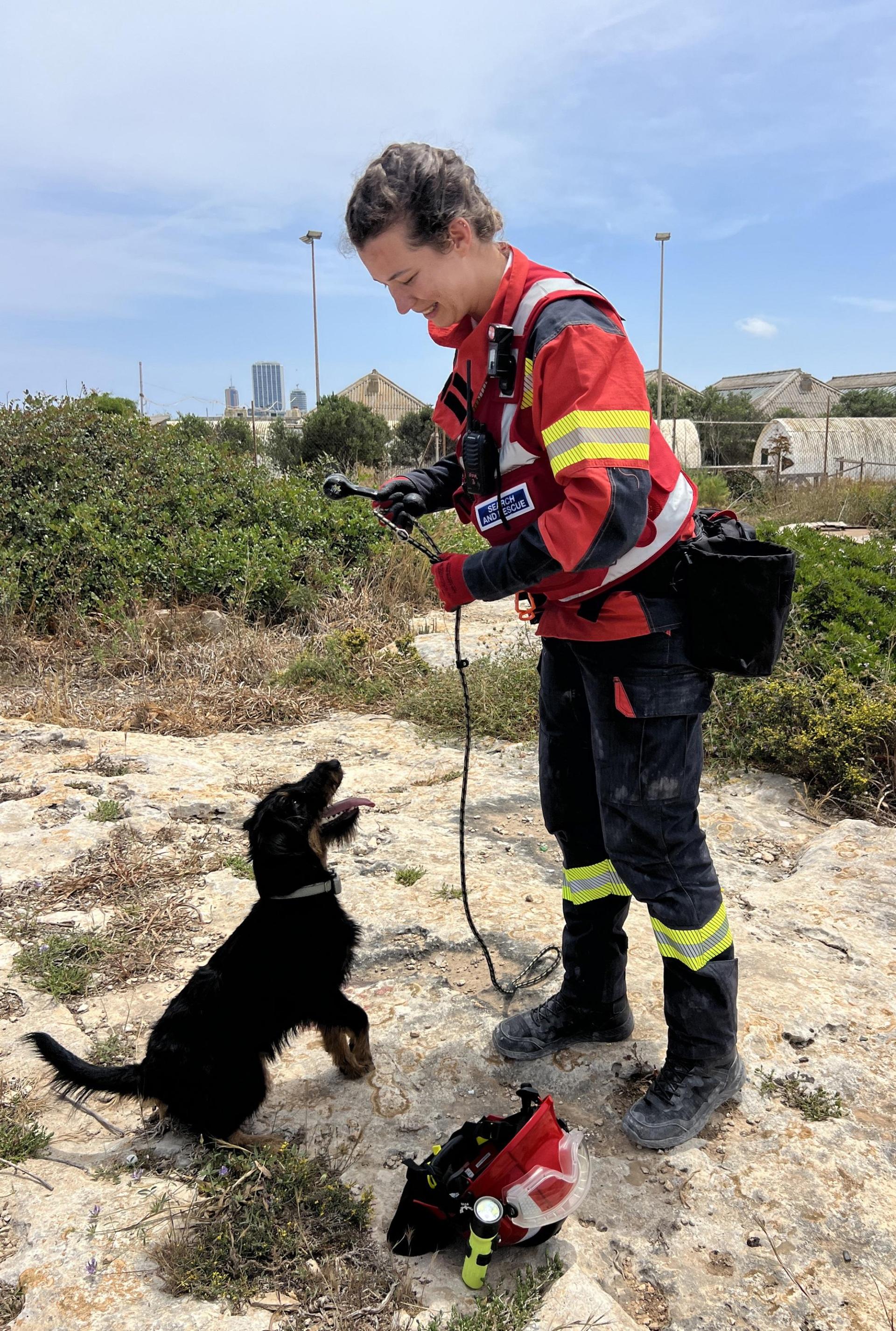 Lilly’s owner Andrea Chirita describes the one-year-old terrier as ‘very demanding’.
The dogs are divided into tracking, air scenting and cadaver dogs, explains team leader Simon Briffa, with the team focused on “supporting disaster scenarios, missing person cases and even where the person has been missing for an extended time and could be dead”.
Whereas tracking dogs locate people by being exposed to clothing or other items belonging to the missing person, providing the dog with that person's unique scent to follow, air scenting dogs are trained to locate any person exhibiting signs of distress or entombment in a given area, Briffa explains.
In one exercise, a drone hovers overhead as the team picks its way through a maze of concrete blocks and metal rods led by Tibet, a Belgian Shepherd – a breed known for its role in military and police forces.
Tibet’s owner, Ettore, explains that due to his charge’s young age, he is being trained in a variety of scenarios, including “detection, tracking, rubble, wilderness... so I can see his focus, response and motivation to select his best talent for future training”.
And Tibet is not the only young dog on the team; Chirita explains proudly that at just over a year old, air scenting dog Lilly “picked up skills very fast... for a one-year-old to be able to do searches on her own, I think it’s a big achievement”.
Should one of the tracking or air scenting dogs locate a missing person – a role played by different members of the team during training exercises – it typically lets out a bark to alert the team, staying with the missing person until help arrives.
Cadaver dogs, or human remains detection dogs, meanwhile, are instead taught to quietly lay down next to their quarry, explains Samara Littlejohn, whose three-and-a-half-year-old English Setter/Pointer mix dog Skipper is in training for that scenario.
“We try to do more of a passive indication when it comes to human remains, so we don’t draw too much attention, because you might have relatives [of the victim] around,” she says.
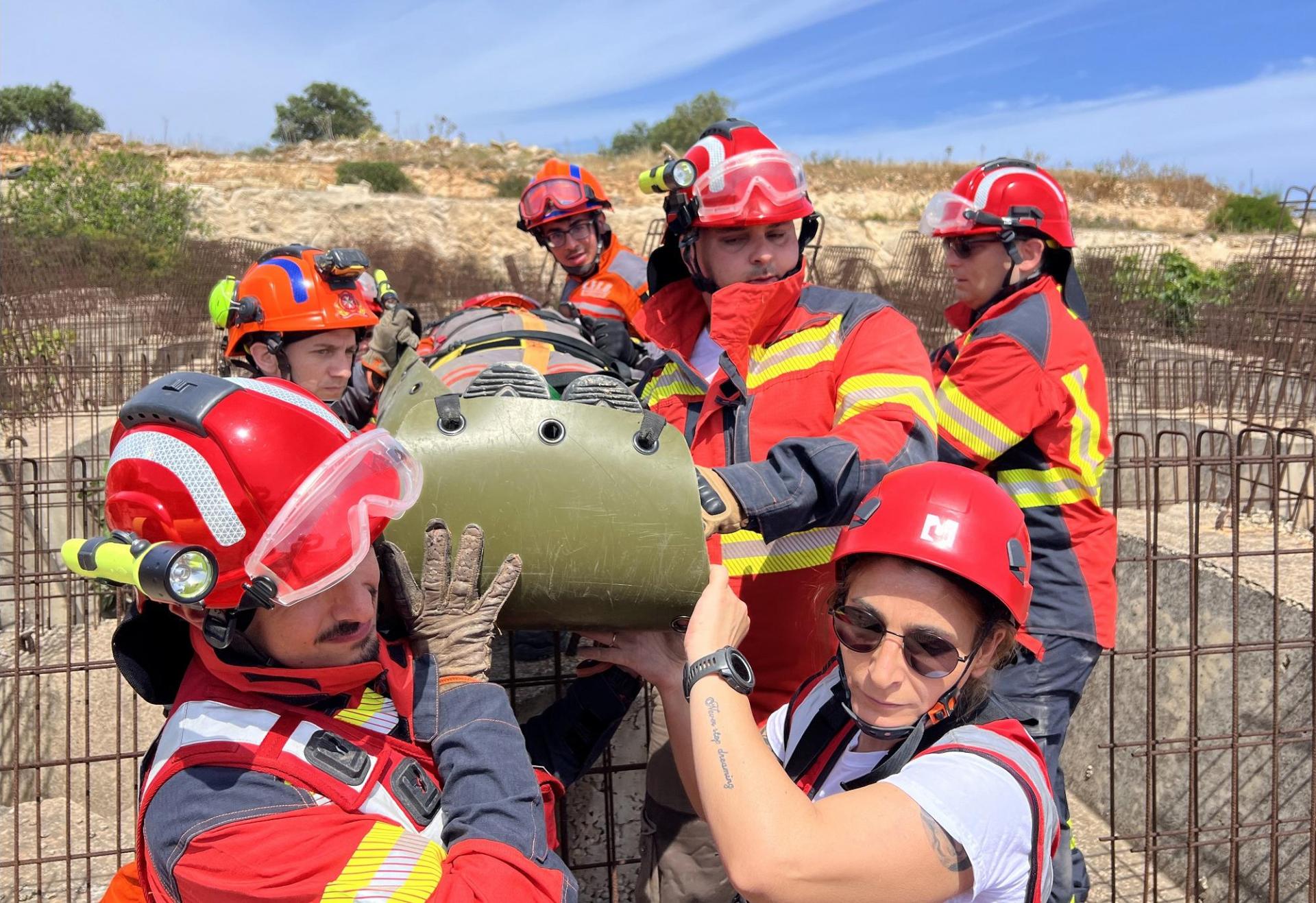 Once the team have been alerted to the location of the missing person, it is time to carry out a rescue.
Skipper is trained on scents from samples collected by, or donated to the unit, including hair, teeth and even a tissue sample from when a member of the unit underwent spinal surgery.
The samples are kept in an airtight container when not in use, then hidden around training areas in vented tins for Skipper to find, with a successful find resulting in a treat.
But being on the team is not just about work, says Littlejohn: “Skipper loves his work; he really enjoys it which is amazing to see”.
And the work of Skipper and the other dogs could prove vital in emergency situations, explains Josef Mizzi, a volunteer with the Emergency Fire and Rescue Unit: “Every second counts and sometimes extrications can take long, especially in collapsed buildings”.
“So, dogs with their sense of smell, which is much better than ours, makes it much faster to locate the casualty.”
Meanwhile, the team’s ability to respond quickly is not just confined to during rescue missions, stresses Briffa, noting that while government entities typically do not start looking for missing persons until 24 hours have passed, his team is not bound by the same restriction.
“We are easy to contact, and we are able to support anyone whose loved ones have gone missing.”
To find out more about the Order of Malta Canine Search and Rescue Unit, visit the team’s Facebook page.