Watch: We visited an offshore fish farm. Workers were trying to contain slime
'There's no doubt what the source of the sea slime is', says fisher and local
Updated 2.30pm with federation statement
Workers at a tuna farm off St Paul’s Bay were filmed this week using a net and bucket to try to contain sea slime before it drifted towards swimming areas along the coast.
Huge globs of oily slime were spotted from Mellieħa to Sliema, a now annual occurrence, but the source appears clearer than ever.
The fish farm industry has long been vague about the origin, saying previous tests proved inconclusive. But Times of Malta footage taken during a boat trip this week shows farm workers attempting to stop the slime at source.
Martin Bugelli, a fisher and former head of the European Commission representation in Malta, who joined the trip, was unequivocal.
“There’s no doubt what the source of the sea slime is,” he said. “People telling us it’s coming from boats. People telling us it’s coming from drainage. It’s neither of these things. It’s fishy oily fat,” Bugelli said.
Bugelli previously served as Malta’s technical attaché for agriculture at the EU, attending EU Agriculture and Fisheries Councils and World Trade Organisation meetings.
He believes the slime may stem from poor feeding practices. Tuna feed, he explained, must be thawed and drained of excess oil before use.
“Once it goes in the water, this oil comes off, goes to the surface, in conglomerates, it accumulates in patches and goes wherever the wind takes it.”
The fish farming industry insists it complies with all rules.
In the past week, sea slime was spotted in Mellieħa, St Paul’s Bay, Buġibba and Sliema. People were seen attempting to clean it up. The Environment and Resources Authority (ERA) said it investigated and instructed tuna farms to launch clean-up operations.
“This isn’t a one-off, it’s a recurring issue. I remember it for as long as I’ve lived here, which is 15 years. It was worse, much worse, but [Wednesday] was as bad as ever,” Bugelli said.
Azzopardi Fisheries: We're doing our best to clean it
The farm filmed belongs to Azzopardi Fisheries.
“Right now, my only job is to make sure we clean up. We’re doing the best we can to clean up the sea slime,” owner Charles Azzopardi said. He said the company has sent three vessels to clear the slime.
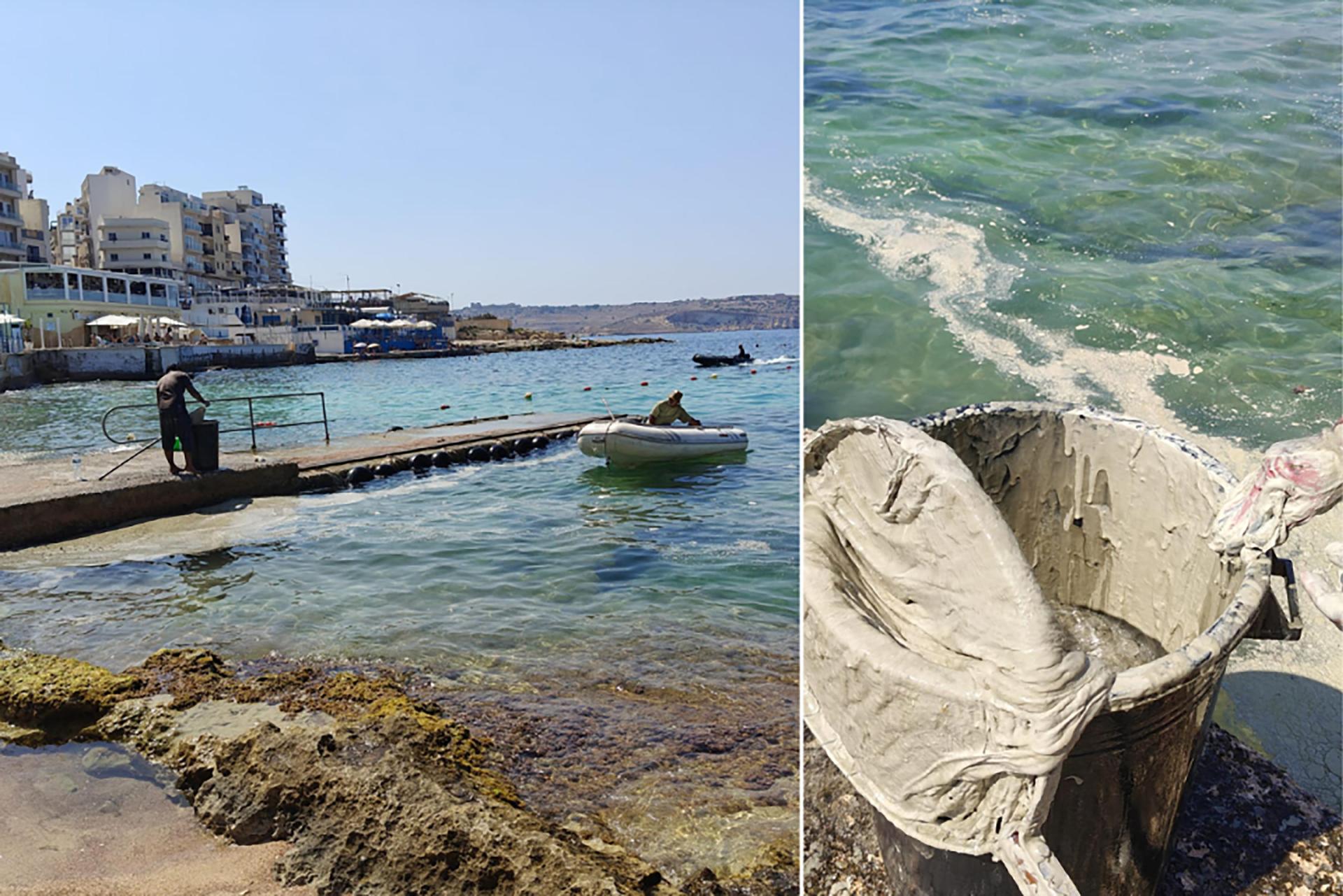 A crew cleaning up sea slime in Buġibba. Photos: Marc Galdes
When asked what is causing it, he said: “I don’t know. It’s never been like this”.
As the boat approached the farm, the surrounding sea looked oily. With the wind blowing towards land, Bugelli predicted the slime would hit Buġibba’s shoreline within the hour. Shortly after, it did. Beachgoers were seen swimming among patches of slime and more workers were seen trying to clear it. A strong fishy smell hung in the air.
“In a way, the fish farm operators are being responsible because they have that cleaning boat out there and they’re trying to collect [the sea slime] before it approaches the shore,” Bugelli said. However, he added, more effective measures are needed to prevent it from escaping the pens in the first place.
He said farms should be equipped with proper containment booms to trap oil slicks. Booms were in place in the Azzopardi farm, but Bugelli called for more effective structures.
“The solution is not to shut down the tuna farms. That is a drastic panic reaction. What needs to be done is that all the authorities concerned should get together with all operators to find the best practices to prevent this from happening,” he said.
Charlon Gouder, CEO of Maltese Aquaculture Producers Federation, said it is actively working to ensure the slime is cleaned up.
When asked whether the slime is coming from a fish farm, he replied: “Sea slime is a composition of so many different things.”
He added that while crews were out cleaning, they also collected a lot of plastic, wood and other types of litter.
Gouder said Bugelli is “completely wrong” to claim the slime may be a result of poor feeding practices, insisting everything is done according to the permits.
Earlier in the week, Gouder said tests on similar patches suggested they were “not necessarily fish slime” and that results of tests carried out will be published “towards the end of the summer”.
Federation takes responsibility for slime
Later on Saturday, the Federation of Maltese Aquaculture Producers released a statement taking responsibility for the sea slime and apologising for causing inconvenience.
“The Federation humbly apologises for those occurrences of nuisance at sea which results from aquaculture and is making all efforts to clean up any nuisance at sea,” it said.
The foundation added that during their clean-up, they have collected approximately six cubic metres of slime and eight cubic metres of various waste, such as polystyrene.
“During the past years, the industry has made significant efforts to minimize inconvenience, and despite the fact that these have reduced, it will continue to endeavour to eliminate this once and for all,” it added.