Watch: Woman rescued alive as Myanmar, Thailand quake death toll tops 1,600
'We need aid': rescuers in quake-hit Myanmar city plead for help
More than 1,600 deaths and 3,400 injured have been confirmed following Friday's shallow 7.7 magnitude earthquake in Thailand and Myanmar.
And, with the scale of the disaster only beginning to emerge, the toll is likely to rise significantly.
Exhausted, overwhelmed rescuers in Myanmar's second-biggest city pleaded for help Saturday as they struggled to free hundreds of people trapped in buildings destroyed by the devastating earthquake.
Friday's earthquake destroyed dozens of buildings in Mandalay, the country's cultural capital and home to more than 1.7 million people.
In one street, a monastery's clock tower lay collapsed on its side, its hands pointing to 12:55 pm -- just minutes after the time the quake struck.
Among the worst-hit buildings in the city is the Sky Villa Condominium development, where more than 90 people are feared to be trapped.
The building's 12 storeys were reduced to six by the quake, the cracked pastel green walls of the upper floors perched on the crushed remains of the lower levels.
A woman's body stuck out of the wreckage, her arm and hair hanging down.
Rescuers clambered over the ruins painstakingly removing pieces of rubble and wreckage by hand as they sought to open up passageways to those trapped inside.
Scattered around were the remains of people's lives -- a child's plastic bunny toy, pieces of furniture and a picture of the New York skyline.
After hours of painstaking work came a rare moment of joy as rescuers pulled Phyu Lay Khaing out of the remains of the Sky Villa Condominium, still alive after 30 hours under the rubble.
She was carried out on a stretcher to be embraced by her husband Ye Aung and taken to hospital.
"In the beginning I didn't think she would be alive," Ye Aung told AFP as he anxiously waited for his wife, then still buried in the rubble, to emerge.
"I am very happy that I heard good news," said the trader, who has two sons with his wife, eight-year-old William, and Ethan, five.
'More help is needed'
Some residents sheltered under the shade of nearby trees, where they had spent the night, a few possessions they had managed to salvage, such as blankets and motorbike helmets alongside them.
Elsewhere, rescuers in flip-flops and minimal protective equipment picked by hand over the remains of buildings, shouting into the rubble in the hope of hearing the answering cry of a survivor.
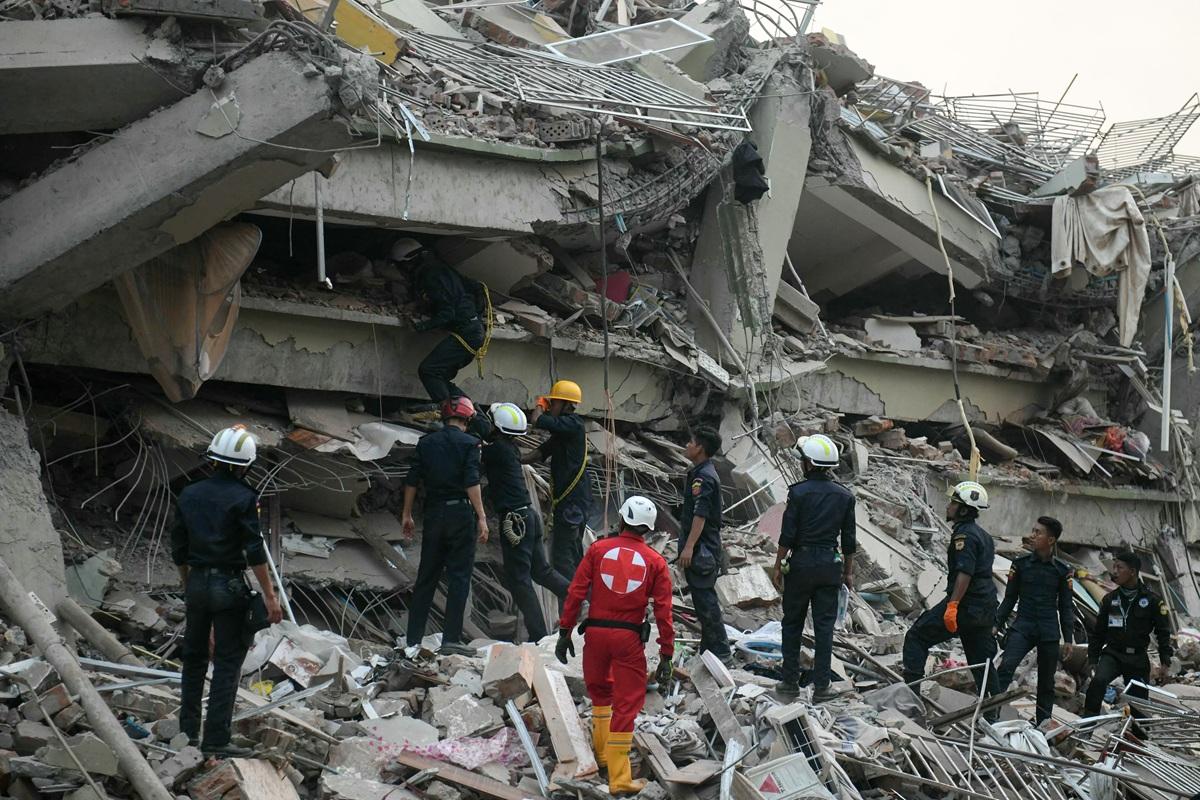 Rescuers search for survivors trapped in the collapsed Sky Villa Condominium in Mandalay. Photo: AFP
"There are many victims in condo apartments. More than 100 were pulled out last night," one rescue worker who requested anonymity told AFP.
As darkness fell on Saturday, AFP journalists saw dozens of people preparing to bed down in the streets for a second night.
Widespread power cuts have hampered rescue efforts, with emergency personnel relying on portable generators for power.
After more than 24 hours of desperate searching, many are exhausted and desperate for relief.
"We have been here since last night. We haven't got any sleep. More help is needed here," the rescue worker told AFP.
"We have enough manpower but we don't have enough cars. We are transporting dead bodies using light trucks. About 10-20 bodies in one light truck."
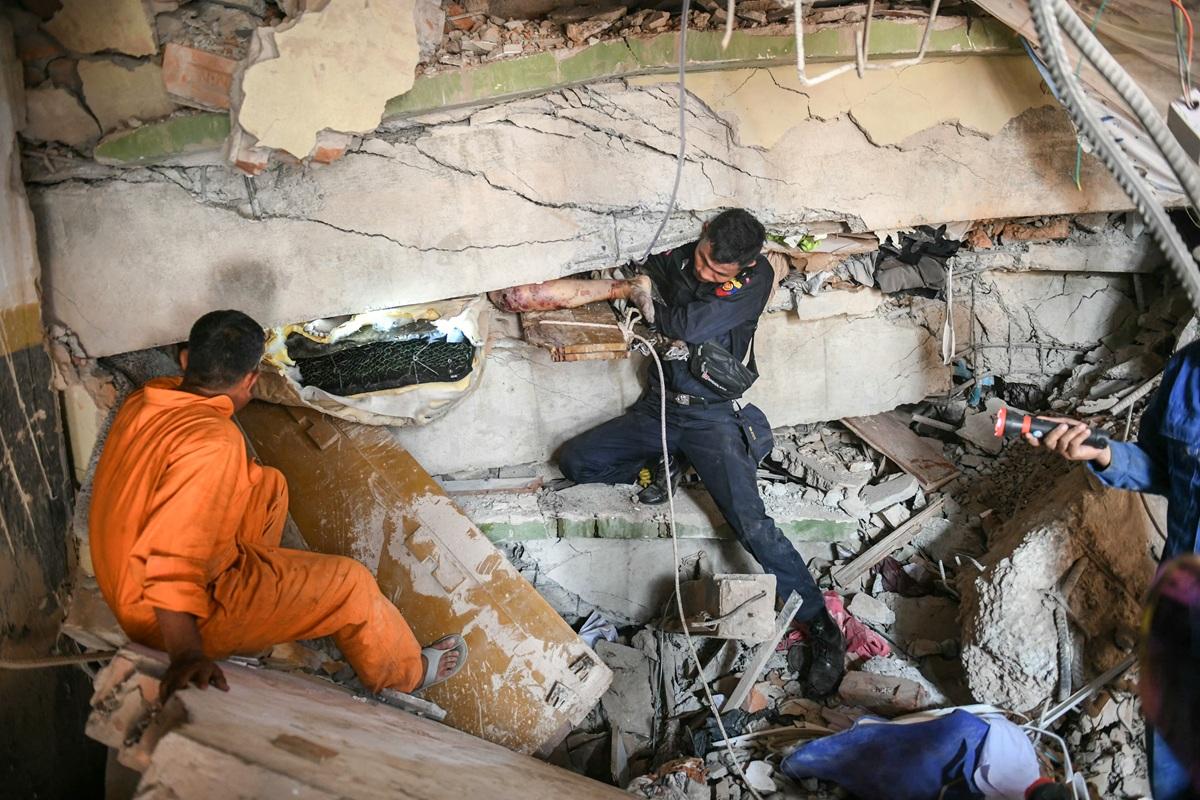 Rescue workers attempt to free a resident trapped under the rubble of the destroyed Sky Villa Condominium in Mandalay. Photo: AFP
Myanmar is accustomed to regular earthquakes, bisected north to south by the active Sagaing Fault, but the violent fury of Friday's quake was exceptional.
"Yesterday, when the earthquake happened, I was in my home. It was quite scary," Mandalay resident Ba Chit, 55, told AFP.
"My family members are safe, but other people were affected. I feel so sorry for them. I feel very sad to see this kind of situation."
Myanmar's ability to cope with the aftermath of the quake will be hampered by the effects of four years of civil war, which have ravaged the country's healthcare and emergency systems.
In an indication of the potential enormity of the crisis, the junta has issued an exceptionally rare call for international aid.
Previous military rulers have spurned all foreign assistance even after major natural disasters.
"We need aid. We don't have enough of anything," resident Thar Aye, 68, told AFP.
"I feel so sad to see this tragic situation. I've never experienced anything like this before."
Shortage of medical supplies
A severe lack of medical supplies is hampering efforts to respond to earthquake, the United Nations said Saturday, adding that those affected needed urgent humanitarian aid.
The UN said it was mobilising emergency response efforts, alongside humanitarian partner organisation.
"As the full scale of the disaster unfolds, urgent humanitarian assistance is needed to support those affected," the UN humanitarian agency OCHA said in a statement.
It said the response was being hindered by a lack of medical supplies, along with damaged roads and communications infrastructure.
"A severe shortage of medical supplies is hampering response efforts, including trauma kits, blood bags, anaesthetics, assistive devices, essential medicines, and tents for health workers," OCHA said.
The agency said hospitals and health facilities had sustained extensive damage or had been destroyed.
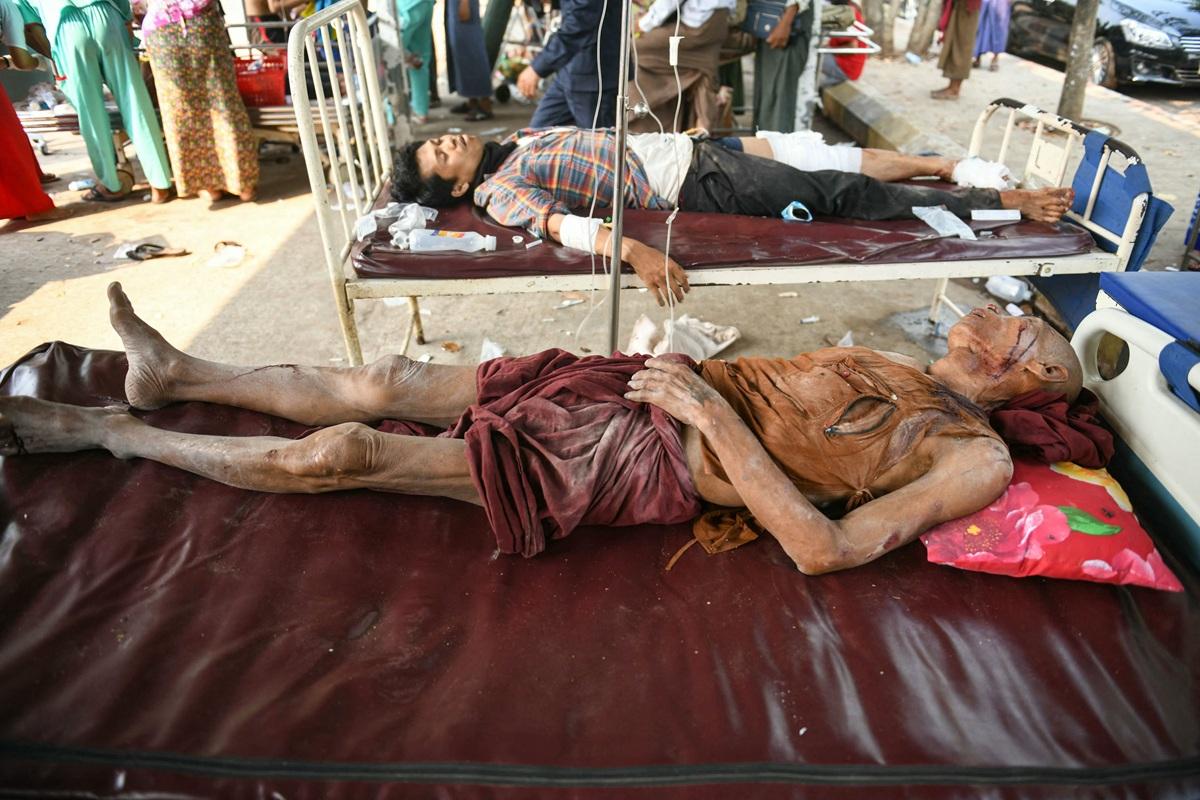 Earthquake survivors lie on a bed in the compound of a hospital in central Myanmar. Photo: AFP
"Telecommunications and internet disruptions continue to hinder humanitarian communications and operations. Damaged roads and debris are obstructing humanitarian access and complicating needs assessments," it added.
OCHA said coordination efforts were under way to conduct rapid needs assessments and scale up the emergency response.
"The earthquake caused widespread destruction of homes and severe damage to critical infrastructure," it said.
"Thousands of people are spending the nights on the streets or open spaces due to the damage and destruction to homes, or fearing further quakes."
In central and northwestern Myanmar, hospitals in Mandalay, Magway and the capital Naypyidaw "are struggling to cope with the influx of people injured".
In the southern part of Shan state, multiple townships have been affected, with clothing, blankets, emergency shelters and food assistance needed immediately, OCHA said.
The agency said a convoy of 17 cargo trucks from neighbouring China carrying shelters and medical supplies was expected to arrive on Sunday.