When a training flight ended in tragedy over Rabat in 1946
The tragic accident killed 16 Rabat residents and the four aircrew members
On April 5, 1946, just before 11am, a Supermarine Spitfire of 73 Squadron, piloted by flying officer John William Gilchrist, took off from Ta’ Qali Airfield. Gilchrist’s mission was to rendezvous with a Naval Vickers Wellington of 765 Squadron and then carry out simulated attacks on the bomber, to give its crew some experience of being under attack.
The Spitfire pilot contacted the bomber crew via radio and received a reply that they were at the meeting point over Ħal Far Airfield. In fact, the Wellington, flown by sub-lieutenant Bernard Arthur Page, aged 23, observer Robert Owen-Davies, 25, air mechanic John Morgan, 20, and leading air fitter Reginald Hathorn, 23, soon came into sight, flying at 5,000 feet (1,524 metres), with Gilchrist’s fighter 2,000 feet (610 metres) higher.
The training exercise started, with the Spitfire diving towards the Wellington and carrying out two dummy attacks, one from the starboard side and another from the port side, while the bomber took evasive action.
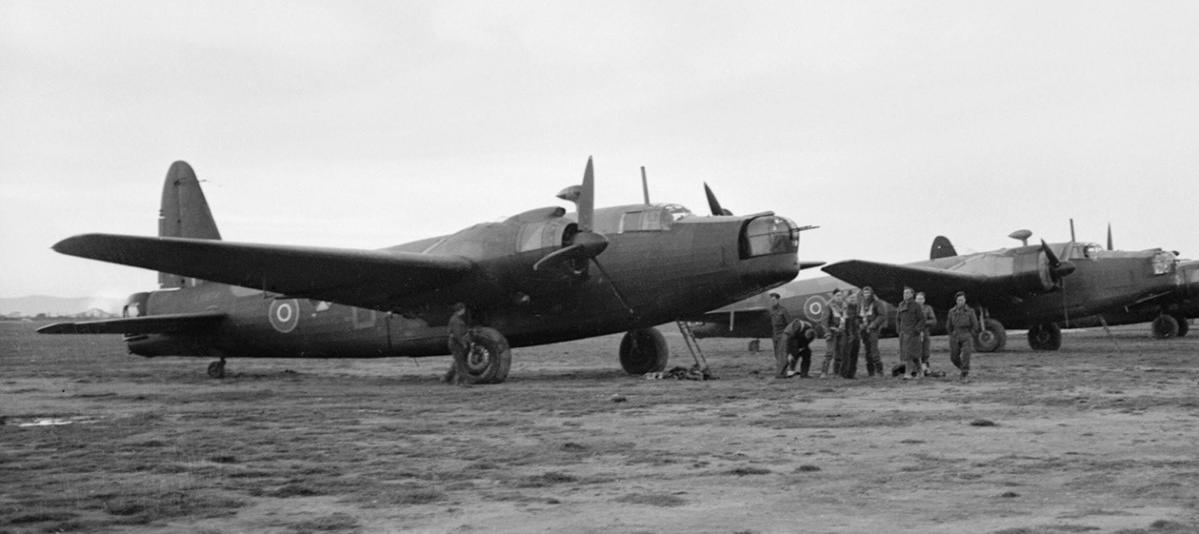 A Wellington Mark X bomber, similar to the one involved in the crash. Photo: Wikipedia
Gilchrist described what happened next:
“I then broke away and began to come up directly astern of the Wellington; he then turned to port, slightly losing height. This position was approximately four miles [6.5 kilometres] northwest of Rabat. After completing approximately 180 degrees, the Wellington straightened up, still losing height, then at approximately 3,500 feet [1,066 metres] in an approximately 20 degrees dive. The Wellington continued in this dive until it crashed in Rabat… I followed the Wellington down to approximately 1,000 feet [305 metres] when I broke away realising that it was going too low. I saw it explode on contact with the buildings. At no time after the first [radio] message, I contacted by R.T. [radio transmitter] the Wellington. No distress signal was ever received by me. I positively state that no ammunition was carried for this exercise.”
On the ground, it was chaos. Carmela Dimech recalled that she was in her mother’s house doing household chores when she heard the tremendous sound of an approaching aircraft. She rushed to the balcony, which overlooked St Mary Street, to see what was happening, only to be engulfed in a ball of flames, which badly burnt her right arm. To escape the fire, she jumped from the balcony to the street below, injuring her legs in the process.
Those who survived the collapse of their residence were killed by the raging inferno
Salvina Xerri was visiting her mother, who lived in St Publius Street, when there was a tremendous explosion and blocks of stone started raining around her. Then, flames enveloped the room she was in, and, since she could not reach the exit of the damaged building, she climbed to the first floor via the damaged staircase. Like Dimech, she had no choice but to leap to the street below from the balcony.
Dimech and Xerri, together with their mothers, were lucky; although injured, they survived to tell the tale. The four aircrew members of the Wellington died on impact, while 14 Rabat residents were found dead inside their demolished houses; one of the victims, Loreta Maranci, was eight months pregnant. Two others later succumbed to their injuries in hospital.
Those killed were Ġużeppi Bugeja, aged 61, and his wife Giovanna, 59; Marija Bugeja, 27; Loreta Maranci, 34, together with her children Vincenza, 2, and Ġużeppi, 11 months; police constable Pietru Mifsud, 29, and his wife Marija, 25; Filippa Said, 75; Giovanni Ciantar, 59, his daughter Felicita Vella, 35, and her sons Karmenu, 14, and Vincent, 1; Sunta Galea, 27, and her daughters Marija, 3, and Maddalena, aged just three months.
Most of the victims were housewives, who were preparing for the midday meal, and their children; at the time, few women were in paid employment. Karmenu Vella was celebrating his birthday that day and had taken the day off school.
It was noted that the Wellington had approached Rabat from the direction of Mtarfa, sheared off the flagpole of the house number 17 and 18, Count Roger Street, struck the balustrades of the building facing it, then crashed into a high house situated in St Mary Street and blew up.
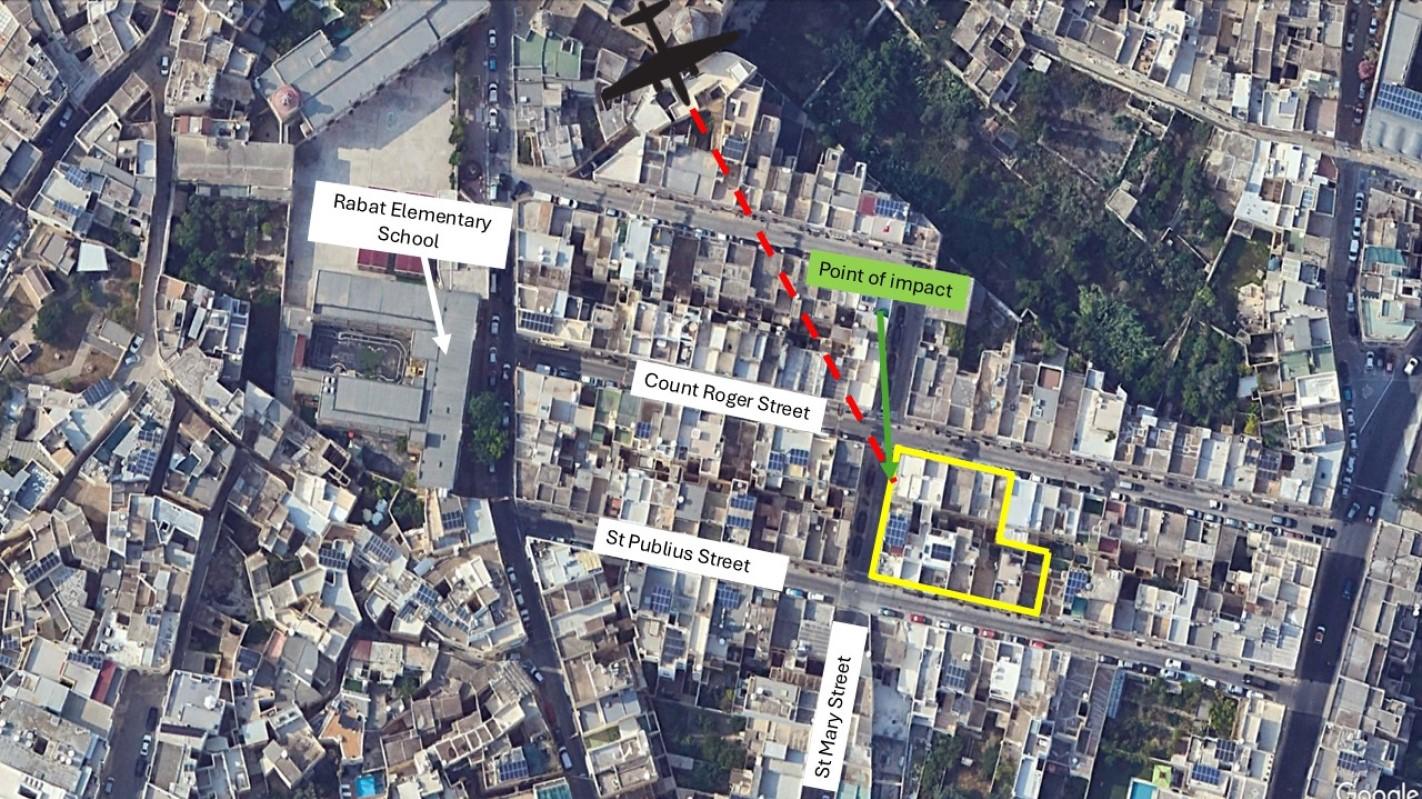 Map showing the route taken by the aircraft and the point of impact with the buildings. Map: Google Earth
The remains of the aircraft continued in a straight line, leaving a path of destruction in its wake. Houses number 10, 11, 12, 13, 14, 15, and 16 in Count Roger Street, 26, 27 and 28 in St Mary Street, and 10, 11, 12, 13, 14, 15, 16, 17, 18, 48, 49, 50, 51, 52 and 53 in St Publius Street were either demolished or damaged. The estimated cost of the damage reached nearly £11,000. Seventy-two people were rendered homeless; some of them lost all their possessions.
Rescue parties from the Royal Marines, the police and the Demolition and Clearance Unit rushed to the scene to try and rescue those beneath the debris of their houses. Fire engines from the Dockyard were also summoned to help the police tackle the blazes caused by the Wellington’s fuel.
Members of the Demolition and Clearance unit had vast experience in this work during World War II, but as the firefighters were hampered by a lack of water, it was only several hours later, when the fires were brought under control, that a thorough search of the rubble could be carried out.
It was discovered that those who had survived the collapse of their residence were killed by the raging inferno. During the rescue operations, a police constable and a worker from the Demolition and Clearance Unit were injured by falling masonry, and both had to be hospitalised. The police also had their work cut out trying to control the relatives of the victims and the crowds of curious onlookers who gathered in Rabat.
It was never determined exactly what the cause of the crash was. Soon after the accident, rumours circulated that smoke and flames were seen coming out from the doomed bomber, but neither pilot officer Gilchrist, who saw the accident unfold before his eyes, nor other eyewitnesses corroborated this.
Magistrate Albert Camilleri could only conclude that since the Wellington crew never sent a Mayday, nor tried to pull the aircraft out of its dive, they could have been rendered unconscious by a leak of hydraulic fluid fumes.
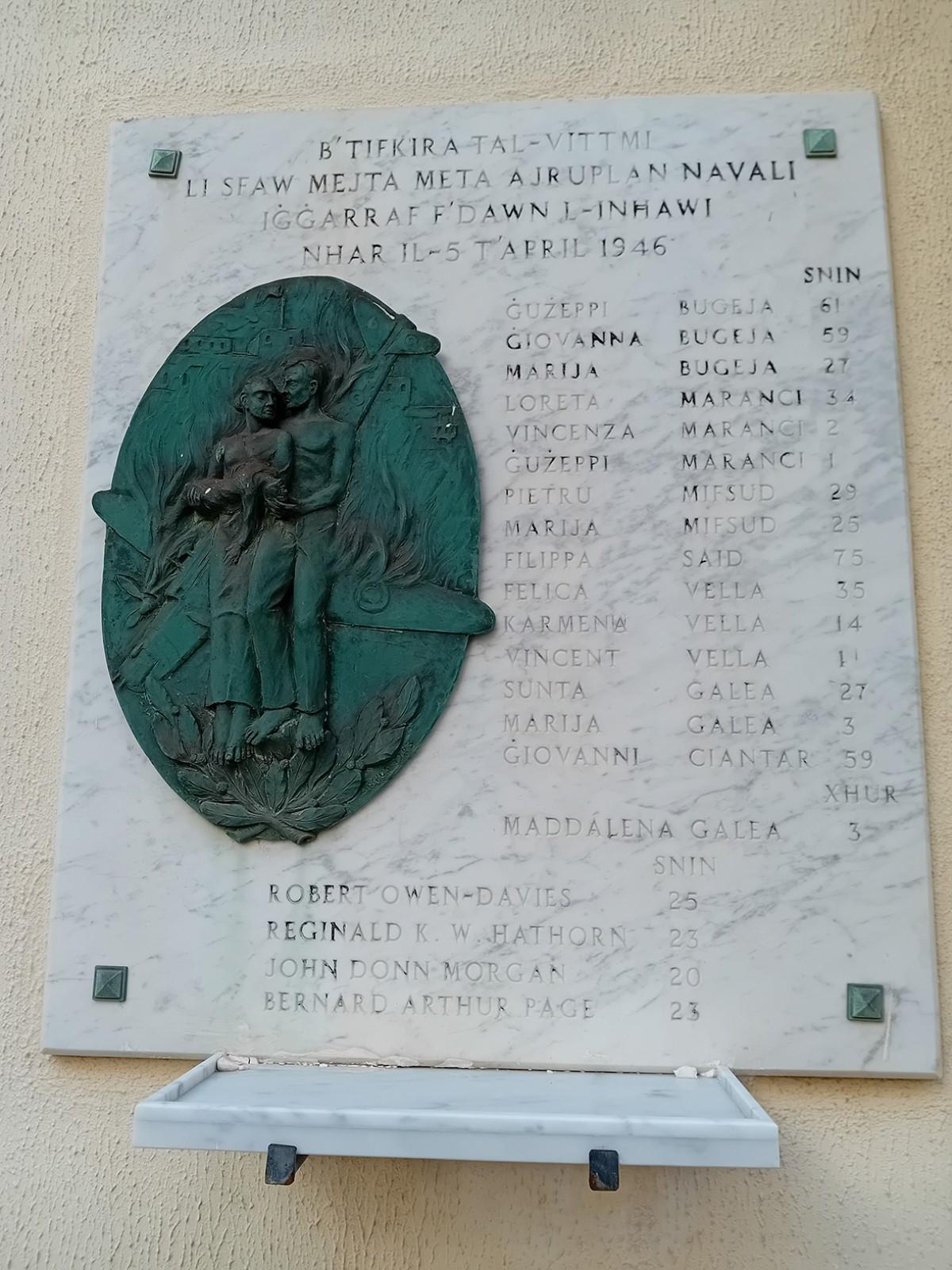 The marble plaque in St Publius Street commemorating the victims of the tragedy. Photo: Author’s collection
Further information can be found in Broken Wings by Colonel Mark Said and in Eddie Attard’s article ‘The Air Crash Disaster in Rabat, 70 Years Ago’ (The Sunday Times of Malta, April 3, 2016).
Acknowledgements
The author thanks David Bartolo, Bernard Schembri, Joseph Scerri, Ruben Vella and the staff at the National Archives, Rabat, without whose assistance this article would not have been possible.