What is the gidmejmun?
Malta’s legends and lore include the shadowy figure of the gidmejmun, a demon cat said to find its origins in the feline gods of ancient Egypt. Joe Felice Pace traces the history of the myth and its appearances across the ages. The gidmejmun finds its...
Malta’s legends and lore include the shadowy figure of the gidmejmun, a demon cat said to find its origins in the feline gods of ancient Egypt. Joe Felice Pace traces the history of the myth and its appearances across the ages.
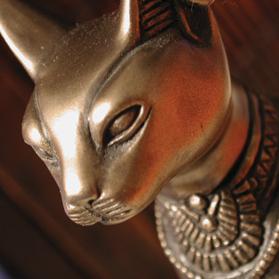 The gidmejmun finds its origins in the Egyptian cat gods.
The word gidmejmun is certainly well-known to Maltese and Gozitans. It is recorded by Ġan Piet Franġisk Agius de Soldanis (1712-1770) on the verso of folio 230 of his Damma tal Kliem Kartiġinis mxerred fel fom tal Maltin u Ghawcin (1750), a dictionary in manuscript form preserved at the National Library of Malta in Valletta.
It is reproduced as kitmejmum by Mikiel Anton Vassalli in his Ktyb yl Klym Mâlti ’mfisser byl-Latin u byt-Talyân printed at Rome in 1796.
Surely, calling somebody gidmejmun will not elicit a positive reaction. In fact, Aquilina’s dictionary (Vol. I, 1987) describes the word as follows: “monkey, gen. used in the expression wiċċ ta’ gidmejmun, ugly person” and, in the etymological explanation gives the probability that it is derived from the Italian gatto mammone. The latter is a terrifying cat demon, a traditional magical creature having the characteristics of a enormous cat which, in the Middle Ages, was popularly associated with the devil.
In fact, its nickname, Mammon is attributed to the devil in the Aramaic language and tradition, when such a cat was depicted as terrifying herds while in the open and was also attributed demoniac movements and expressions.
However, in a number of other versions it has a protective function as a spirit of good, positive trends, immune to the inauspicious effects of the spells of other spirits. In some cases it is depicted with the letter ‘m’ in white on a black nose. On other occasions it is all black, and hides in dark angles.
According to a number of studies, the gatto mammone tradition goes back to Ancient Egypt when cats were considered sacred animals and were symbols of fertility.
With the advent of Christianity these ancient rites were first demonised and then performed only at carnival time, preceding Lent; their symbols were a dummy made of rags and cats’ skin, and a head made from cats’ flesh, a personification of carnival. But there also exists a personification of Shrove Tuesday, in Italian Martedì Grasso) conceived as an acrimonious cat which assumes gigantic proportions to punish those who try to perform any work on that day.
At Igeslias, in Sardegna, there is a fountain over which stands a figure of grotesque aspect called Maimoni, whose brusqueness is proverbial in those areas. At the same time, there still exists on the island the association between the term Maimone and numerous toponyms relative to fountains and/or water sources, a connection possibly deriving from the ancient Phoenician word mem, which actually means water, and to a divinity connected to it.
Gatto mammone appears frequently in Italian fables
In 1968, a certain Serafina dal Pont wrote in the papers at Cesiomaggiore (pro-vince of Belluno) of gatto mammone, a monstrous feline which frightened a herd of feeding cows.
She is said to have been saved due to the miraculous intervention of Saint Rita who appeared in the form of an enormous rat which distracted the monster which began to follow it in the countryside and then disappeared. The occasion was depicted by Dino Buzzati (1906-1972), but naturalists contend that it was just a hallucination and pure fantasy.
 Dino Buzzati’s Il Gatto Mammone.
Gatto mammone appears frequently in Italian fables, as in the Pentamerone of Giambattista Basile (1566-1632), a Neapolitan poet, courtier, and fairy tale collector, or the Novellaja Fiorentina of Vittorio Imbriani (1840-1886) and is mentioned to frighten children; in this it resembles the Italian babau and Maltese babaw.
It also occurs frequently in Italian literature from its very origins, for example in Lo specchio della vera penitenza by Iacopo Passavanti (1302 c.-1357) (animale a modo d’un satiro, o d’un gatto mammone), in Bisbio a magnificentia di messer Cane de la Scala by Immanuel Romano (1261-1328) (Qui sono leoni, e gatti mammoni), and in the Milione by Marco Polo (1254-1324), at times also meaning leopard.
A gatto mammone, who accompanies knights of King Arthur and narrates in the first person his adventures, is also the protagonist of the anonymous Detto del Gatto Lupesco.
The female equivalent and its family occur also in Goethe’s Faust, a tale about a scholar who sells his soul to the devil. In German literature we have a description of the family of a gatta mammona which lives in a smithery of magic filters, where it is commissioned by the fallen angel Mefistofole to prepare an alchemic potion that can bring the protagonist back to his youth.
The cat demon at times reappears also in modern narrative as a fantastic animal, for example in Dino Buzzati’s La famosa invasione degli orsi in Sicilia. Buzzati, born at Belluno in 1906, was a well-known Italian journalist who began his career with the Milan daily Corriere della Sera in 1928. He was also a dramatist, short-story writer and novelist. He died in Rome in 1972.
Some characteristics of the gatto mammone are found in the Cheshire Cat in Alice in Wonderland, called Stregatto in Disney’s Italian cartoon version.
Although there is an amount of uncertainty, even Tevildo, lord of the gatti mannari in the Book of Lost Talesby J.R.R. Tolkien (1892-1973) may be derived from this character.
The gatto mannaro is the term used by the pop culture of the 1970s to indicate an imagin-ary feline creature; its English version was the werecat (or were-wolf), a shapeshifter similar to werewolves, except that they turn into some species of feline instead of a wolf.
Il Gatto Mammone featured also as a film which was directed by Nando Cicero in 1975 and had among its protagonists such well-known Italian names as Rossana Podestà, Gloria Guida, Lando Buzzanca and Umberto Spadaro.