Beyond compliance: Towards elevating workplace well-being in Malta
Watch: Event hosted by Times of Malta in collaboration with OHSA
Malta has placed occupational health and safety among its national priorities over the past two years. As agreed during a recent business breakfast jointly organised by the OHSA and the Times of Malta, the country now faces a more complex challenge. This relates to moving beyond compliance towards a culture where workplace well-being is embedded in everyday practices.
During the opening speech, the Minister for Justice and Reform of the Construction Sector Hon. Jonathan Attard emphasised the importance of collaboration, and the role stakeholder perspectives play in the decision-making process.
Following the opening speech, CEO of OHSA, Dr Josianne Cutajar delivered a presentation outlining the key developments over the past year. Inspections reached unprecedented levels of 23,000 in 2025, resulting in more enforcement actions by the Authority, compliance improvements in several sectors and also a drop in the non-fatality accident rate in the country. This is the lowest recorded in the past five years. She also highlighted areas requiring increased attention such as health surveillance, near misses, incident reporting, and more accessible training and awareness.
The event, which was attended by 180 participants, brought together representatives of employers, workers and occupational health and safety professionals, reflecting the shared responsibility required to strengthen workplace well-being.
Their collective message was clear, regulations alone cannot guarantee safer workplaces. Meaningful progress depends on awareness, skills, leadership, collaboration and culture.
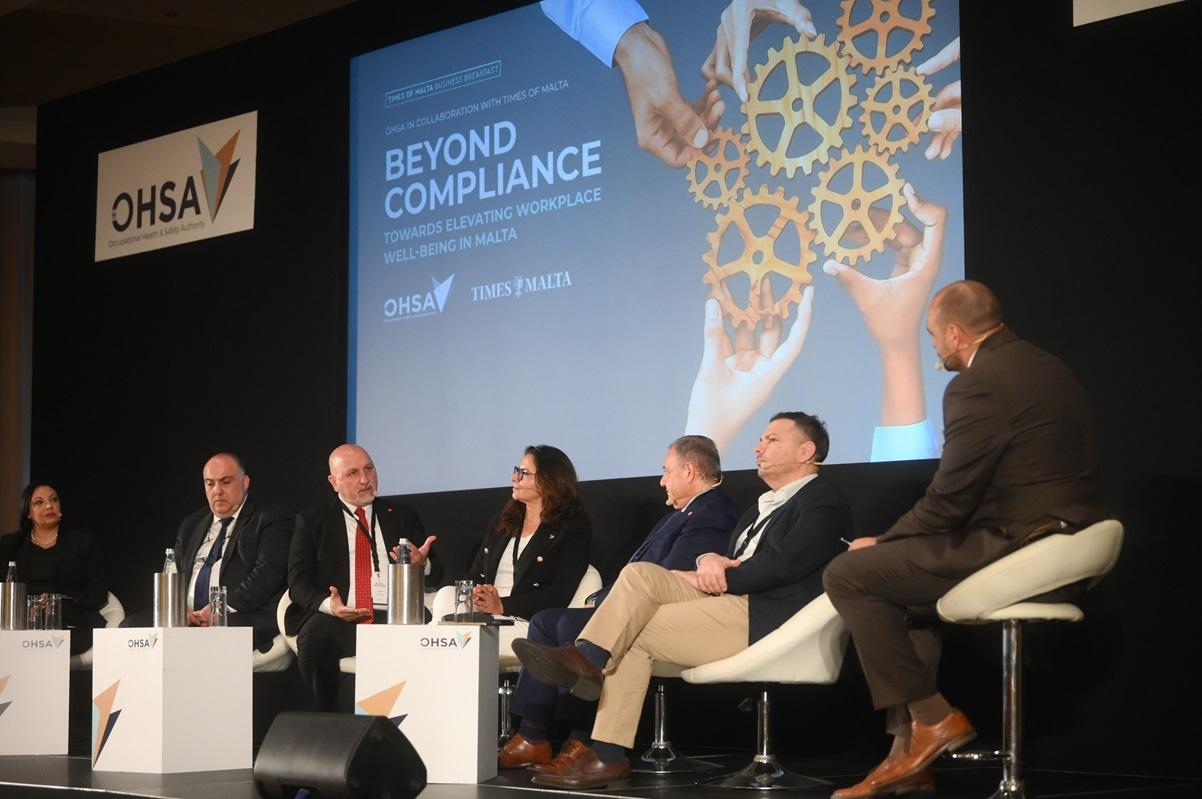 Panel discussion.
From compliance gaps to greater awareness
Panellists reflected on the transformation that has taken place since Malta first established its national occupational health and safety authority.
George Steve Darmanin, President of MOSHPA, stated that while the improvements in occupational health and safety over the past two years are acknowledged and commendable, they must be seen as a foundation rather than a finish line. He stressed that meaningful progress now depends on strengthening competence at all levels through structured, sector-specific training and genuine specialisation, moving beyond tick-box approaches towards professional development that translates knowledge into safer behaviours and, ultimately, a stronger safety culture.
 ‘Beyond Compliance: Towards Elevating Workplace Well-Being in Malta’.
Ivan Refalo, President of the Malta Employers Association, underlined the value of dialogue between social partners, stating that education remains a key pillar to change existing mentalities, which is why it is important to instil health and safety awareness from a young age. This allows us to improve as human beings and as a nation.
Balancing standards with practical realities for small businesses
The panel acknowledged that while occupational health and safety requirements are essential, compliance can be particularly demanding for micro and small enterprises. Limited administrative capacity and resources can make it more difficult for smaller firms to keep pace with regulations.
Panellists emphasised that risk is determined primarily by the nature of the work rather than the size of the organisation.
Dr Marthese Portelli, CEO of The Malta Chamber, emphasised the shared responsibility between employers and employees, stating, “Health and safety arrangements should be determined by the type of work being carried out and the level of risk involved, rather than by the size of the company or the number of employees. It is important to acknowledge that to ensure health and safety succeeds, contributions are required from both employers and employees. Although employers have their responsibilities such as providing training, material and equipment, the employee has the responsibility to utilise the resources provided. Organisations that promote health and safety will also benefit from staff retention.”
 From left: Minister Jonathan Attard, OHSA chairperson Pierre Fava and OHSA CEO Dr Josianne Cutajar.
Enforcement driving measurable improvements
Recent investments in inspections and enforcement were widely recognised as a positive development. Participants emphasised the importance of maintaining and strengthening these efforts, while also expanding attention to sectors where inspections have been less frequent.
Kevin Camilleri, Deputy Secretary General of the General Workers Union, highlighted that Malta’s demographic and economic shifts have made it increasingly difficult to meet labour demand solely from the local workforce. The introduction of a national skills card system would help ensure workers possess the competencies required for their roles. Such certification would not only validate technical skills but also provide an opportunity to integrate occupational health and safety training from the outset.
Josef Vella, CEO of UHM – Voice of the Workers, reinforced this commitment, noting, “As a social partner we shall continue to strive, work and collaborate with the Authority to ensure that this theme remains of vital importance, as our objective is to ensure that all workers return home safely. The Union is always at the forefront to voice worker concerns, especially when it comes to health and safety.” Mr Vella referred to high risk sectors where the presence of unions can strongly contribute towards compliance.
Collective responsibility towards further improvements
Greta Rapinett, Council Member of the Malta Chamber of SMEs, emphasised the importance of shared responsibility and continuous education, stating that, “everyone is responsible for the health and safety of workers. Supporting and helping each other remains a priority for everyone. I look forward to further discussions in this regard.”
In his concluding remarks, the Chairperson of the OHSA, Mr Pierre Fava stated that he was satisfied with the outcome of this very engaging discussion between the different representatives and social partners. The OHSA Board firmly believes in its legal responsibility to create such opportunities for collaboration. Whilst thanking all contributors and participants for the outcome of this successful event, the Chairperson emphasised that it is through the input of the various stakeholders that we can improve occupational health and safety’s standing in the national agenda.
The overarching conclusion of the business breakfast was that Malta has made meaningful progress, but the next phase requires a broader mindset. Compliance remains essential, but it should be seen as a starting point rather than the final objective.
 OHSA
OHSA