World tour, adverts and billboards... but PBS keeps Eurovision bill under wraps
Malta tight-lipped on Eurovision campaign costs despite lavish promotion efforts
Malta’s Eurovision campaign had all the trappings of a big-budget push: a 12-country promo tour, foreign billboards, full-page British newspaper adverts and paid online coverage.
What it does not have, so far, is a price tag.
The public broadcaster and the culture ministry have remained tight-lipped about how much taxpayers’ money was spent to promote Malta’s participation in the Eurovision Song Contest with Aidan’s entry, Bella.
When asked for the total cost, Culture Minister Owen Bonnici did not give a figure. Instead, he thanked Aidan and the PBS team for their work and said the government’s obligation is “to support the Maltese entry”.
“We did all that was needed to support Maltese talent,” he said.
In the weeks leading up to last Saturday’s grand final in Austria, Aidan and his team embarked on a promotional tour across 12 countries to boost support for Malta’s song.
The marketing effort also included billboard campaigns in several European countries, with adverts spotted in Bulgaria, Cyprus, Romania and Milan, Italy. Football fans also reported seeing a call to vote for Malta displayed on a billboard at the Trafford Road Arch.
Advertising rates suggest billboard costs can range from a few hundred euros a month in countries such as Bulgaria and Romania to a few thousand euros in parts of Italy and the UK.
Aidan was also promoted through a full-page colour advert in London’s Metro newspaper and a sponsored article in the Daily Mail.
The total cost remains unclear, particularly because advertising rates may have been negotiated as part of package deals. However, the standard rate for a full-page colour advert in Metro exceeds £19,000 (€21,950).
When contacted about the cost of a sponsored article, a Daily Mail representative quoted about £30,000 (€34,600) for 100,000 guaranteed views. The representative also said the company provided Metro packages. Prices vary depending on the market, placement and promised reach.
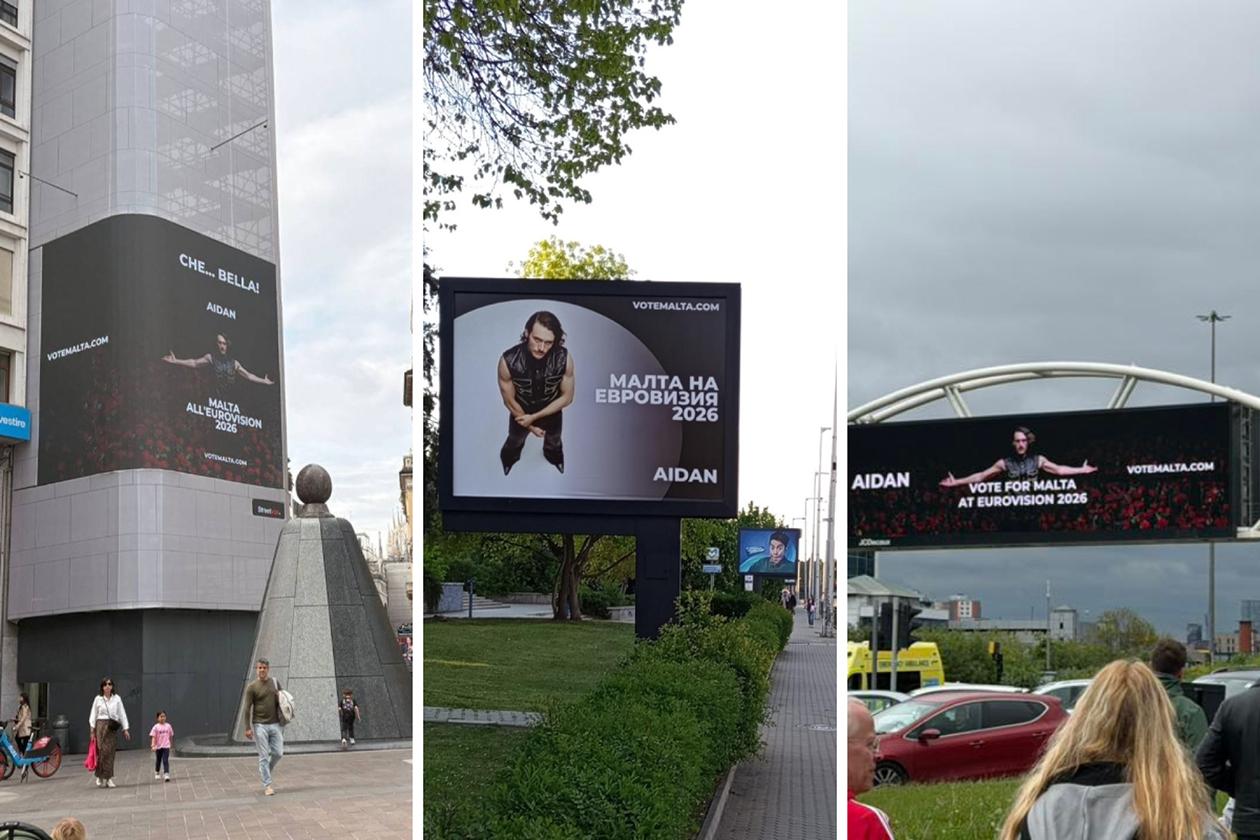 Billboards across Europe promoted Aidan, who received eight points in the public vote. Photo: Times of Malta
Despite the promotional push, Malta finished 18th out of 35 countries in this year’s contest, after getting a disappointing eight votes from the public.
Times of Malta asked how much the promotion of Malta's Eurovision entry had cost taxpayers. Questions were sent to Public Broadcasting Services (PBS), the national broadcaster responsible for Malta’s Eurovision participation. The same questions were also sent to the culture ministry, under which PBS falls.
They were asked for a breakdown of the marketing, promotional activities and other costs, as well as the total spend on Malta’s participation. No replies were received by the time of writing.
The lack of transparency around Eurovision-related spending has become increasingly common.
In January, Bonnici refused to disclose the costs of the Malta Eurovision Song Contest, describing the information as commercially sensitive. The request had been made through a parliamentary question by Nationalist MP Julie Zahra.
Last year, PBS similarly declined to reveal the costs of that year’s contest, again citing commercial sensitivity.
In 2021, Times of Malta reported that more than €650,000 had been spent to boost Destiny’s chances with bookmakers with her song Je Me Casse.
According to sources, €350,000 were spent by the Malta Tourism Authority, and a further €300,000 came from PBS.
At the time, the government ordered an audit after receiving reports that part of the allocated budget for the 10-day event had been used to place bets on the Maltese performer.
Efforts to obtain financial transparency date back further. In 2016, a Freedom of Information request by Times of Malta for a full breakdown of Eurovision-related spending by PBS and other government entities was rejected.
The request followed reports of a “limitless” budget aimed at boosting singer Ira Losco’s chances. Leaked documents at the time indicated expenses exceeding €200,000, though the final figure was believed to be significantly higher.
Earlier, in 2013, PBS stated that the contest had cost €200,000 but insisted it was a fully commercial activity, with no direct government funding.