All 12 gender mechanism seats needed, but it won’t be enough
If the only two women contesting the PN’s casual elections get elected, parliament will still need the full allocation of gender quota seats
More women have been elected into parliament in this general election, but with the limited number of women contesting the Nationalist Party’s casual election, parliament will need the maximum 12 seats allocated to women – and will still be five percentage points short of the 40% threshold.
This year’s general election saw a record number of women getting elected to parliament on day 1 of the count, and after Labour held its casual elections, the current number of elected women in parliament has gone up to 14.
The PN will be holding its own casual elections today, with seven seats up for grabs. More women will be hoping to get elected during this process.
However, there’s a catch: only two women have put their names forward for the PN’s casual elections. These are Marija Elena Gauci and Graziella Attard Previ, both contesting in the 10th district.
Gauci was eliminated on the 16th count with 229 votes, while Attard Previ made it to the 27th count with 1,570 votes. While two seats are up for grabs in the 10th district, Graham Bencini is a likely candidate for one of those seats, after he was left hanging with 2,971 votes.
Even under the optimistic assumption that both women get elected in their district, the total number of women in parliament before the corrective process will stand at 16 candidates, or 23.8%.
Little room for interpretation
The law, which amended the Constitution and the General Elections Act, leaves little room for interpretation.
To calculate the exact number of additional seats needed to bring representation to 40%, the law lays out a formula that states clearly how the percentage is calculated not on the original number of seats in parliament, but on the new amount of seats after the corrective mechanism is applied.
Assuming 16 women are elected to parliament in total after the PN’s casual election on Tuesday, the number of additional seats allocated to women that will be needed to reach 40% representation will be 18.
However, since the law establishes a cap on the number of seats that can be doled out, parliament will only get another 12 women, meaning women will hold 35.4% of the now 79 seats in parliament.
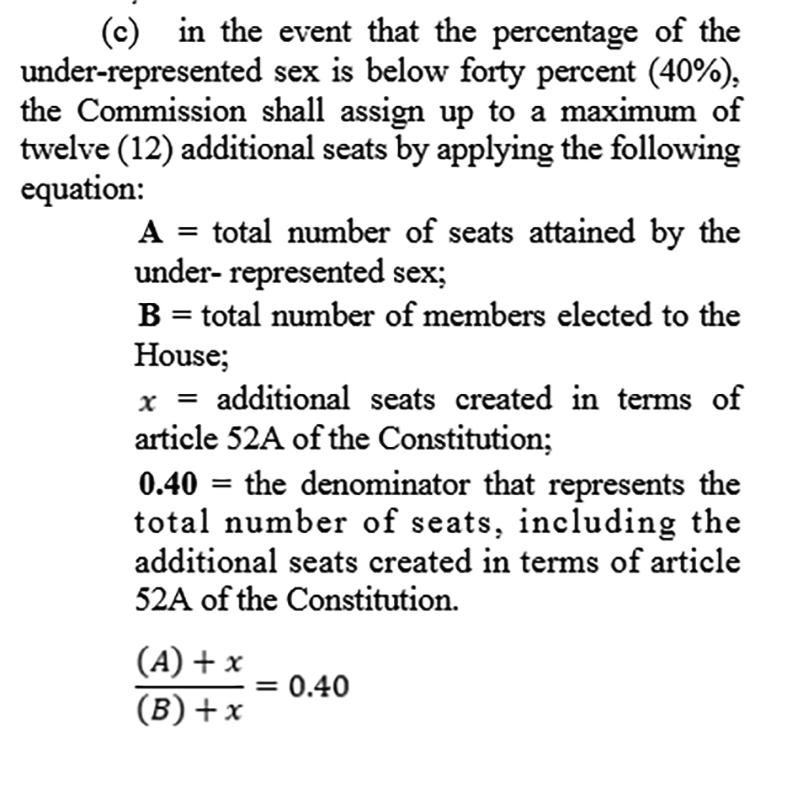 The formula used by the Electoral Commission to decide how many more seats are needed.
Initial high hopes
Soon after the Labour Party’s casual elections, many were hopeful that fewer seats would be needed to reach the 40% quota of women in parliament.
Carmen Sammut, one of the lead authors of the mechanism, was happy to see more women getting elected but hedged her predictions by saying calculations still need to happen to see how many seats are needed.
“At first glance, I do not believe that the ‘under-represented sex’ obtained anywhere near the 40% required. But we still need to calculate whether all 12 additional seats are required to approach that percentage,” she said.
Labour Party sources had initially also told Times of Malta that fewer seats might be needed to reach the quota.
How the mechanism works
The gender corrective mechanism is a complex process introduced in 2021 that tries to ensure 40% of seats in parliament are held by women.
It does so by giving additional seats to women who contested the election but did not get elected.
The first step of the mechanism is to use the formula mentioned above to figure out exactly how many women are needed for parliament to reach the 40% quota.
That number is then rounded down to the nearest even number, so that the additional seats can be divided equally between the two parties elected in parliament.
The mechanism only comes into effect if no more than two parties are in parliament.
Once the number is established, the first seats are allocated to so-called ‘hanging candidates’. These are candidates who made it to the very last count but missed out on a seat by a couple of hundred votes.
PN MP Janice Abela Chetcuti is an example of a candidate who was left hanging on the final count. She received 3,458 total votes in the fifth district, and lost a seat by 500 votes to Carmelo Abela.
These candidates are prioritised for the gender quota seats. They are ranked according to who received the highest number of votes in the last count.
If there are not enough hanging candidates to fill up all the seats, the Electoral Commission turns to the remaining candidates that were eliminated earlier in the count.
These candidates are ranked by the number of votes they received in their last count as a percentage of their district quota. The best performers in each party are awarded seats accordingly.