1802: Malta’s declaration of rights
The declaration indicates a political maturity and a knowledge of the then current progressive and liberal ideas extant in Europe and America
The signing of the 1802 Treaty of Amiens, including Article 10 by which the Maltese islands were to revert to the Order of St John, left the inhabitants irritated and disappointed, and this is putting it very mildly.
After the great sacrifices suffered to oust the French, seeing the Order returning with the very distinct possibility that the French might somehow return in the future, and having their wishes and aspirations ignored by their former allies, was a slap in the face the Maltese could not stomach.
Within a month, the Maltese leaders had met and issued a Declaration of Rights, dated June 15, 1802, in which they outlined what they stated and believed to be the constitutional rights pertaining to Malta and the Maltese. The declaration has also to be seen as the Maltese answer to the Treaty of Amiens.
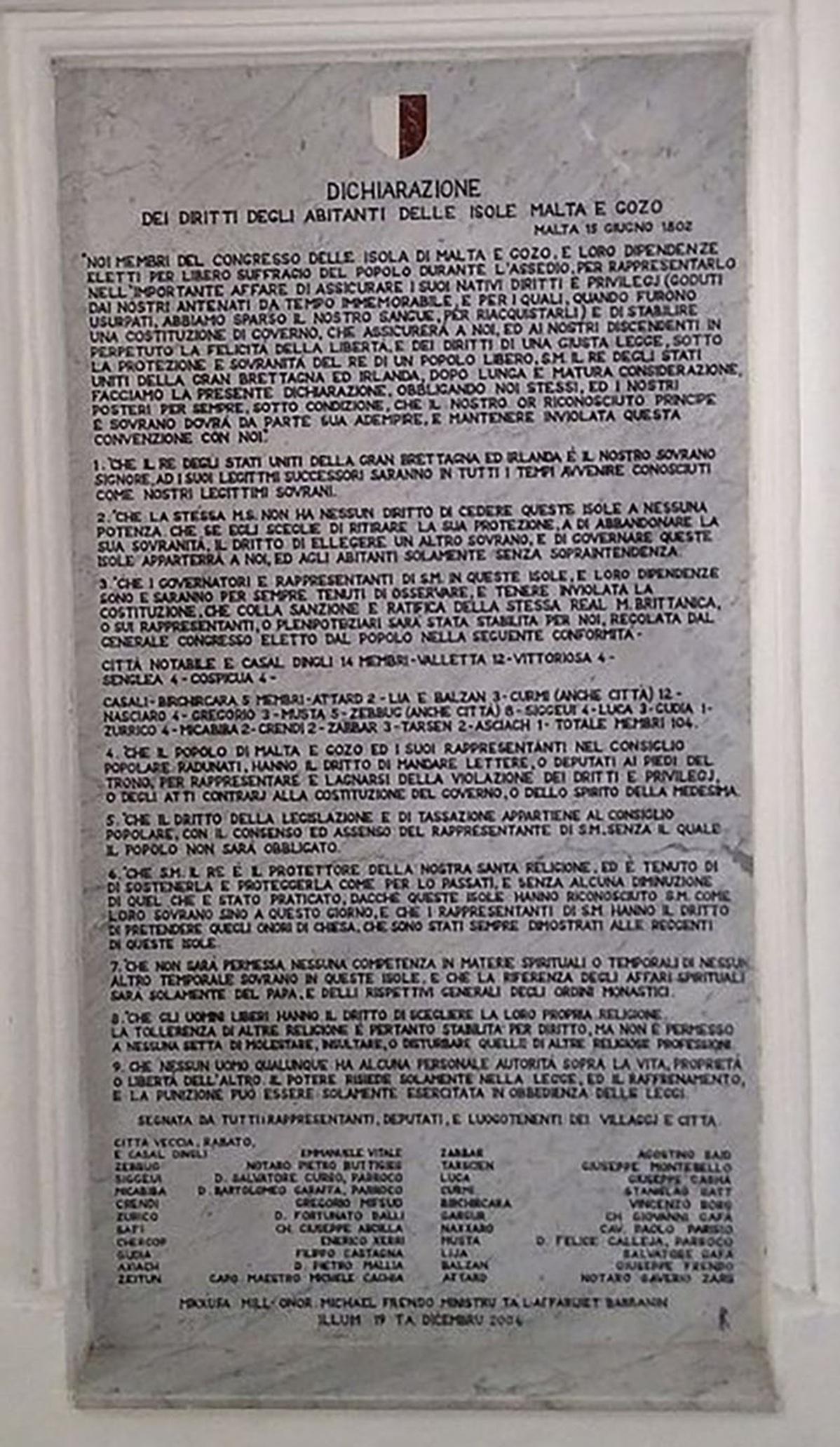 Malta’s Declaration of Rights, 1802: Marble Tablet at Palazzo Parisio, Valletta. Photo: Ministry of Foreign Affairs, Valletta
The contents of the declaration merit a proper perusal. They show a familiarity and knowledge of the declarations that accompanied the 1776 American Declaration of Independence, and indicate that the Maltese leaders knew all about the political thoughts and developments of the latter years of the 18th century, including the principles of popular sovereignty. Therefore, the 1802 declaration indicates a political maturity and a knowledge of the then current progressive and liberal ideas extant in Europe and America.
The Declaration was not just an academic exercise but aimed at showing that the Maltese intended to fight for their rights, which had been ignored
After the French capitulation of 1800, Captain Alexander J. Ball (later promoted to rear admiral), who had been the principal leader against the French, had dissolved the Maltese congress that had led the Maltese against the French, and the Maltese had been requested to return their arms. Irrespective of what Ball had ordered, the congress was still alive, as evinced from the opening lines of the declaration:
“We, the members of the Congress of Malta and Gozo and their dependencies, by the free suffrage of the people, during the siege, elected to represent them on the important matter of ascertaining our native rights and privileges… and of fixing a constitution of government, which shall secure to us and our descendants in perpetuity, the blessings of freedom and the rights of just law…”
These words indicate that the declaration was not just an academic exercise but aimed at showing that the Maltese intended to fight for their rights, which had been ignored.
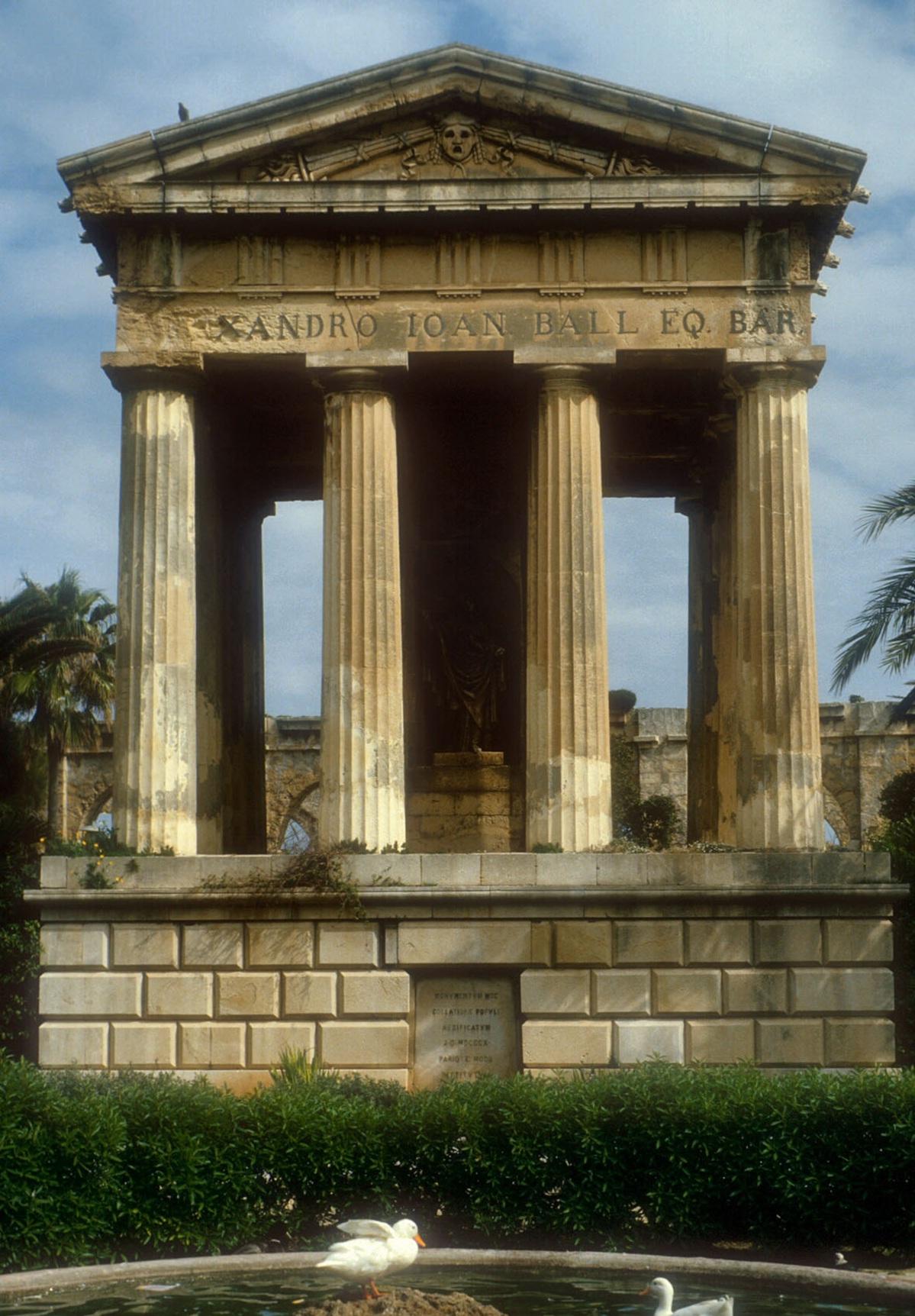 Monument to rear admiral Sir Alexander J. Ball at the Lower Barrakka Gardens, Valletta.
The congress declared in favour of placing the islands “under the protection and sovereignty of His Majesty the King of the United Kingdom of Great Britain and Ireland”, and bound themselves and posterity for ever, but “on condition that our now acknowledged Prince and Sovereign shall, on his part, fulfil and keep inviolate his compact with us”. The declaration goes on to state that the king had “no right to cede those islands to any power”. If the king “chooses to withdraw his protection, and abandon his sovereignty, the right of electing another sovereign, or of governing these islands, belong to us, the inhabitants alone and without control”.
Moreover, the king’s governors/representatives in Malta were “bound to observe and keep inviolate the constitution which… shall be established by us, composing the General Congress elected by the people…” The declaration then listed the numbers of delegates that formed the congress, namely: Mdina and Dingli together, and including (presumably) Rabat: 14 members; Valletta: 12; Vittoriosa: 4; Senglea: 4; Cospicua: 4; Birkirkara: 6; Attard: 3; Lija and Balzan: 3; Qormi: 12; Naxxar: 4; Gregorio: 3; Mosta; 6; Żebbuġ: 8; Siġġiewi: 4; Luqa: 3; Gudja: 1; Żurrieq: 4; Mqabba: 2; Qrendi: 2; Żabbar: 3; Tarxien: 2; Għaxaq: 1, for a total of 104 members.
It was affirmed that the people of Malta and Gozo and their representatives had the right to send letters, or deputies, to the Crown and to complain of acts of violations of rights and privileges, or acts contrary to the constitution or its spirit.
These declarations concerning liberty of conscience and the rule of law are today taken for granted in democratic states
A very important declaration was that “the right of legislation and taxation belongs to the Consiglio Popolare with the consent and assent of His Majesty’s representatives, without which the people are not bound”. This recalls the English 1688 Bill of Rights, through which the monarch reigned but did not govern.
Reminiscent of the very recent turbulent couple of years of French rule (1798-1800), which had been characterised by religious ‘disagreements’, was Article 6, which declared “that His Majesty the King is the protector of our Holy Religion, and is bound to uphold and protect it as heretofore; and without any diminution of what has been practised since these islands have acknowledged His Majesty as their sovereign to this day, and that His Majesty’s representatives have a right to claim such Church honours as have always been shown to the Regents of these islands”.
The importance of religious matters is further emphasised in Article 7, perhaps reflecting the fact that the British crown was a Protestant one. It states categorically that “the interference in matters spiritual or temporal of no other temporal sovereign shall be permitted in these islands; and reference in spiritual matters shall only be had to the pope, and to the respective generals of the Monastic Orders”.
The final two articles in the declaration, numbered 8 and 9, expound the doctrine of the rule of law as explained in the political thoughts of the philosophers John Locke (1632-1704) and the Frenchman Charles Louis de Secondat Montesquieu (1689-1755).
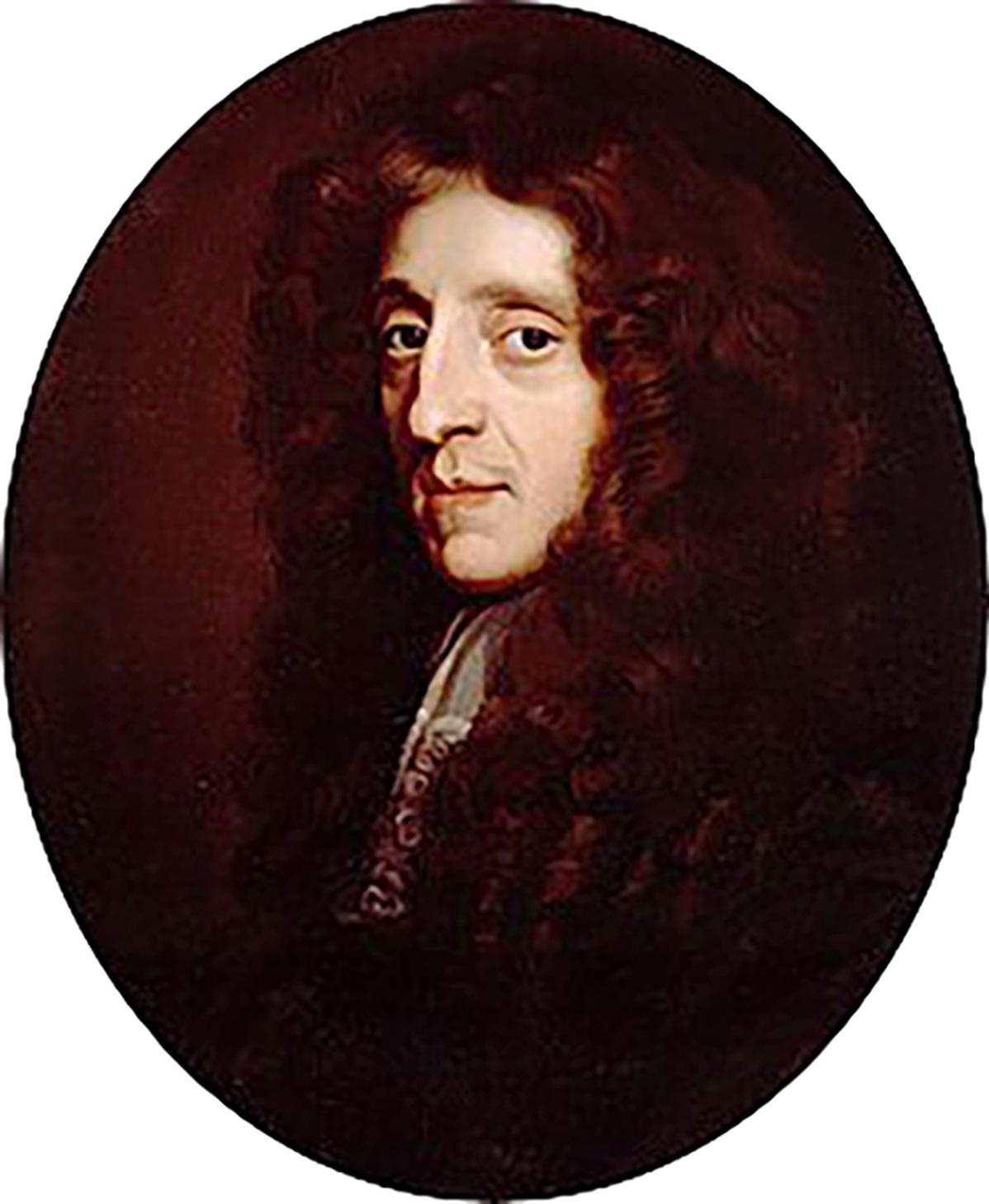
Portrait of philosopher John Locke (1632-1704), by John Greenhill (1644-76).
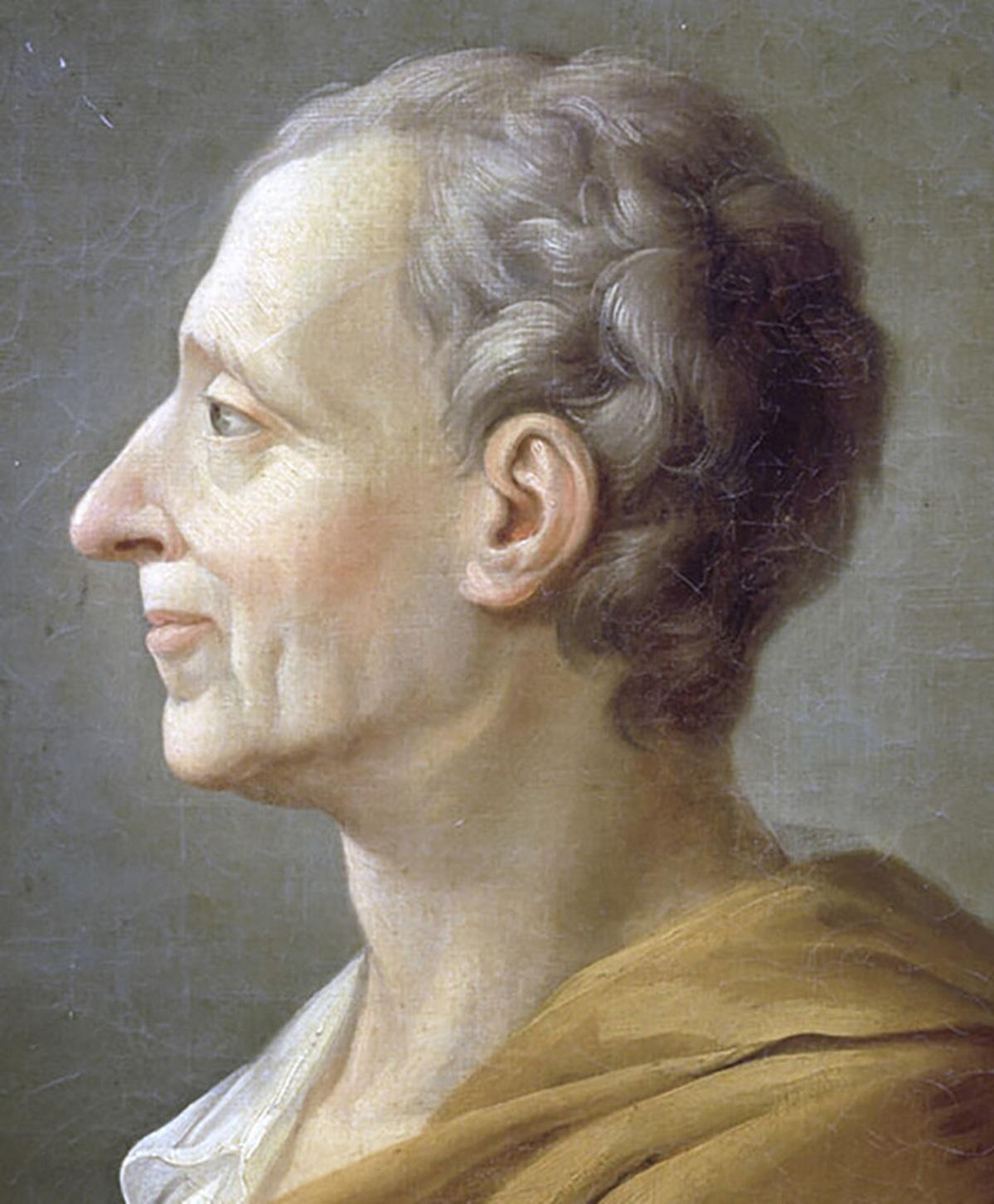
Portrait of philosopher Montesquieu (1689-1755), by Jacques-Antoine Dassier (1715-59).
Locke, widely regarded as one of the most influential thinkers of The Enlightenment, contended that religion is a matter for the individual. Regarding government, he argued for a government based on the consent of the governed and for the right to revolt against a tyrannous government.
Montesquieu, who was also very influential, expounded the theory of the Separation of Powers by dividing political authority into the legislative and judicial powers. The last two articles show tolerance and democracy in the spirit of other declarations of rights, notably the American and French. It is here worth repeating them verbatim:
“8th – That freemen have a right to choose their own religion. Toleration of other religions is, therefore, established as a right; but no sect is permitted to molest, insult or disturb those of other religious professions.
“9th – That no man whatsoever has any personal authority over the lives, property or liberty of another. Power resides only in the law, and restraint, or punishment, can only be exercised in obedience to law.”
These declarations concerning liberty of conscience and the rule of law are today taken for granted in democratic states, but this declaration is a product of the early 19th century and, for those days, they were relatively advanced ideas. 1802 was a time of uncertainty and the Maltese must have been fearful of what was in store for them in the future. Through this Declaration of Rights, the Maltese leaders tried to fashion a path for a future based on clear structures and principles, and in a clear agreement and understanding with Great Britain.
Alas, this was not to be. War broke out again the next year, just a year after the signing of the Treaty of Amiens, and heralded a future different to the one envisaged in 1802.
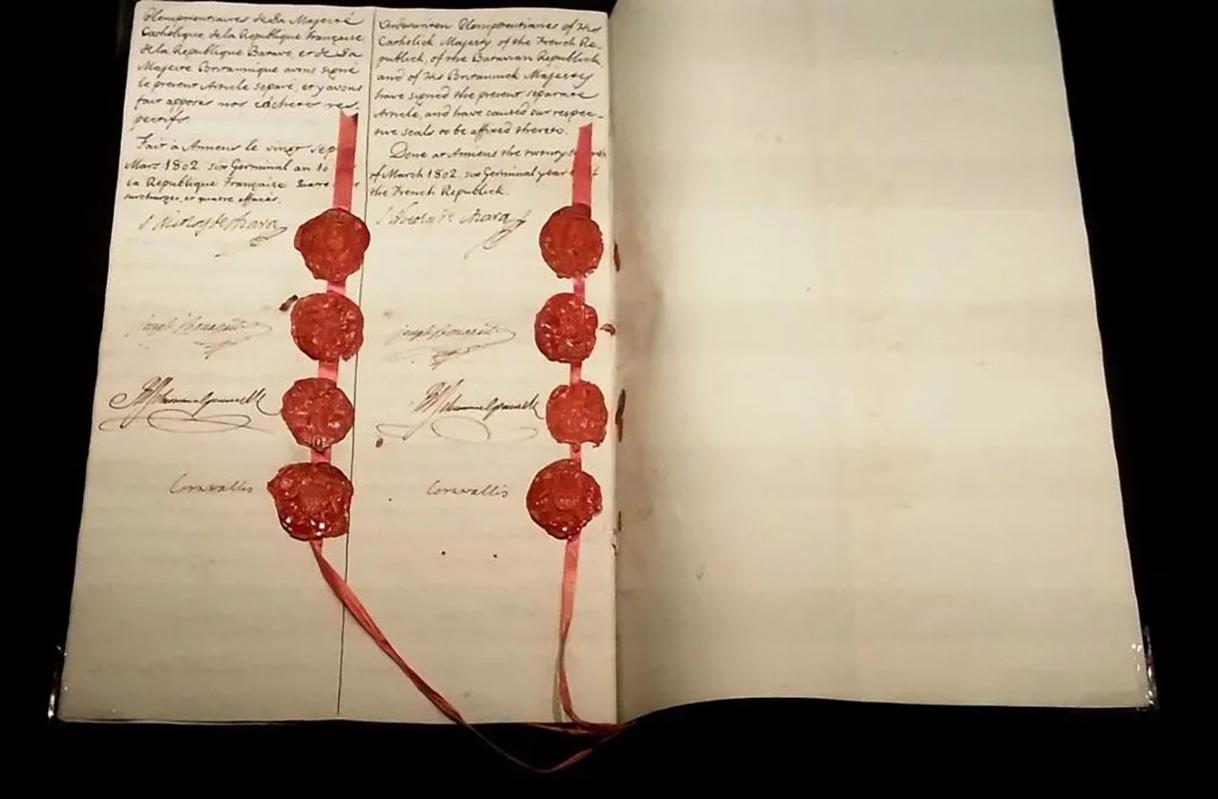 The page of the Treaty of Amiens containing the eight seals and signatures of the participants. Photo: Wikipedia.com