€7,000 and a priest: The price of silence in Malta's Church
The silence from Gozo about a rape case is a structural cover-up, writes Karl Schembri
The number that stays with me is €7,000. Not because it is large; it is insultingly small, but because of what it was designed to purchase. The silence of a family. The erasure of a 14-year-old girl's testimony. The continuation of a system that has been buying, bullying, and burying the voices of survivors for as long as the Church has held power in Malta.
A court has now confirmed what Times of Malta first reported on its front page in 2008: that Fr Michael Said acted as intermediary in a payment to a Nadur family, in exchange for withdrawing a rape complaint against the brothers of a Nationalist MP.
Cardinal Mario Grech, who was Bishop of Gozo at the time, says he only became aware of this last Sunday. Eighteen years after the front page. Eighteen years after the family was approached. Eighteen years of institutional amnesia, apparently untroubled by the fact that the priest in question remains listed today as assistant headmaster at the Gozo seminary.
The Curia: no comment. The safeguarding commission: no comment. The seminary: no comment. The priest: no comment.
This silence is not accidental; it is structural, a historical cover-up of biblical proportions.
When I was writing Eħlisna mid-Deni, the novel I published last year about clerical abuse in Malta, I made a deliberate choice to give the survivor a voice that the institution had spent decades trying to extinguish. The novel's narrator, Mario, speaks directly and relentlessly to his abuser, a monsignor who raped his father as a boy, whose actions destroyed a family across generations, and who was protected at every turn by a hierarchy that valued its own reputation above the children in its care. Mario's father, Victor, is also, in large part, my father: a fact I have spoken about publicly and which I cannot separate from anything I write about this subject.
What I was writing, I knew, was not fiction in any comfortable sense. It was documentation in a different register. The filing cabinets full of unanswered letters. The psychiatric reports dismissed by prosecutors determined to treat mental illness as moral failure. The archbishop who received complaint after complaint and moved the abuser from parish to parish, from Malta to Australia and back again, rather than face what his institution had done. These are not inventions. They are the architecture of cover-up, reproduced across jurisdictions, across decades, across the specific geography of this small Catholic island where the Church and the state have historically been too comfortable with each other to ask difficult questions.
The survivors in my novel are composites drawn from real testimonies, real experiences, real silences. Each of them was silenced in a different way. The Nadur family in the Gozo case was silenced with €7,000 and the mediation of a man in a collar, whose authority in that community carried a weight that no family in 2008, in rural Gozo, could easily refuse.
Cardinal Grech has a preferred formulation when faced with abuse allegations: he says he "always took all the necessary steps whenever I was informed of allegations of abuse." The phrase is a masterpiece of institutional self-protection. It outsources responsibility to the act of being informed. If no one told me, nothing is required of me. If the file never reached my desk, my hands are clean. He is no different to his other Gozitan brother and disaster of an Archbishop, Ġużeppi Mercieca, who covered up and lied through his teeth to protect Maltese predatory paedophile priests, whom he knew were wanted for child rape abroad.
But the question is not only what Grech, and Mercieca, knew. The question is what the institution was designed to ensure they would not need to know. The safeguarding commission that will not comment. The seminary that will not comment. The curia that will not comment. The priest who continues to work with young people while a court judgment sits on the record, confirming his role in silencing a child. This is not a series of individual failures. It is a system: coherent, self-reinforcing, and still functioning.
In Eħlisna mid-Deni, Mario constructs his own tribunal because the real ones failed. He kidnaps the monsignor who abused his father, holds him in a basement in Rome, and forces him to hear the full account of the destruction his actions caused: across one family, across generations, in ways that no statute of limitations can contain. The novel's argument is that justice is not the exclusive domain of courts, and certainly not of Church commissions. It is also the domain of testimony. Of the survivor who insists on being heard even when every institution around them has invested in their silence.
What this country needs is not another commission that reports to the hierarchy it is meant to scrutinise. It is not another statement from a cardinal who was, apparently, the last person in Gozo to read the Times of Malta. It is a fully independent, forensic public inquiry — with statutory powers, access to Church and state records, and a specific mandate to hear survivor testimony — into the institutional handling of clerical abuse cases in Malta and Gozo.
Ireland had its Ryan Report. Australia had its Royal Commission. Both were deeply uncomfortable for the Church. Both produced findings that the Church alone could never have produced about itself, because the Church is constitutionally incapable of investigating its own crimes with the rigour those crimes demand.
The Nadur family accepted €7,000 in 2008. We do not know what pressure accompanied that offer, what was said by the priest acting as intermediary, what the alternative seemed to be for a family with limited resources facing powerful people in a small island where everyone knows everyone and the bishop's word still carries the weight of God. We do not know because the Church made sure we would not know, and then, when a court finally named the priest, said nothing.
The survivors of Malta's clerical abuse are still waiting. Not for €7,000. For the thing that was never offered them: a full accounting, in public, of what was done and who enabled it.
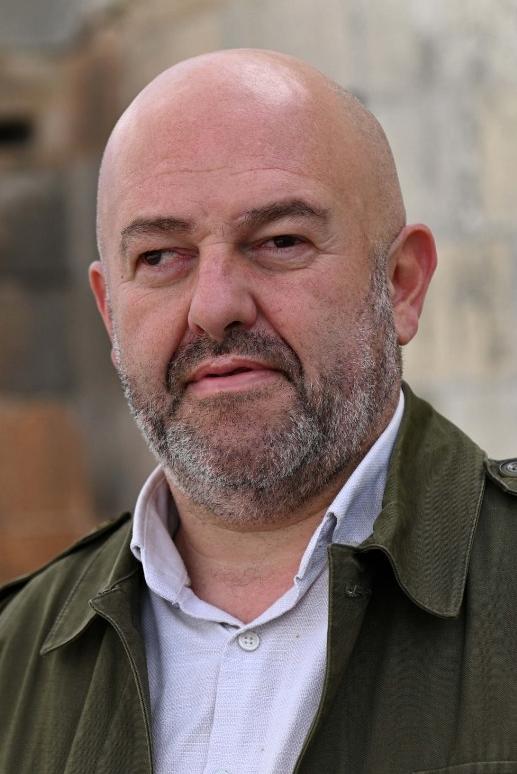 Karl Schembri. Photo: Gilbert Calleja
That inquiry should begin now.
Karl Schembri is a former journalist who uncovered the first cases of wide-ranging institutional clerical child rape in 2003, and the author of Eħlisna mid-Deni (Merlin Publishers, 2025), a novel about clerical abuse and its generational consequences.