Count Roger’s conquest of Malta in 1091
Many popular but unfounded legends and traditions continue to surround the historical fact of his liberation of Malta from Arab rule
Although it is a historical fact that the Norman leader in Sicily, Roger de Hauteville, invaded Malta in July 1091, it seems his plan to attack Malta may have been drawn up 20 years earlier, in 1071.
However, the attack did not take place and Count Roger’s official chronicler/biographer, Gaufredus Malaterra, never mentions it, and we are left in the dark as to whether such an early plan existed or not. Very probably, the experienced Count Roger would not have embarked on such a project before he had conquered all Sicily, a feat he accomplished successfully with the capture of the last Muslim stronghold of the city of Noto in 1090.
From a military point of view, Count Roger could not afford to leave nearby Malta in the hands of the Muslims, thus leaving his flank exposed to the enemy. Hence the almost immediate amphibious invasion of the island the following year after the necessary preparations, including the construction of ships, had been carried out. Count Roger fell out with his eldest son (albeit the illegitimate) Jordan, who had wanted to lead the expedition himself in view of his father’s advanced age, Roger being 60 years old in 1091.
Very probably, Count Roger wanted to use the Malta campaign to further underline his personal achievements. According to Malaterra, Count Roger boarded his ship with pomp, including music playing and the blowing of trumpets. Setting sail in the wake of what was termed a “prosperous breeze”, the naval squadron arrived in Malta within two days, with Count Roger’s ship at the front.
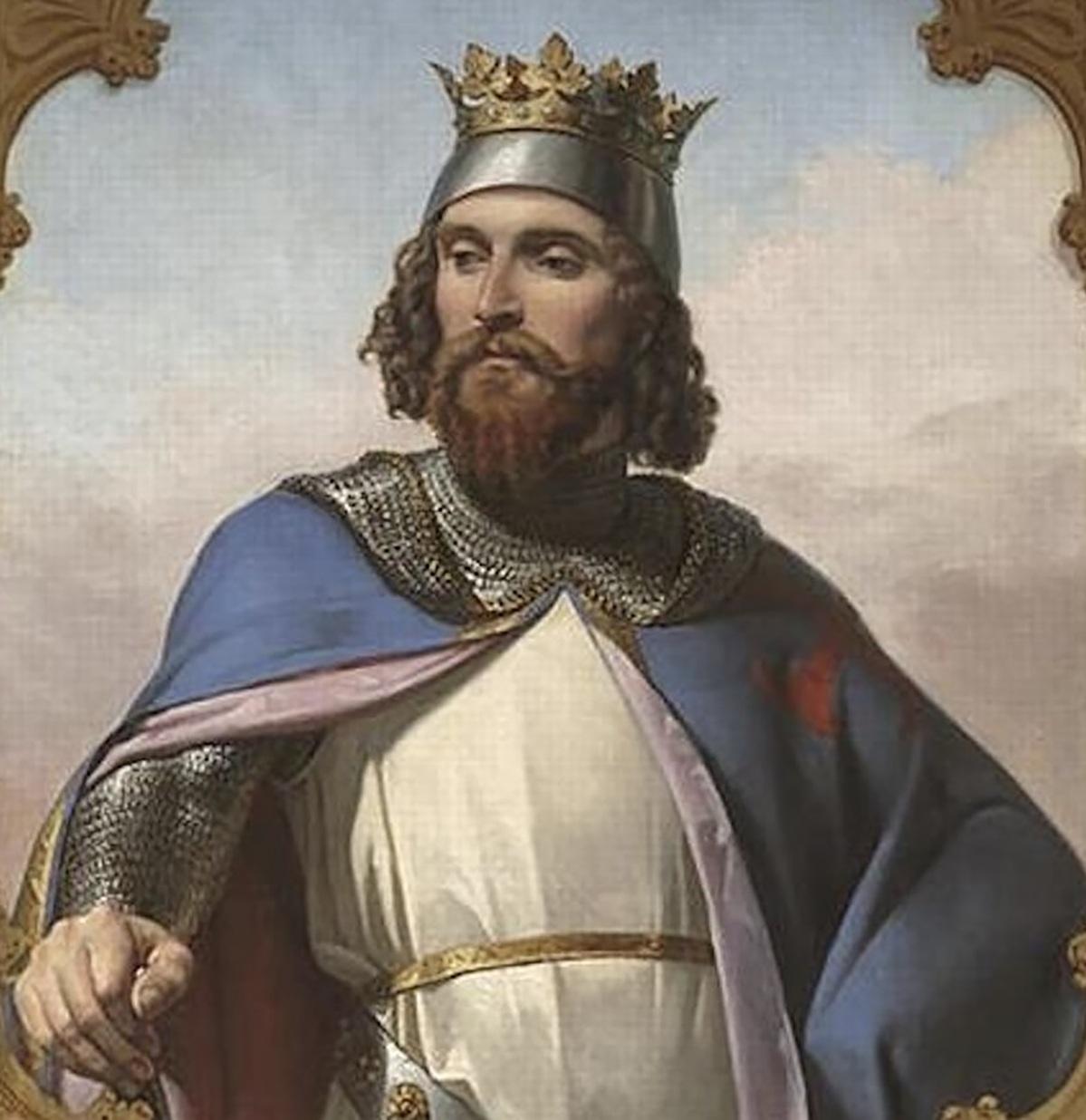 An anonymous imaginary portrait of Count Roger.
Together with 13 knights on horseback, Count Roger landed to confront a crowd of natives opposing the landing. The Normans soon disposed of this opposition which was chased off. The rest of the Norman army soon arrived, camped on the seashore and, at daybreak, proceeded to the city, Mdina, to prepare for its siege.
It is pertinent to note that the actual site of the landing has remained unknown irrespective of untenable legends regarding its site. At the start of the siege, the ruler of the island, the gaytus, asked for permission to discuss peace conditions. It seems, from Malaterra’s description, that neither the gaytus nor the islanders were particularly warlike, and discussions were quickly concluded. The gaytus offered to release the Christian captives held by the Muslims, most of whom were confined within the city. This offer was augmented by the surrender of horses, mules, all the Muslims’ weapons and a sum of money.
Miġra l-Ferħa… can hardly hold two or three small craft… let alone landing a fighting force with cavalry and a siege train
It was stipulated that an annual tribute would be paid to Count Roger, and an oath of fealty was undertaken, thus effectively making the gaytus and the inhabitants subjects of Count Roger. The liberated captives left the city joyful at their newly-found liberty, brandishing crosses made of branches and crying out Kyrie Eleyson. They threw themselves at Count Roger’s feet such that, according to Malaterra, Roger and his soldiers were brought to tears.
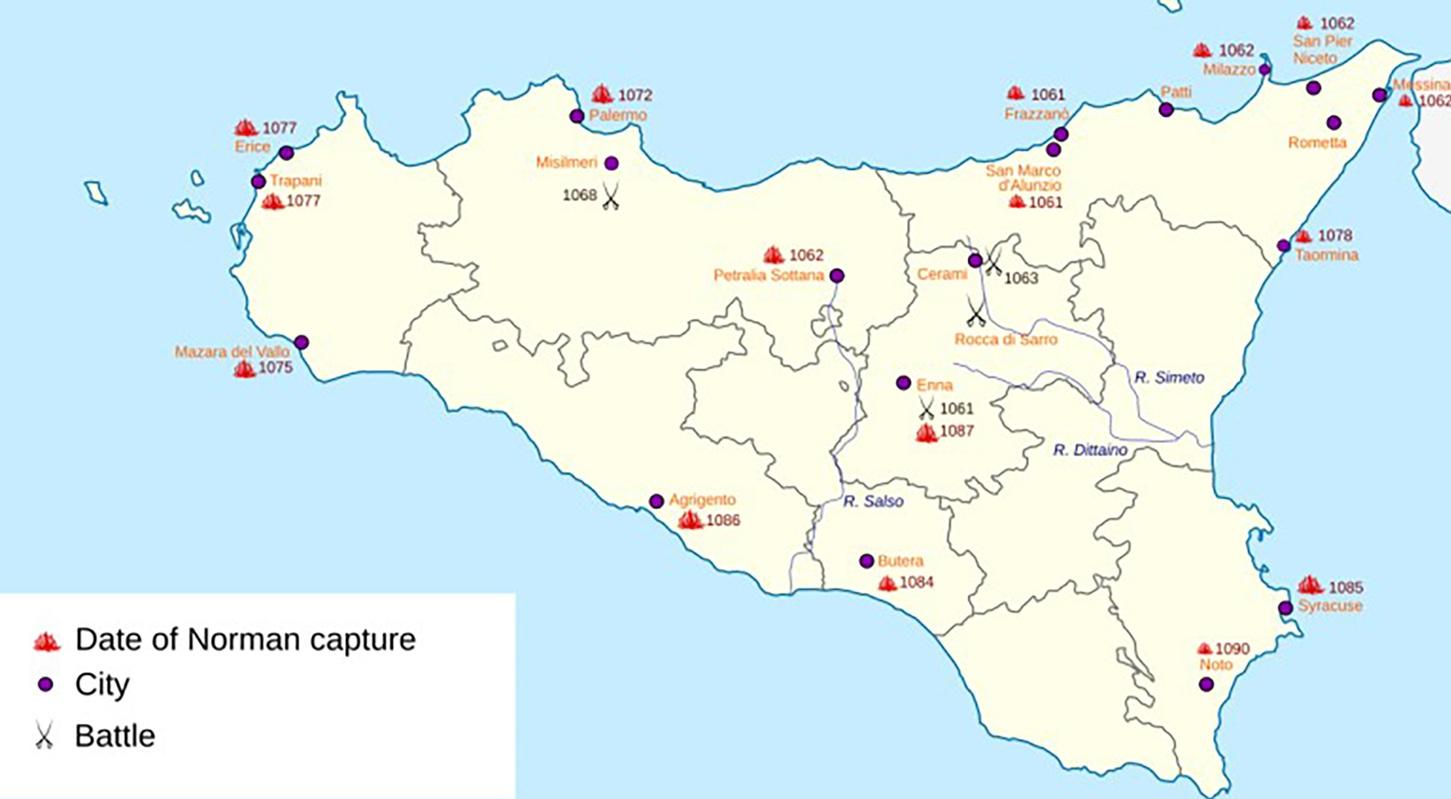 Map of Sicily denoting how it was conquered by the Normans in the years leading to 1090
These liberated Christians were not Maltese, as some erroneously think, but foreigners who had been captured by the Muslims in previous wars. In fact, they were all taken, according to Malaterra, aboard Count Roger’s ship, fostering the fear that it could sink with the added weight but, the chronicler added, “God’s hand was with them, and the ship rose above the waves, as though it had become lighter.” Count Roger then turned his attention to the smaller island of Gozo, which Malaterra called Golsa. Malta’s sister island offered some resistance to the Normans, who pillaged and sacked the island, forcing the ‘Gozitans’ to accept the Norman terms, which were similar to those imposed on the larger island.
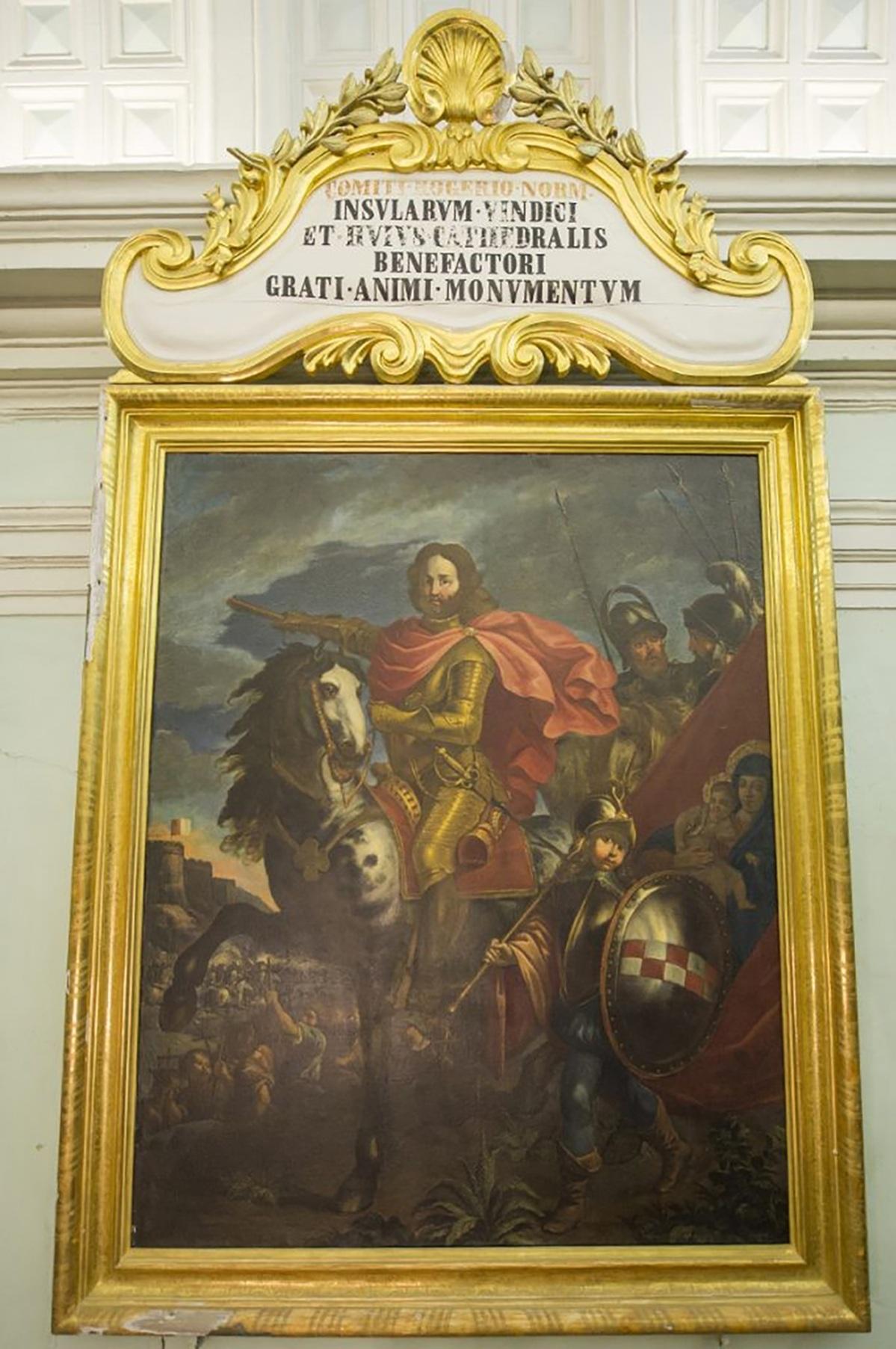 Count Roger freeing the Christian slaves in Malta in 1091 in an imaginary and idealised depiction by Alessio Erardi (1669-1722) at the sacristy of the Mdina Cathedral. Photo: Cathedral Chapter, Mdina
The harsh treatment of Gozo certainly did not endear Count Roger to the ‘Gozitans’. On his return to Sicily, Count Roger offered the liberated Christians freedom to settle themselves in a new town, which would be free from tribute or servile exactions, but they preferred to return to their homeland/s. Count Roger therefore permitted them to travel freely across his territories to go back home. They did so, praising the count wherever they went. Malaterra’s account, like those of other official chroniclers, was meant to extol the virtues and deeds of Count Roger and it has to be taken as such.
However, it is a fact that his narrative is the best and the only account that provides us some tangible information about the first Maltese/Norman connection. Conversely, it became ideal raw material for early modern writers to fabricate a number of legends meant to paint the Maltese as a people who suffered under the Muslim yoke until they were liberated by the Noman leader. It is with this in mind that legend has depicted the liberated captives as Maltese when this was not so. The legend of the Maltese Christians, supposedly freed by Count Roger, greeting their liberator with palms, olive branches and songs of thanksgiving befitting a popular hero, probably owes its origin to the biblical account of Jesus’s triumphal entry into Jerusalem.
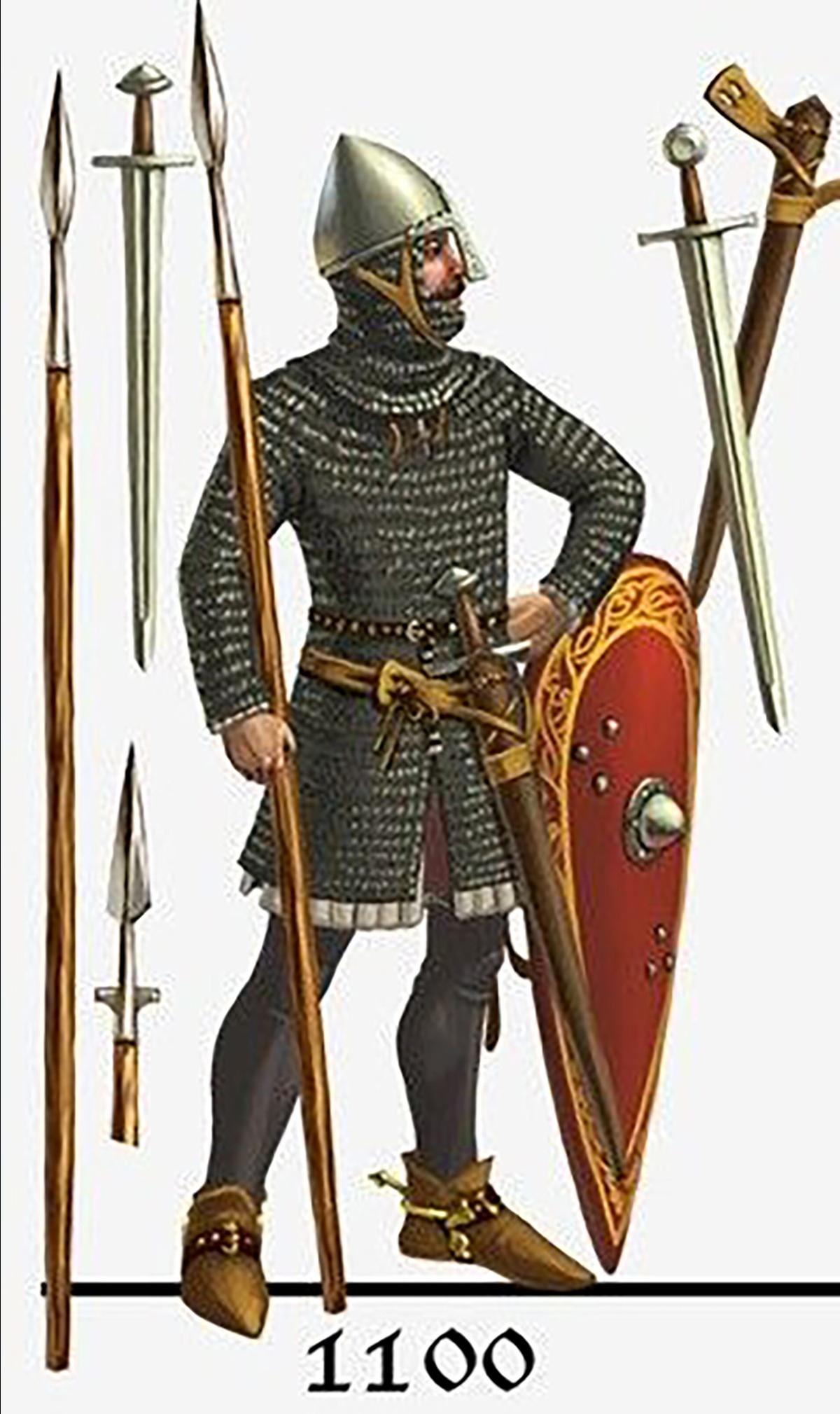 A typical armed Norman soldier of the latter years of the 11th century.
Gian Francesco Abela was mistaken when, in 1647, he interpreted Malaterra’s captivi christiani as Maltese and, unfortunately, the mistake has been repeated ad nauseam up to the present day. Among the toponymic legends, designed to account for the origin of a place-name, is the one connected with the landing-place of the Normans, which is historically unknown but is popularly denoted as Miġra l-Ferħa (a streamlet), a small inlet beyond Imtaħleb a couple of miles away from Mdina. This is, in fact, unsuitable for a landing place: it can hardly hold two or three small craft and is very unsafe in the case of a strong wind blowing from the outside, let alone for landing a fighting force with cavalry and a siege train.
Sometimes, the word Miġra is changed to Miġja meaning ‘arrival’ thus implying the joyful arrival of the Norman liberators. A widespread and deeply implanted belief is that the Maltese national flag’s red and white colours (naturally excluding the George Cross) were bestowed by Count Roger, thus raising Malta to the rank of a small nation with its own banner and shield. But Malaterra makes no reference to the bestowal of flags or colours, something he would surely have written down to enhance the stature of his employer.
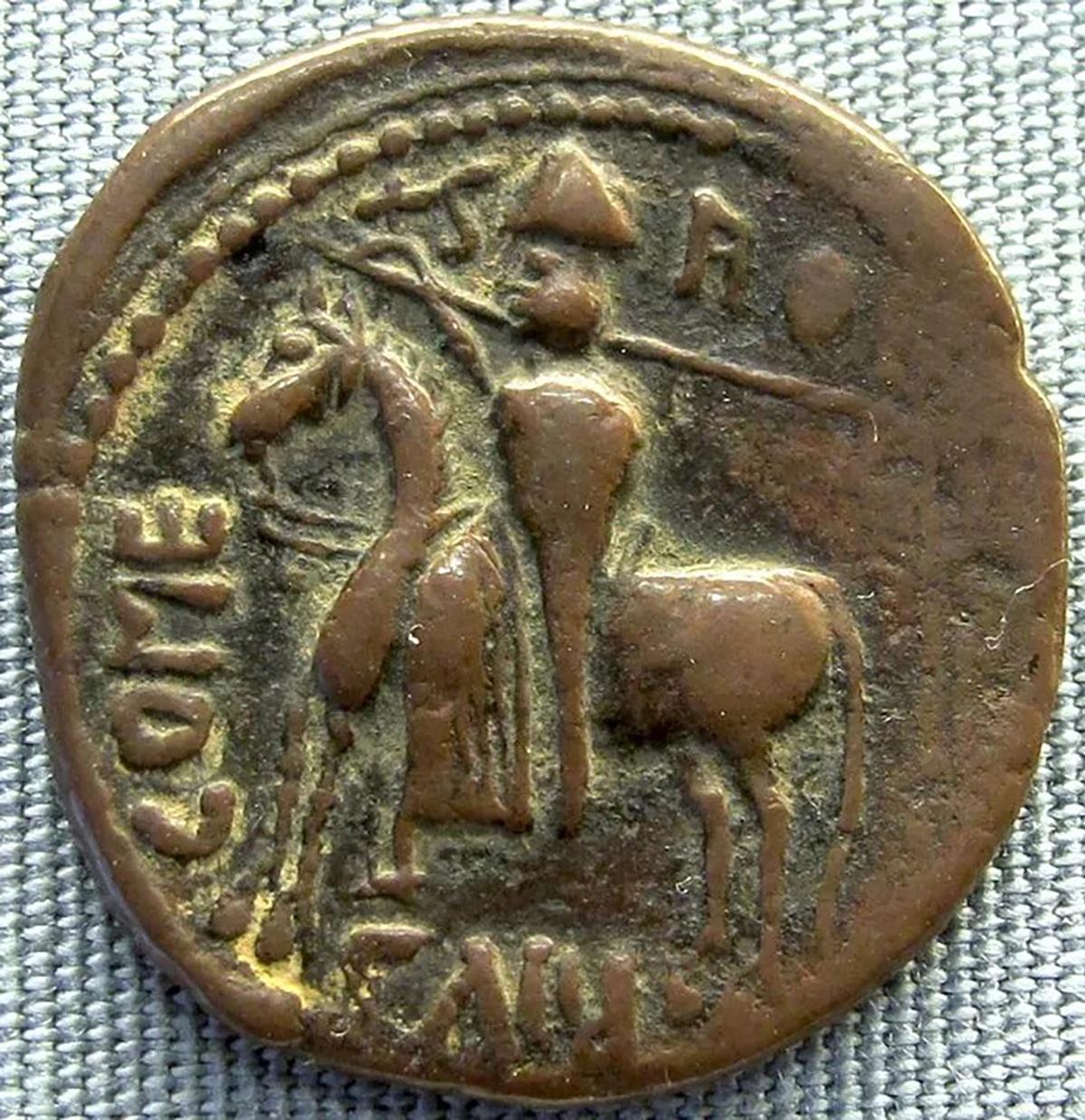 A Norman coin minted c.1090 in southern Italy which was under Norman rule
True heraldry began to emerge only in the first half of the 12th century and was certainly not yet in use when Count Roger invaded Malta. It could be that the red and white colours were granted by an unknown later ruler but attributed to Roger together with many other erroneous attributions.
Other popular but unfounded traditions include: the restoration of the Gozitan principal church; the raising of the Birgu chapel of St Lawrence to parochial status; and the belief that the traditional annual procession to St Gregory’s church in Żejtun commemorates Count Roger’s liberation of the Maltese islands in 1091.
The local Curia sees Count Roger as the founder of the Mdina Cathedral, although any real proof is conspicuous by its absence. In fact, Bishop Alpheran de Bussan (1728-1757) instituted a commemorative service that is held every November 5. In the sacristy, there hangs a large painting by Alessio Erardi (1669-1722) with a Latin inscription in which Count Roger is called the “Liberator of the Islands and Founder of the Cathedral”. The painting also includes an escutcheon with the purported red and white colours of Count Roger.
Malaterra makes no reference to the bestowal of flags or colours, something he would surely have written down
One can continue listing the Norman legends, but the unvarnished truth is that the historical Count Roger was a great military leader, as shown by his conquest of Sicily, who possessed the same virtues and weaknesses as other contemporary leaders, and was not the Count Roger of popular tradition. Which brings us to our last point: was Count Roger’s arrival in Malta a mere razzia (a hit and run raid) or was it a conquest?
Various writers have dismissed it as a mere raid, but raids do not include negotiations, the taking of oaths of fealty and agreements to pay annual tributes. I agree with those historians of Maltese medieval history that the Norman attack of 1091 was a conquest and not a raid. A total lack of records leaves us in the dark as to what happened in the following three decades or so: whether the agreements were maintained or broken.
What is known, however, is that, according to the chronicler Alexander Telese, Malta had to be reconquered in 1127, this time by the Count’s son, also named Roger. But that is another story.
Joseph F. Grima is a retired casual history lecturer and assistant director of Education.