Courts urged to stop lawyers undermining domestic violence risk tool
New rent subsidy scheme to support domestic violence survivors finding new home
The courts should not allow lawyers representing those accused of domestic violence to discredit the credentials of social workers and risk assessors, the head of the Foundation for Social Welfare Services (FSWS) has said.
FSWS CEO Alfred Grixti described a worrying pattern of lawyers representing alleged perpetrators attacking the outcome of risk assessments carried out on victims.
“To put it blatantly, lawyers defending perpetrators are simply not qualified to call the tool into question – just to introduce a measure of doubt to get their client off the hook," he said.
"The courts should not allow this line of defence,” said Grixti, stressing Malta's assessment was internationally validated, and those using it were trained and licensed.
Shelter challenges
Grixti welcomed the increase in the number of magistrates handling domestic violence cases from two to three since his appeal last year. Now, he added, attention had to be focused on what takes place in the courtroom.
Grixti was speaking during a conference to mark the 25th anniversary of the Għabex emergency shelter for women and children victims of domestic violence. He emphasised that such shelters were critically important.
The conference was held on the first day of 16 held internationally to combat domestic and gender-based violence.
During the conference, speakers outlined challenges faced by shelters, including financial, capacity and staff shortages.
Rent subsidies for domestic violence victims
Junior minister Rebecca Buttigieg said emergency shelters were more than a safe space; they are a first step towards building a new life away from abuse.
However, she said, too many survivors could not access long-term housing after leaving their abusive homes.
Buttigieg said the government would soon launch a programme to support domestic violence survivors accessing the rental market by subsidising monthly rents.
Social Policy Minister Michael Falzon said that since its establishment over a year ago, the Multi-Agency Risk Assessment Meeting (MARAM) — made up of entities working directly with victims of domestic violence, and their children — handled more than 1,200 cases.
The prime minister's wife, Lydia Abela, said domestic violence remained one of the most "silent and devastating social issues of our time." Education was key to teaching future generations about respect, equality and love, she said.
Diversity
Support workers Mary Desira and Sandra Micallef, who have been at Għabex since it opened, spoke about how they had seen the service grow to include women of different cultures and ages.
Micallef said she would like every resident to have her own room; at the moment, they have to share.
She added that she would like to see policies, procedures, and forms available in various languages, after seeing women from different cultures make use of the service.
'I rebuilt myself'
One third-country national who used the service shared her story, telling the conference she had been in Malta for seven years, and had reached out to the police to save herself and her children.
“Thankfully, we have a new life now and a safe place where we can sleep without fear – a great healing place. I’m very glad that I took my children to a safe place, and they are like butterflies now. I rebuilt myself”, she said.
'My brain started working normally'
A Maltese woman also shared her story. She said that when she walked into an emergency shelter with her baby, she felt that for the first time in a long time her brain had started working normally.
“Taking out the fear and removing the predatory environment… as soon as we entered Għabex, that fear dissipated. I started using my brain in a normal way again – the fear was clouding it", she said.
Both women agreed that, at the shelter, they were surrounded by people who understood their situation and who offered comprehensive support.
'I am now free'
Appoġġ director Graziella Castillo spoke about a girl she had met at a shelter. The girl, together with her mother and siblings, was living in the shelter. She gave her a drawing that she still has in her office.
As she described the drawing, the girl told her: “I am the girl in the drawing; my hands are open as I am now free.”
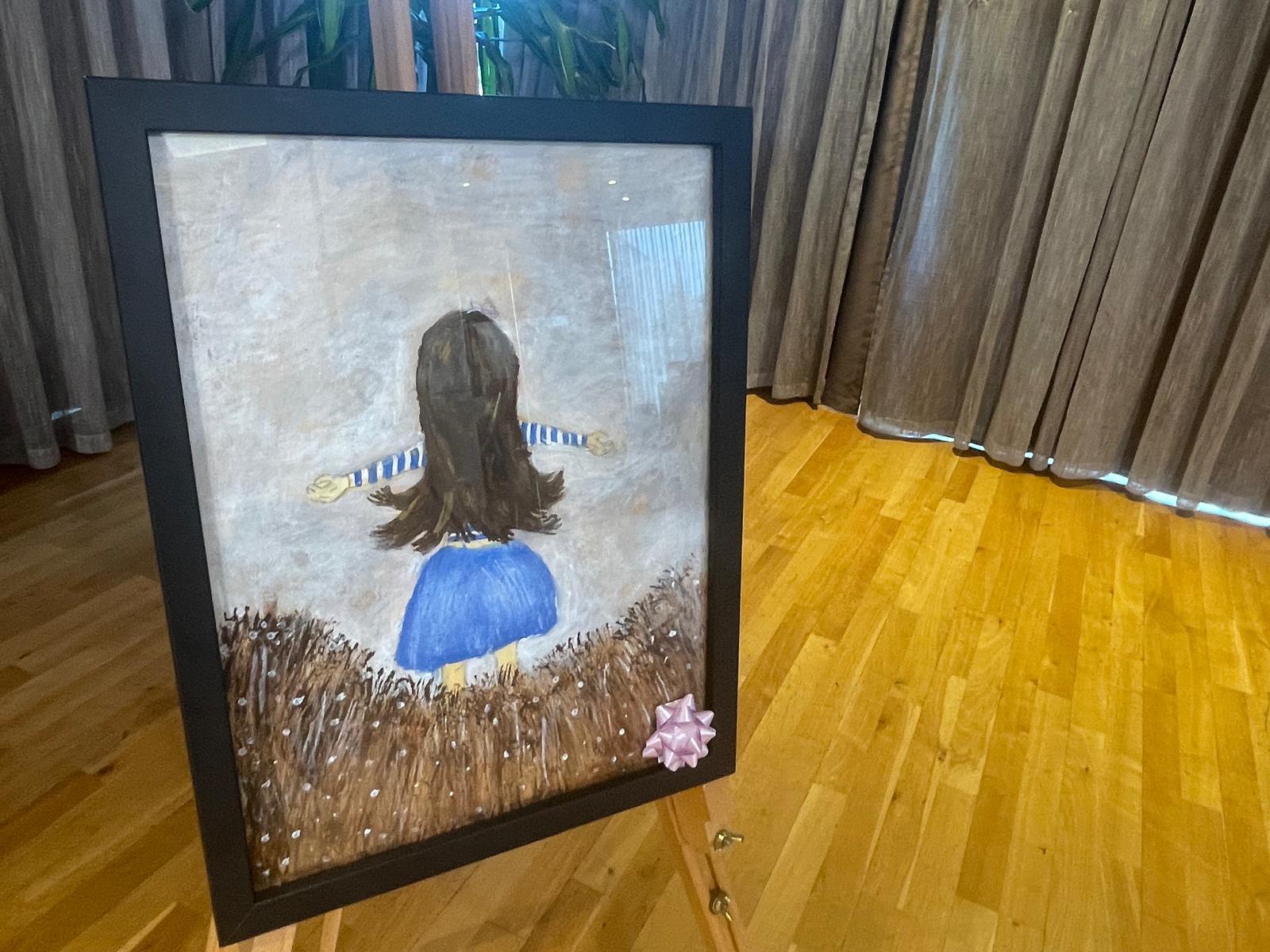 A picture drawn by a girl who escaped a life of domestic violence.
Castillo said she remained speechless, noting that although victims have to leave everything behind when they leave a life of abuse, their departure nonetheless represents freedom.
A current Għabex resident shared some reflections: “The power to define yourself is in your hands and not in the hands of others… walking away from an unhealthy relationship is brave.”
If you are living a life of domestic or gender-based violence, you can reach out for help through the support line 179.