Gozo mum takes on big tech, starts group keeping kids off phones
Parents are joining a global movement pushing back against smartphones for children
As a mother of two boys aged seven and nine, Elaine Pavia Grima wished there was a way she could avoid giving them a smartphone until they were old enough to handle its perils. But what could she do?
She knew their friends in class would soon start bragging about having one. Being an educator herself, she knew children as young as seven (Year 3) were being handed their own smartphone nowadays, and that by age 11 (Year 6) almost everyone in class had one.
If all their friends had one, how could she explain to her children that a smartphone was dangerous at their age? And how could her sons socialise if they were the only ones without a social media account? Imagine the bullying they could face for being the odd ones out.
Then it struck her. Most other parents were probably struggling like her, she thought, and they were only succumbing to giving their children smartphones out of fear they would be sidelined by their peers. But what if those parents got together and agreed not to give their children a smartphone until they turned 13? What if they could band together and help each other through it?
So she teamed up with four like-minded parents to put the plan into action. What started out as a small group of parents in Gozo has since grown into a WhatsApp group with over 200 members.
They have agreed to a common goal: keeping their children off personal smartphones until they are at least 13 years old. Now, the Smartphone Free Childhood Gozo community functions as a strong support network, sharing ideas, research, and providing mutual support to overcome the difficulties this challenge presents.
The Gozo group then teamed up with parents in Malta trying something similar and the two groups are now part of a global organisation of parents around the world striving to do the same.
Smartphone perils
Parents’ concerns are not unfounded. Multiple studies worldwide indicate it is not healthy for young children to have access to smartphones, and it is not recommended they are given one before age 13. And even then, social media accounts should be avoided, Pavia Grima said.
“Research shows that the constant scrolling and instant feedback from social media platforms trigger repeated bursts of dopamine which is the brain’s ‘feel-good’ chemical in much the same way addictive substances like alcohol or drugs do.
Over time, this can desensitise the brain’s reward system, making children crave more stimulation and find everyday activities less satisfying. It’s only a matter of time until it becomes an addiction and exposes young children to pornography and inappropriate content which their brains are not developed enough to handle,” she said.
“And yet, all the awareness we spread on the effects of drugs, smoking and alcohol are not matched with the awareness that social media can be as harmful. I believe it will soon be declared a form of addiction like the others, but I fear by then it will already be too late for our children. At least we have found an interim solution until governments and authorities open their eyes and legislate on it.”
In Malta the government has launched a discussion on social media regulation with the intention to legislate in the coming months.
Pavia Grima, 37, is an MCAST senior lecturer. She started her career as a primary school teacher and furthered her research on long-term relationships and family life.
“The research in this field overwhelmingly points to this direction,” she said.
“Social media algorithms are designed to start showing children explicit content, eventually even pornography, even if they did not search for it. Not only that: it isolates them and creates severe self-esteem issues early on, especially in girls who develop unrealistic expectations of beauty and grow up believing they should only show themselves to the public through filters.”
She said the problem often begins when parents who are about to upgrade their phone give their old one to their child, thinking it would be harmless.
“But it’s so much more worth it to throw the old one away and buy them a basic phone instead,” she said.
“Some parents of older children warned us that the moment they gave their child a smartphone, they ‘lost’ them. That’s how bad it is.”
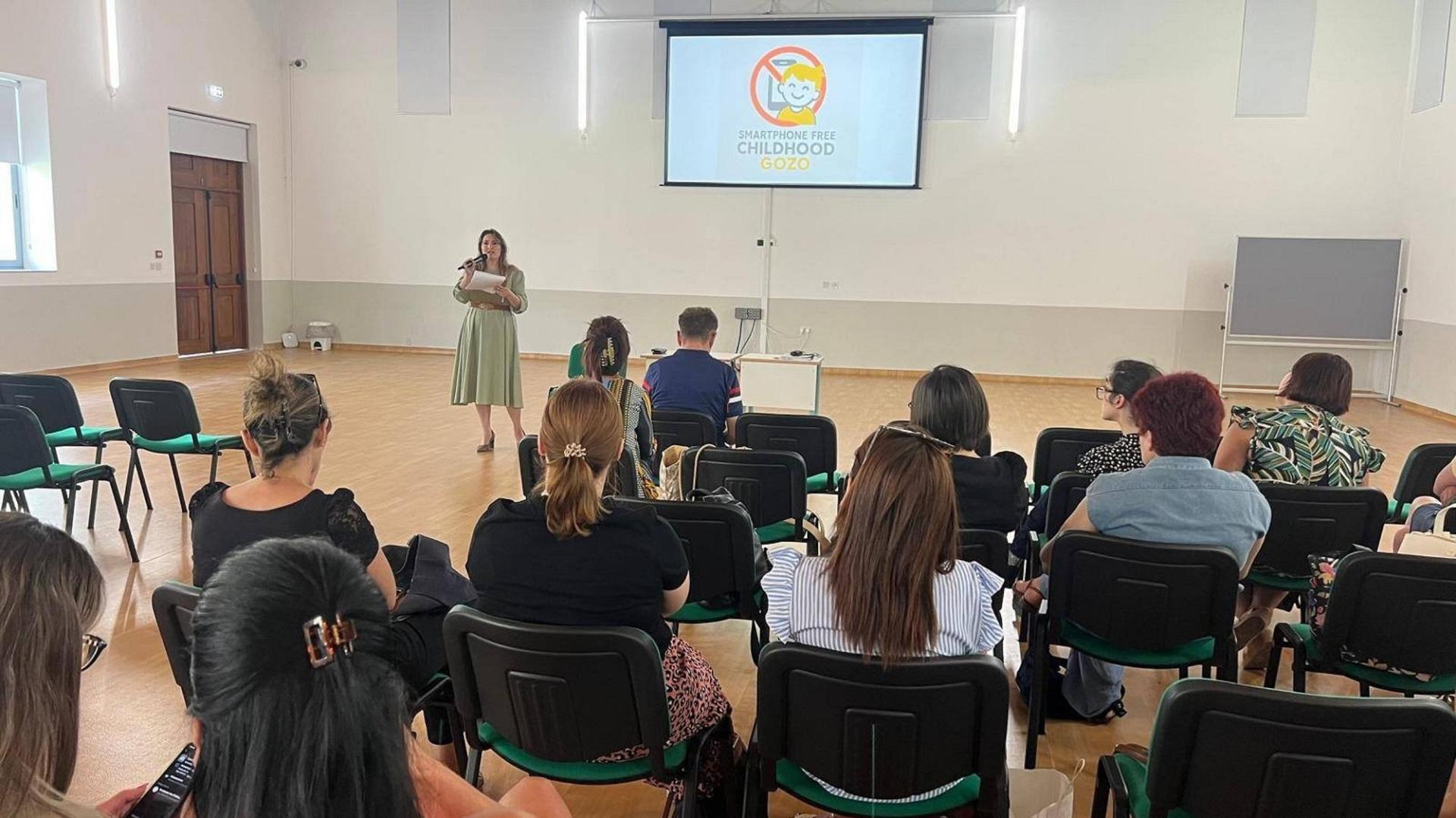 Pavia Grima has since been giving talks about the subject to parents and educators in schools.
Parents not at fault
Pavia Grima said the initiative understands that parents who give in are not at fault.
“Tech companies have put us parents in a lose-lose situation where we must either give our children access to a product that we know is harmful or we risk alienating them from their peers at a crucial stage of their development.”
The Gozo community began by reaching out to Year 4 parents and, due to the small size of the island, is quickly expanding, with the goal of covering all primary schools in Gozo. She said she could not have done it without the help of Gozo’s government primary school head Lelio Spiteri, who spread the word among parents of his so-called ‘happy school’.
“We’re trying to start a generation of children who are smartphone free,” she said.
In this community, the parents share links to articles, videos and ideas on how to explain to their children why this is important and on how to educate them about sexuality, digital safety and protecting themselves from harmful online content.
It ensures their children have a large circle of peers who, like them, do not own a smartphone but have a basic mobile phone instead, like a brick phone or flip phone, to allow them to communicate with their parents or friends when needed.
For older children, Smartphone Free Childhood International recommends mobiles that may look like smartphones but do not support social media, as an alternative to smartphones, to help avoid any possible embarrassment.
The Smartphone Free Childhood community is growing so much that they are considering breaking it into smaller subgroups, including one for parents whose children already have a smartphone, to share ideas for parental controls.
After starting her group, Pavia Grima thought the idea must have come to someone else around the world, and a quick search revealed the initiative has sprung into a global “smartphone free childhood” movement, with entire websites dedicated to the concept.
They are now in direct contact with the international movement that connects founders from over 30 countries.
Children accept it
And the children seem to have accepted it. Pavia Grima says the parents speak to them about social media addiction like they do about smoking and alcohol, and their children understand that they should not own a smartphone when they are young, just like they should not be drinking and smoking.
“So far, so good. I don’t know how long we can keep it going, but we’ll do our best, because I don’t see other options. Until legislation is in place to regulate this issue as it does other vices like smoking and other addictive substances, we must band together,” she said.
“The more parents we are, the better chance we have at succeeding.”
‘Unplug, Play, Grow’
Her initiative is not the first effort of its kind in Malta. Earlier this year parents of young children at San Anton School launched the 'Unplug. Play. Grow' initiative to collectively combat the issue.
The project, spearheaded by parents of children aged three to seven, aims to create a community where children are smartphone-free until age 15 and social media-free until age 16, effectively normalising a childhood without these pressures.
One of the parents spearheading that initiative is behaviour analyst Dr Natasha Attard, who says social media is simply not a place for children. She says today’s youth are more depressed, anxious and isolated than previous generations, and questioned the quality of the social experiences they have online.
Attard was part of panel in a conference organised last week by Times of Malta in collaboration with Parliamentary Secretariat for Equality and Reforms, which brought together experts and professionals discussing the subject ahead of a potential law regulating social media.
During the conference it was clinical psychologist Dr Nicholas Briffa who mentioned Pavia Grima’s initiative and hailed it as a step in the right direction, saying that empowering parents was essential.
He questioned what young people are seeking online that they are not finding in real life and observed that parents today face the opposite problem from the past – children no longer want to leave the house.
Later he also told Times of Malta the country offers very few organised urban spaces where families and children can meet and socialise, and that they don’t have many options in rural parts either, as most of that space is privately owned.
“Social media gives them a space that the physical world does not. That’s why governments should take this seriously and create more organised urban spaces where this crucial socialisation can happen, for everyone’s mental well-being,” he said.
Parents who are interested in joining the initiative can follow @smartphonefreechildhoodmalta on Instagram or visit the Facebook page ‘Smartphone Free Childhood Malta & Gozo’. The link to the WhatsApp group is available on both platforms.