‘I was in tears’: The night vandals brought down Mnajdra’s megaliths
Nobody was ever charged for the incident 25 years ago
The megaliths at the Mnajdra temple complex had been standing strong for some 5,000 years. But it took just one fateful night, 25 years ago, for vandals to topple 60 of the heavy stones in an attack that has stayed with Museums Department workers, who were brought to tears at the devastating sight.
It was in April 2001, on the night of Good Friday, that the attack – described by those who recall it first-hand as “systematic”, “frenzied” and “violent” – was carried out, severely damaging the prehistoric monument.
One of the oldest free-standing structures in the world, a UNESCO World Heritage site, had been partially knocked down, and despite an accepted climate of lax security at the time, it was unthinkable for those who arrived on site in the early hours of the following morning.
To date, the perpetrators of the crime remain unknown, although many rumours have since swirled, pointing fingers at hunters, quarry owners, esoteric activity and planning permits. A phrase uttered in parliament stuck: “Whoever did this was more protected than the temple itself.”
'I burst into tears'
Mario Coleiro, who worked in the archaeology team of the Museums Department, the precursor of Heritage Malta, recalls the incident step by step.
When he arrived at Mnajdra on his day off, following a call about the vandalism, he could not contain himself.
“I am not ashamed to say I burst into tears,” he said. The extent of the unexpected damage left him shocked. Coleiro thought he would find paint sprayed on the monument, as had been the case before.
“I was, in fact, one of the persons who had cleaned that off,” he said, listing similar paint attacks on other sites at the time.
Mnjadra had also withstood damage in a storm that knocked down a megalith some years back – and that turned out to be a blessing in disguise.
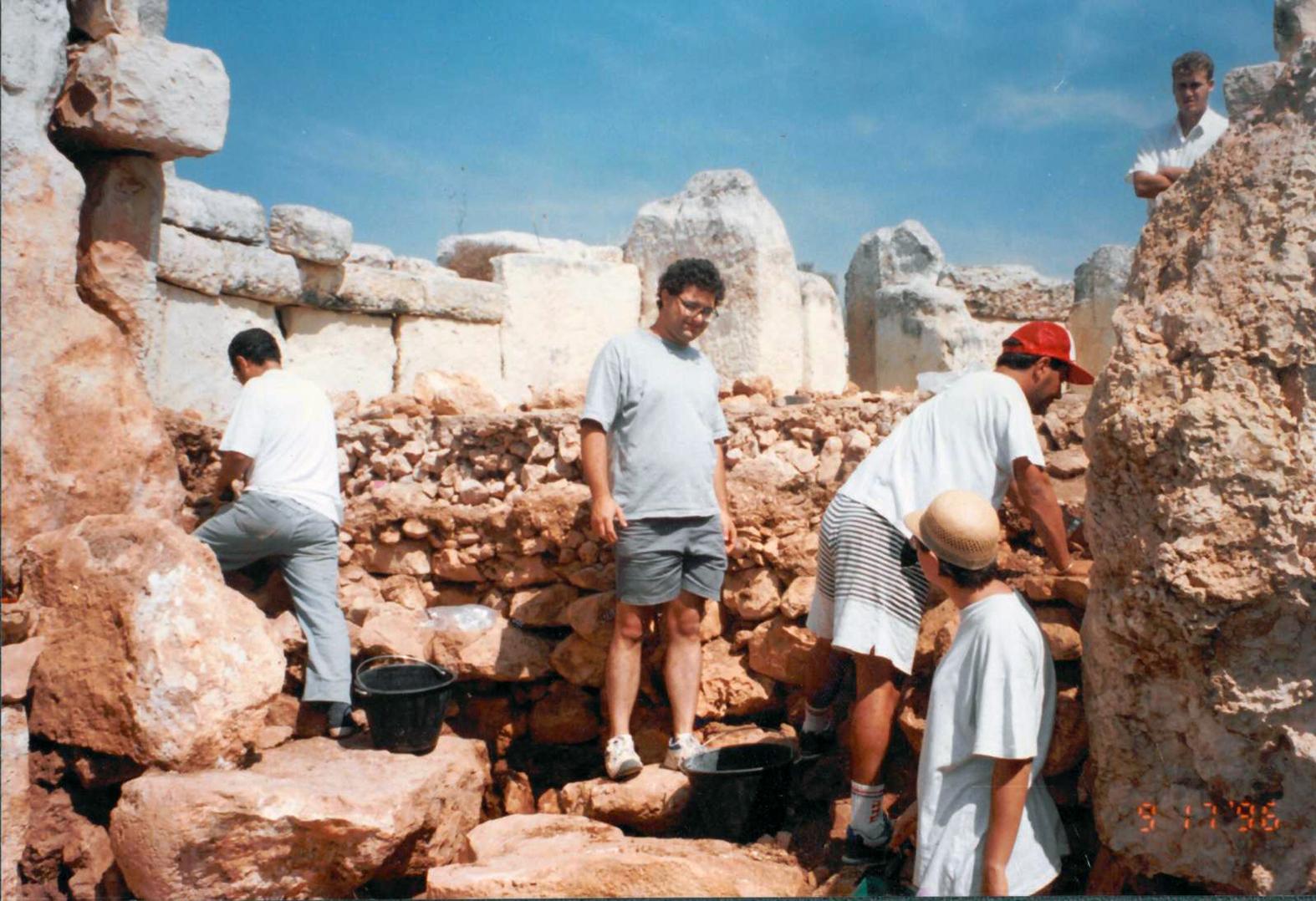 Mario Coleiro (in red cap) working on restoring the megalith after a storm.
The controversy that arose when the structure was put back “wrongly” led to a decision to photograph every single stone and its exact surroundings, “so that if any accidentally fell, we would know how to put them back”.
This was no accident, but that detailed photographic record proved to be an invaluable reference point when an assessment of the damage kicked off – at a time of no digitisation and a reliance on sketches, Coleiro said.
Security at heritage sites was minimal 25 years ago, and the scene was such that the key to a historical venue would be in the hands of a farmer living close by, or a neighbouring resident, Coleiro recalled.
With no watchman and fencing, people could picnic at the site at weekends, he said, remembering he would tell them to get off the stones if he happened to be there.
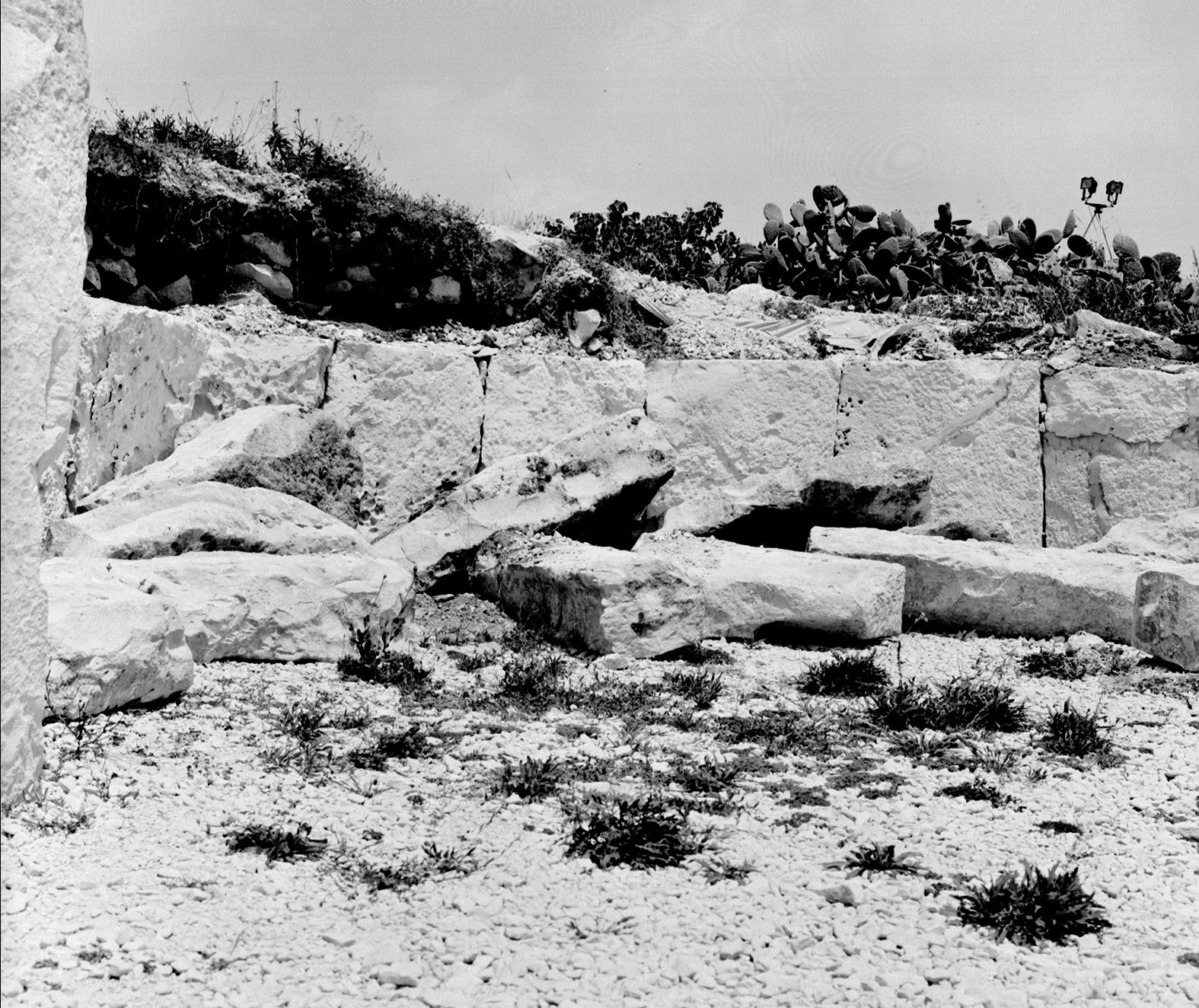 The vandalism was clearly 'systematic'.
A visit to the site that night by a group of university students for an astronomical event at Mnajdra also proved providential, according to Coleiro. As they descended along the path from Ħaġar Qim with their torches flashing in pitch darkness, a car was seen driving off through a passage behind the temple that is today closed off.
“Had those students not shown up, they would have dropped the whole thing,” Coleiro believed, given the way in which the stones were pushed down, one by one.
“It was not random. They would have gone on until the morning,” he said.
Coleiro recalled “preaching” to the journalists that accompanied him down to the site to “condemn the act with all their might”, fearing the idea of vandalising a heritage site for any protest would take root.
He was angry and wanted the perpetrators to pay for it, but more than anything, he was disappointed.
Immediate site improvements
Coleiro was involved in the consequent reinstatement of the stones – a long process that spilled over onto weekends and meant the temple complex was closed to the public for a while.
A fence was eventually erected, and today, his mind is at rest, thanks to “formidable” security.
The attack caused major outrage and led to site improvements in response to the outcry, spurring a wider effort to protect Malta’s prehistoric sites through security fencing, lighting, and later, protective covers at the temple complex.
“At the time, it was standard practice that sites in distant rural areas did not have any formal security, neither human nor otherwise,” Heritage Malta has said. A night watchman used to be posted at Ħaġar Qim only.
“Since then, starting immediately following the infamous event, the site has 24-hour professional security, even during opening hours, is surrounded by a discreet fence, and has full CCTV coverage.”
“Since 2010, both Mnajdra and Ħaġar Qim also enjoy a different kind of protection – that from the elements, through the protective tent shelters,” said the national agency that manages the sites.
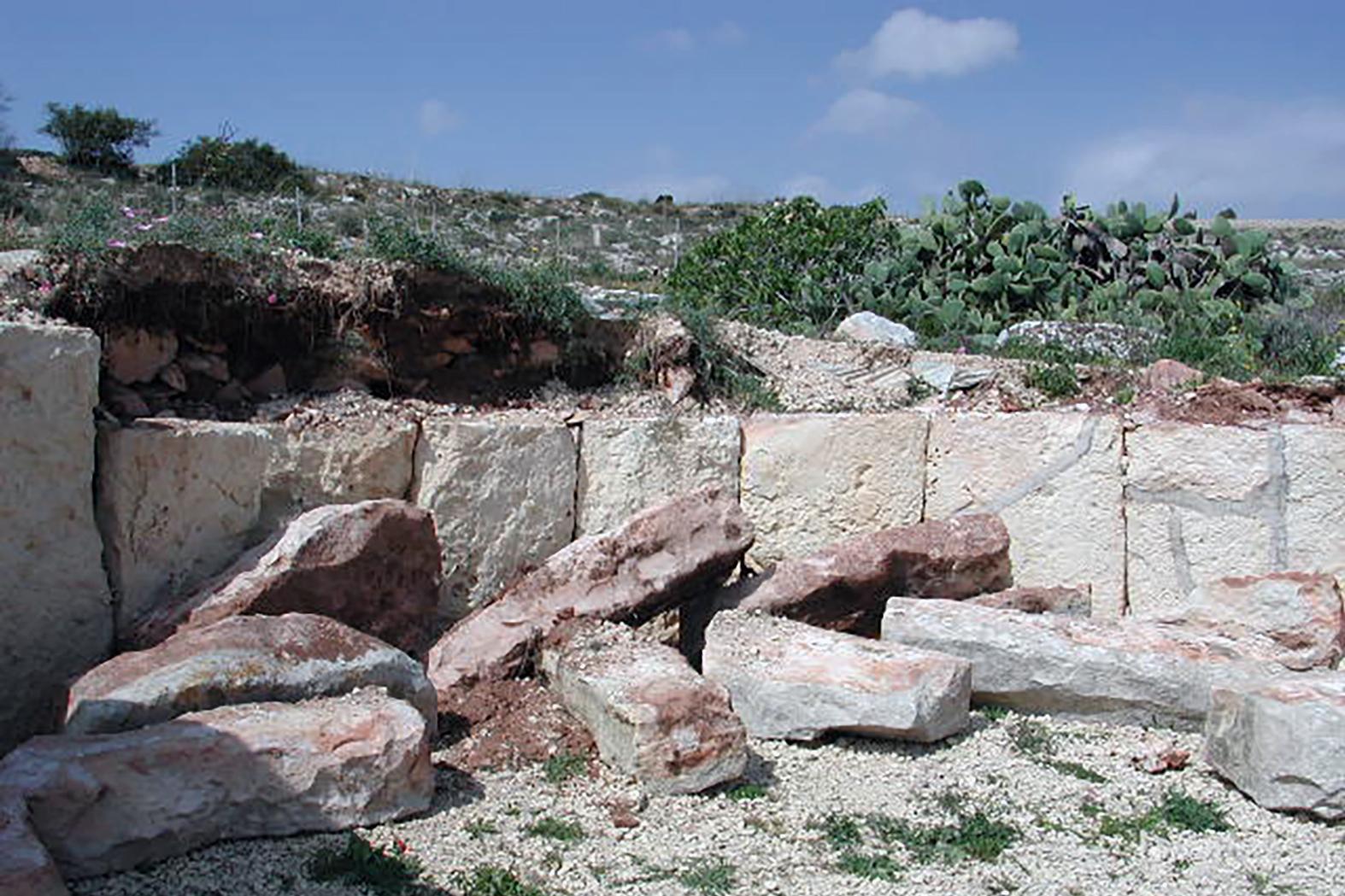 Mnajdra suffered severe damage.
‘The writing was on the wall’
While times were different 25 years ago, the attack “could have been avoided”, according to archaeologist Nathaniel Cutajar, then assistant curator at the National Museum of Archaeology.
He said the “writing was on the wall” and was left feeling “bitter” after cries to protect the monuments had been ignored, irrespective of reminders.
Mnajdra was exposed and plans for fencing were ongoing – at the time a “heart-wrenching” decision to take, with no unanimous agreement on the way forward.
The old fences were “awful”, and while the idea of exploring see-through boundaries was maturing, a fresh allocation of resources remained lacking.
Among the first crop of archaeologists to graduate in Malta, Cutajar was familiar with a decades-long controversy surrounding Ħaġar Qim and Mnjadra, which were “just part of the open landscape”, as well as funding issues.
It was a time when tourism was booming but the heritage it was relying on was “extremely under-resourced”, he said. Things had started to change, but it was “like filling an empty well”.
Security was an issue that clashed with public access and a universal right to enjoyment and ownership where heritage was concerned, he said. Many were using the same space, and the monuments were caught in between.
When the first fence was erected at Ħaġar Qim, the criticism was heavy from many fronts, so the Mnjadra fence never went up, resulting in minimal security at the top of the complex and none whatsoever below.
“You would hike at night and stop at Mnjadra to look at the sky…”
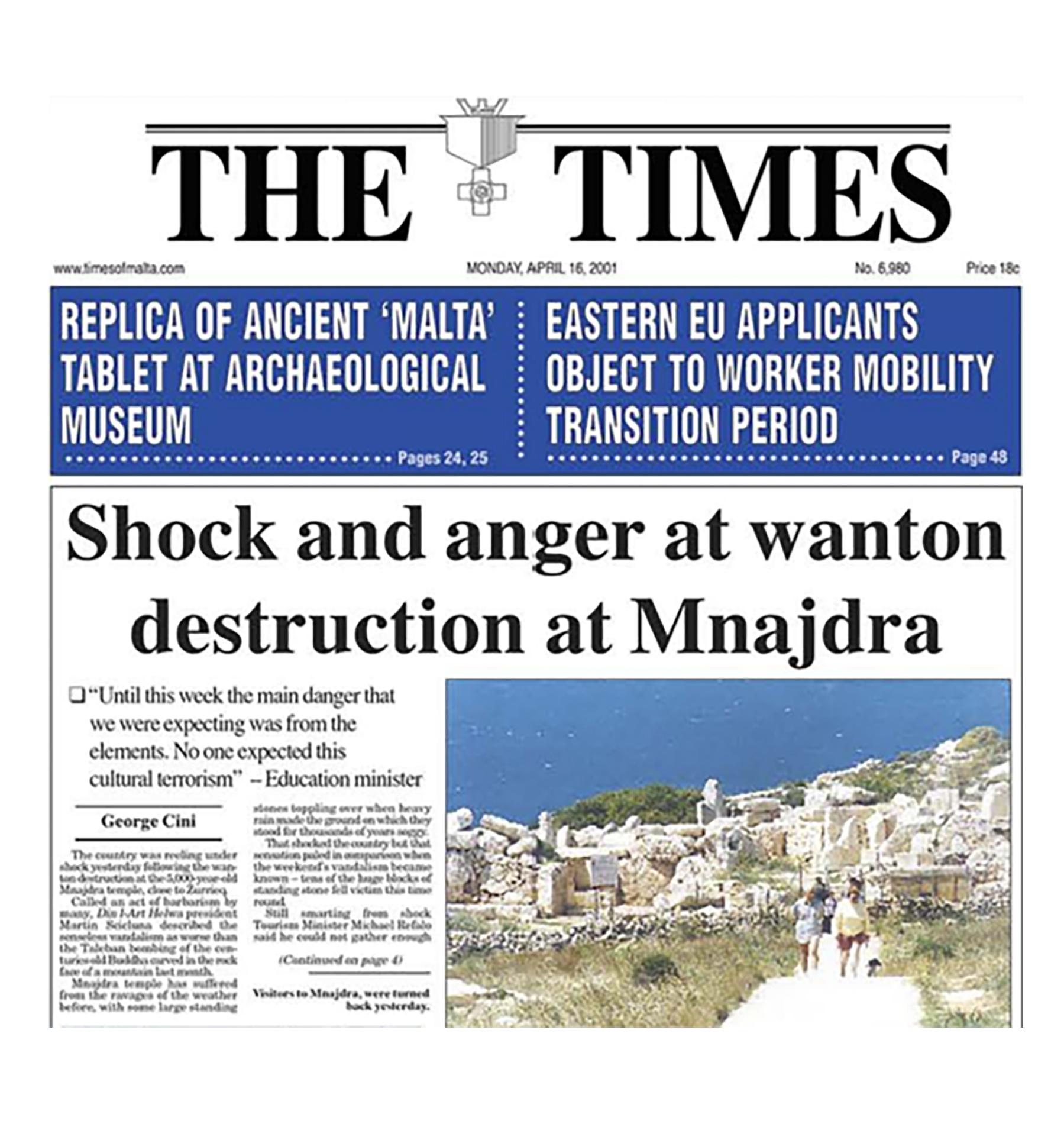
The reports about the Mnajdra vandalism in The Times of Malta
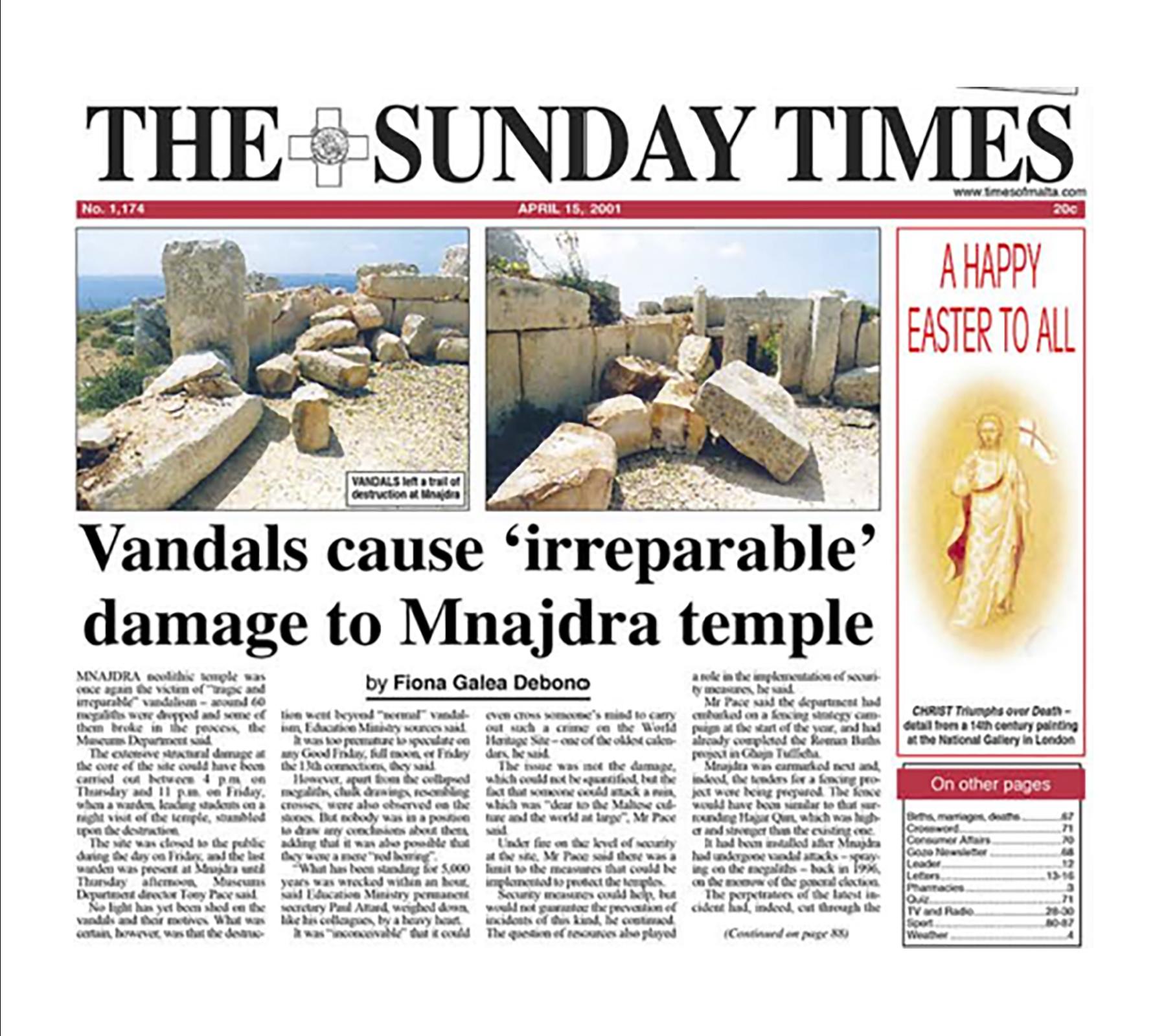
.
‘It felt very violent’
On that night, he rushed over with his colleague Rueben Grima at first light, and what dawned on them was “devastating”.
“We had been told some stones were upturned. Some is some… but there were 60!”
Cutajar, today the curator of medieval archaeology at the museum, was “not psychologically prepared for it”.
The vandals remain at large, but what Cutajar can say with some certainty is that it would have taken more than one person to push a megalith over – “not even if it were hit by a tornado”.
He insisted it was no mean feat. “Try and push a megalith… in the darkness… without hurting yourself,” suspecting a “team” was behind it.
“It is shocking in that way; when you try to visualise the scene.”
The police inquiry appeared to have been inconclusive, but the vandalism was clearly “systematic”: whoever did it was walking on the site and knocking down megalith after megalith from above.
“This was not about dropping a couple of stones to make a point,” Cutajar said, claiming the attackers appeared to have had a “frenzied” state of mind.
For the archaeologist, it “felt very violent”. Describing the nature of the attack as “overkill”, he equated it to “a murderer who does not stab a victim once but 50 times”.
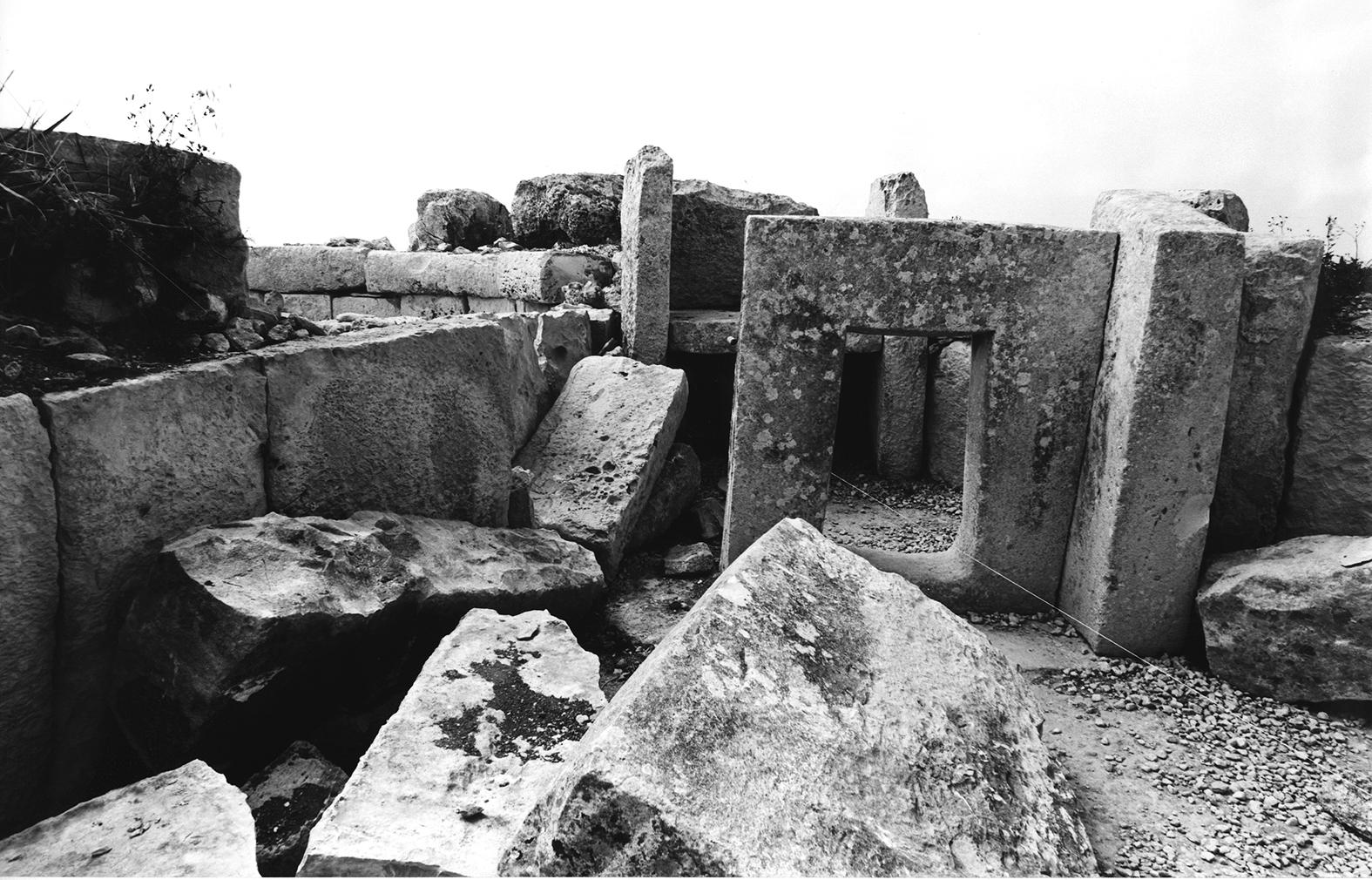 The attack caused major outrage and led to site improvements in response to the outcry, spurring a wider effort to protect Malta’s prehistoric sites through security fencing, lighting, and later, protective covers at the temple complex.
Fortunately, most of the stones did not actually break when they fell and a comprehensive reconstruction was eventually possible.
It was a long day 25 years ago, but fearing it could happen again, Cutajar and Grima volunteered to stay the night, without any light. They were later relieved by a contingent of watchmen who took over.
“We live with a constant threat,” he said, “because heritage is a symbol – and Mnajdra is one of recognised, outstanding, universal value, a monument to human ingenuity, particularly precious because of its age. Its creators had nothing to go by and found solutions to build on this scale.”
But symbols sometimes become the object of hate – “sometimes by the very people who love them in a sort of reverse psychology situation, and sometimes for greed”, Cutajar said.