Ian Borg nominates US President Donald Trump for Nobel Peace Prize
Foreign Minister cites Trump's work mediating talks between Armenia and Azerbaijan
Foreign Minister Ian Borg has nominated US President Donald Trump for a Nobel Peace Prize, citing his work mediating the conflict between Armenia and Azerbaijan.
Writing on Facebook, Borg said he had “presented the American president with a letter I wrote in my own name, in which I informed him that, like many others, I have nominated him for the Nobel Peace Prize”.
“I also urged him to continue working on the Middle East and Ukraine,” wrote Borg, adding he was “pleased today to see increased commitment that is bringing us closer to peace”.
Borg noted that through his role chairing the OSCE last year, he had “worked with many people on the conflict between Armenia and Azerbaijan, towards a peace that was finally brokered this summer by the American President”.
The leaders of Azerbaijan and Armenia signed an agreement at the White House in August aimed at ending decades of conflict between the two countries, in a move described by the US president as “historic”.
Meanwhile, earlier on Thursday, Israel and Hamas agreed a Gaza ceasefire deal that could free the remaining living hostages within days, in a major step toward ending the war in the conflict-stricken Gaza Strip.
In January, Borg was one of just eight top government officials from around the world to attend Trump’s inauguration.
Trump has made no secret of the fact that he would like to win the Nobel Peace Prize. But so far, the award has eluded him throughout his two US presidencies.
Trump's push for the prize, whose 2025 winner will be named on Friday, is fueled by a potent mix of a desire for prestige and a long rivalry with former president Barack Obama.
Sometimes Trump, who is often better known for his divisive rhetoric, anti-migration drive and embrace of foreign authoritarians, has appeared to acknowledge that he is an unlikely candidate.
"Will you get the Nobel Prize? Absolutely not. They'll give it to some guy that didn't do a damn thing," Trump said during a speech to hundreds of the US military's top officers in September.
But in the same breath, Trump revealed his true feelings.
"It'd be a big insult to our country, I will tell you that. I don't want it, I want the country to get it. It should get it because there's never been anything like it," he said at the same gathering.
'Seven wars'
As the Norwegian committee's announcement has drawn nearer, the steady drumbeat of Trump's campaigning for the peace prize has intensified to unprecedented levels.
In recent weeks, barely a public event has gone by without Trump bragging about what he says is his role in ending seven wars.
Trump's administration recently listed them as being between Cambodia and Thailand; Kosovo and Serbia; the Democratic Republic of Congo and Rwanda; Pakistan and India; Israel and Iran; Egypt and Ethiopia; and Armenia and Azerbaijan.
But while Trump has been quick to claim credit for some — for example, announcing a ceasefire between nuclear-armed Delhi and Islamabad in May — many of the claims are partial or inaccurate.
Trump has even bombed one of the countries he mentions. He ordered US military strikes on Iran's nuclear program in June.
But perhaps the biggest issue is that the two main wars that Trump promised to end within days of his inauguration — in Gaza and Ukraine — are still raging.
His push for a deal between US ally Israel and Hamas to end the brutal two-year war in Gaza has reached a climax just days before the Nobel announcement — but is almost certainly too late to sway the committee.
Foreign leaders seeking to curry favour with Trump have been quick to talk up Trump's chances.
Israeli Prime Minister Benjamin Netanyahu nominated Trump for the prize, as did an Israeli advocacy group campaigning for the release of hostages in Gaza.
Pakistan also nominated Trump while the leaders of several African countries paid tribute to his supposed peacemaking efforts on a visit earlier this year.
Obama rivalry
But while Trump wants international recognition as "peacemaker-in-chief," there is another driving factor.
Since the beginning of his presidential ambitions 10 years ago, "he has put himself in opposition to Barack Obama, who famously won the Nobel Peace Prize in 2009," Garret Martin, a professor of international relations at American University, told AFP.
The prize awarded to the Democratic former president, barely nine months after he took office, sparked a heated debate — and continues to annoy Republican Trump.
"If I were named Obama, I would have had the Nobel Prize given to me in 10 seconds," Trump complained in October 2024, during the final stretch of the presidential campaign.
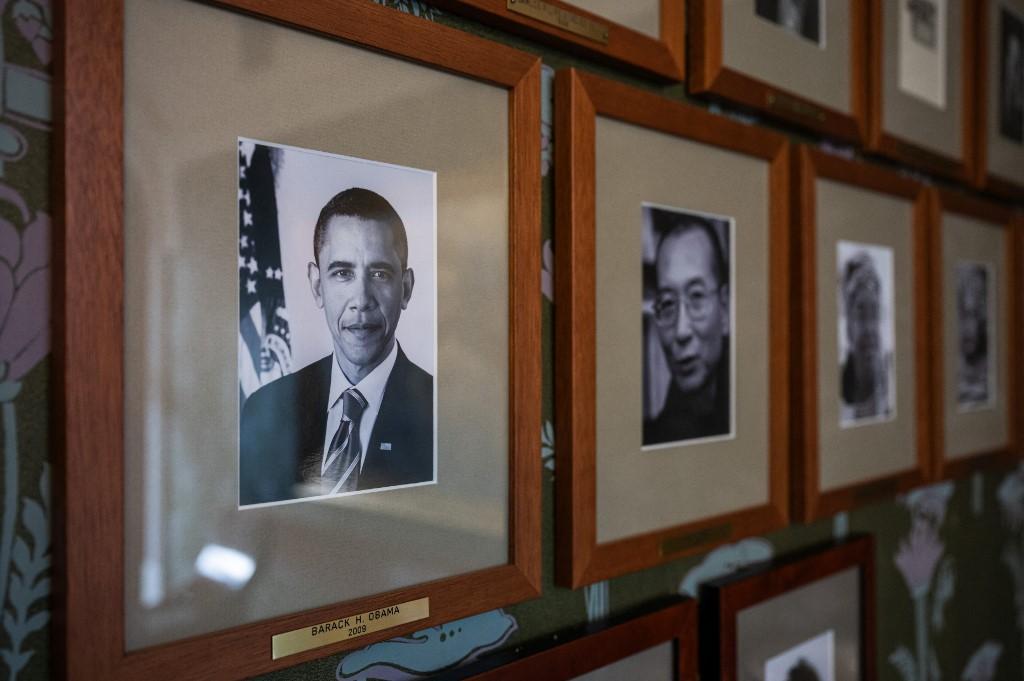 A portrait of former US president Barack Obama, Nobel Peace Prize laureate of 2009, next to other photographs of laureates on a wall of the committee meeting room at the Norwegian Nobel Institute. Photo: AFP
Three other US presidents have also won the award: Theodore Roosevelt, Woodrow Wilson, and Jimmy Carter, although Carter won his decades after his presidency for his subsequent peace efforts.