Malta hosts European conference on work-based learning
Event calls for system-wide collaboration to close graduate skills gap
A high-level conference held in Malta has confronted an urgent systemic challenge: education is not keeping pace with the demands of the modern labour market.
The event heard how nearly three in every four employers report difficulty finding graduates with the right skills, calling on measures to tackle the issue across Europe.
Held at The Brewhouse, Central Business District Malta, under the theme From Insights to Impact: Pioneering Work-Based Learning and Digital Transformation, the event drew more than 80 participants, including senior academics, government ministers, industry leaders, European chamber representatives, peer-reviewed authors, and Erasmus+ partners from Malta, Ireland, Italy and Portugal.
The event was hosted by Knights College Malta as part of the two-year Erasmus+ KA220-HED Cooperation Partnership WBL Champion (Project No: 2024-1-IT02-KA220-HED-000245540), coordinated by VITECO SRL (Italy), alongside partners INOVA+ (Portugal) and Technological University Dublin (Ireland).
Opening the Summit, Morgan Parnis, CEO and Chancellor of Knights College, challenged delegates to consider the surgeon who scores top marks on every written exam, but has never performed surgery.
"Knowledge matters," he said, "but competence only comes from doing, under real conditions, with real consequences."
He argued that Work-Based Learning is not a correction to the current model. Rather, it is a restoration of something higher education already knew worked.
Education doesn't end in the classroom — it begins in the workplace- Morgan Parnis, CEO and Chancellor, Knights College Malta
The Summit carried significant institutional weight.
A video address by European Parliament President Roberta Metsola underlined the European policy relevance of Work-Based Learning, while Hon. Stefan Zrinzo Azzopardi, former Minister for European Funds, in his personal address, praised Knights College for its Erasmus+ leadership and stressed that Malta's competitiveness depends directly on the quality of the people it produces.The national research underpinning the project confirmed the urgency.
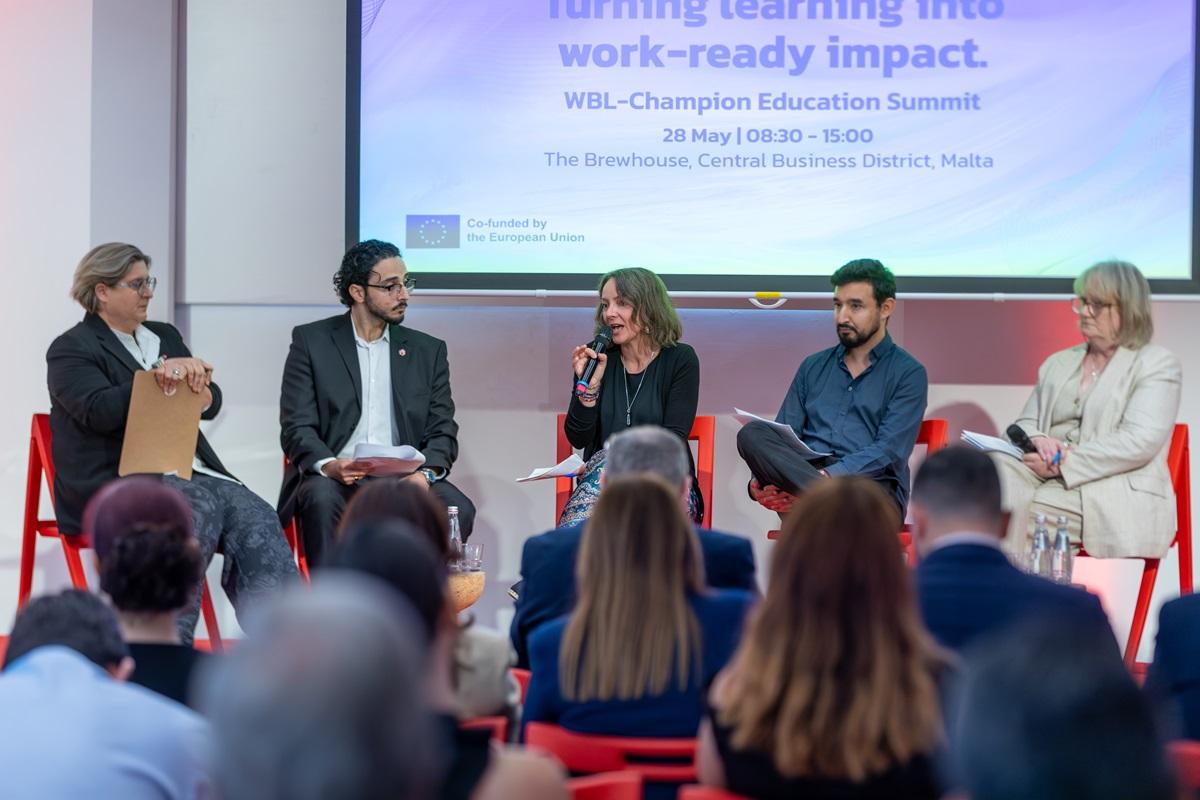 The event drew more than 80 participants.
Employers report skills shortcomings
Across Malta, Italy, Portugal and Ireland, the consortium's reports found that 74% of EU employers report difficulty finding graduates with the right skills (CEDEFOP, 2023), and 40% of Higher Education Institution degree programmes lack structured Work-Based Learning (OECD, 2023).
Mary Anne Cauchi, representing Esplora Interactive Science Centre, reinforced this with a call for STEAM-centred learning, arguing that creativity and interdisciplinary thinking are precisely what the labour market needs, and that children are already hardwired for them. "Technology alone doesn't innovate," she noted; "people do."
Alessandro Di Lullo of SuperCharger Ventures added that 72% of employers believe AI will reshape their workforce, posing a key question: "Are our graduates ready?"
Lara Camilleri of Konnekt observed that today's employers recruit as much for attitude as for technical skills, and that the labour market is increasingly candidate-driven.
Prof. Patrick Flood of Technological University Dublin brought a change-management lens, arguing that institutions must confront the cost of not changing. "The power of persuasion is important to share your vision," he told delegates.
The panellists were united on the diagnosis but direct about the remaining gaps.
Martin Borg, who contributed to the development of Knights College's Work-Based MBA, identified the three pillars underpinning effective WBL: intentional curriculum design, robust quality assurance, and strong employer partnerships.
Clayton Micallef Grimaud, Director of Strategy and Education Relations at the National Skills Council, added that these pillars cannot stand without structural policy alignment, pointing to coordination failures between education and the labour market as the central systemic bottleneck that goodwill alone cannot resolve.
Michelle Vassallo Pulis, Senior Manager at Deloitte and Senior Teaching Associate at the University of Malta, grounded this further, arguing that applied professional insights must be systematically embedded in programme design if WBL is to scale beyond isolated examples.
An expert panel representing all four consortium countries examined what it takes to move WBL from isolated good practice to systemic reality.
Kristina Galea Borg, Principal and Vice-Chancellor of Knights College, described WBL as the institution's organising principle, not an add-on feature, and called on institutions to give employers a genuine voice in curriculum and assessment design.
“Work-Based Learning is not a fashionable add-on. It is the organising principle of Knights College — and this project makes that visible and scalable at European level,” she said.
Assumpta Harvey of TU Dublin argued that WBL is a strategic imperative requiring buy-in across academic leadership, QA offices, and teaching staff.
Marcio Couto of INOVA+ highlighted the importance of adaptable, transferable models across regulatory contexts, while Nadja Dokter of VITECO SRL noted that European collaboration reveals there is no single perfect model — the value lies in shared principles: clear outcomes, robust supervision, meaningful assessment.
The Summit also showcased the project's open-access outputs: national WBL research reports in four languages, six redesigned HE degree programmes, three CPD modules for academic coordinators, supervisors, and industry mentors, a Quality Assurance Toolkit, and an online platform, all freely available to institutions across Europe.
The WBL Champion project continues through 2026. Involved partners encourage interested readers to follow the project’s LinkedIn for more updates in the coming weeks