Mediterranean surface temperatures rise as Europe swelters in record heatwave
The EU’s Copernicus Marine Service on Tuesday revealed higher-than-usual temperature readings across the continent
Above-average surface temperatures of up to six degrees Celsius above the norm were recorded in parts of the Mediterranean yesterday, amid a baking European heatwave.
Thermal imaging of European waters released by the EU’s Copernicus Marine Service on Tuesday reveals higher-than-usual temperature readings across the continent, as high as six degrees Celsius higher in the Western Mediterranean.
The waters around Malta were among the hottest, with the imagery suggesting Malta’s waters could have seen temperatures around three or four degrees Celsius above the norm.
“After the marine heatwave at the end of May 2026, the intense temperatures which affected western and central Europe during the third decade of June caused further warming of the surrounding seas”, the Copernicus Marine Service explained.
Imagery captured by the service on May 30 showed parts of the Mediterranean experiencing moderate to strong marine heatwaves. Waters south and southwest of Malta saw moderate marine heatwaves.
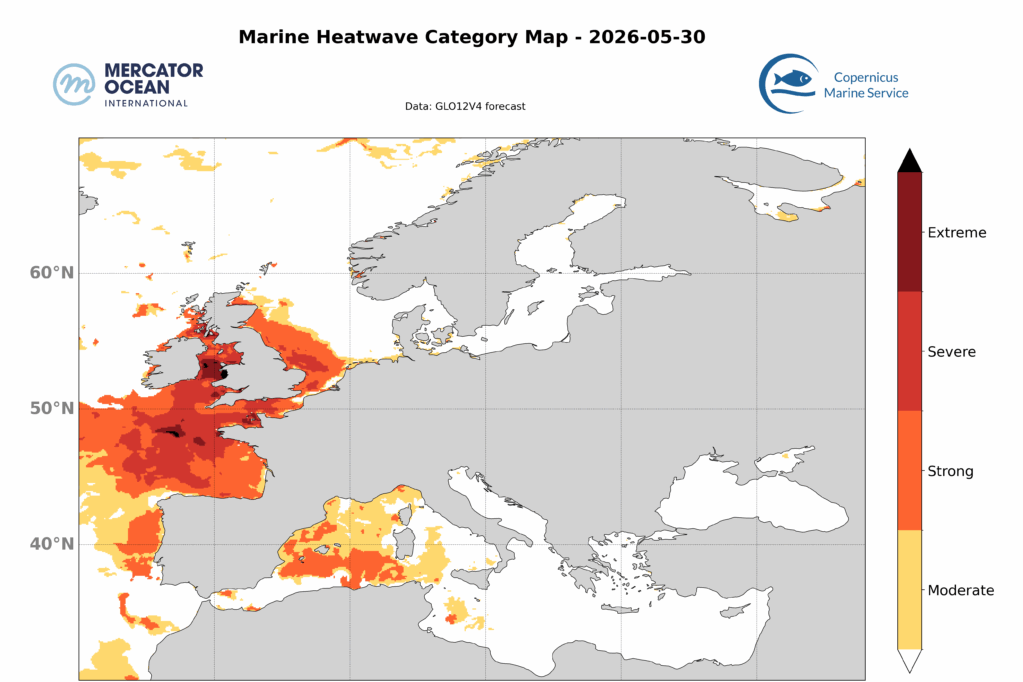 Marine heatwaves seen at the end of May, coupled with a heatwave in June, has led to rising surface temperatures. Graphic: Copernicus Marine Service/Mercator Ocean International.
“The largest anomalies reached approximately 6°C in the western Mediterranean Sea, particularly in the Gulf of Lion off the coast of southern France, and in the Ligurian and Tyrrhenian seas along the western coast of Italy”.
Higher surface temperatures were not only recorded in the southern, traditionally warmer parts of Europe; temperatures of up to five degrees Celsius higher than the norm were also seen in the Baltic Sea and parts of the North Sea, the imagery released Tuesday suggests.
Earlier this month, leading marine biologist Alan Deidun told Times of Malta that marine heatwaves were leading to a “tropicalisation of the Mediterranean”, killing off native species and driving the spread of invasive species in Malta’s waters.
Warning that parts of the Mediterranean were heating “beyond our wildest expectations”, the University of Malta professor said, “it’s not just about the sea heating up but also about it not cooling down”.
Europe has been cooking in a record-breaking heatwave for over a week, with temperatures climbing as high as 40 degrees Celsius across parts of the continent, sparking wildfires and public health concerns.
World Health Organisation (WHO) director-general Tedros Adhanom Ghebreyesus said on Sunday that more than 1,300 excess deaths had been recorded across Europe since June 21, with 150 million people living under extreme heat.
“Heat stress is often called the ‘silent killer’ – and European homes, workplaces and schools were not built for these temperatures. Europe is now the fastest-warming continent on Earth, heating at twice the global average," he said.
“Driven by climate change and global warming, the phenomenon of the “once-in-a-generation” heatwave is now occurring nearly annually. We were warned.”
The WHO chief called on European countries to implement heat health action plans in response to the rising temperatures.
High temperatures are forecast to continue through tomorrow in Malta, with the latest Met Office forecast predicting the temperature will feel as hot as 36°C.