Malta’s bays ‘becoming alien worlds’, says leading marine biologist
University of Malta warns of toxic pufferfish invasion, impacting marine ecosystem
Marine heatwaves are driving the spread of invasive marine species into Malta’s waters, with popular bays across the country “becoming alien worlds”, according to a leading marine biologist.
Alan Deidun said Mediterranean temperatures were rising, with parts of the northwest recording increases “beyond our wildest expectations” and temperatures up to eight degrees above the norm.
Warmer waters are killing native species and helping alien species flourish, including potentially lethal species of pufferfish increasingly found in local waters.
The marine biologist pointed to recent results showing that the underwater temperature last Thursday was higher than 90 per cent of all temperature results recorded for June 18.
Temperatures were registered by scientific buoys placed at depths ranging from five to 50 metres.
A recent study by Deidun and researchers Laura Prieto and Adam Gauci found evidence of marine heatwaves to depths of 30 metres in coastal waters off Mġarr ix-Xini every year from 2019 to 2023. Marine heatwaves are registered when a record-breaking underwater temperature, compared to past examples of the same calendar day for that location, continues for five days in a row.
“So, it’s not just about the sea heating up but also about it not cooling down,” Deidun said.
He said the “tropicalisation of the Mediterranean” was happening faster than elsewhere, stressing native species and helping invasive species survive in waters that were once too cool for them.
“Invasive species are spreading like mad in bays like Wied iż-Żurrieq, Xgħajra, Marsascala and Marsaxlokk, which are becoming alien worlds,” said Deidun.
Sea urchins were forced to retreat to lower, cooler depths while entire colonies of some coral species were dying off, he said.
Deidun, who heads the University of Malta’s Oceanography Malta Research Group (OMRG), warned that four species of pufferfish – two native and two invasive – had been found in Maltese waters: the diamondback puffer, blunthead puffer, oceanic puffer and silver-cheeked toadfish.
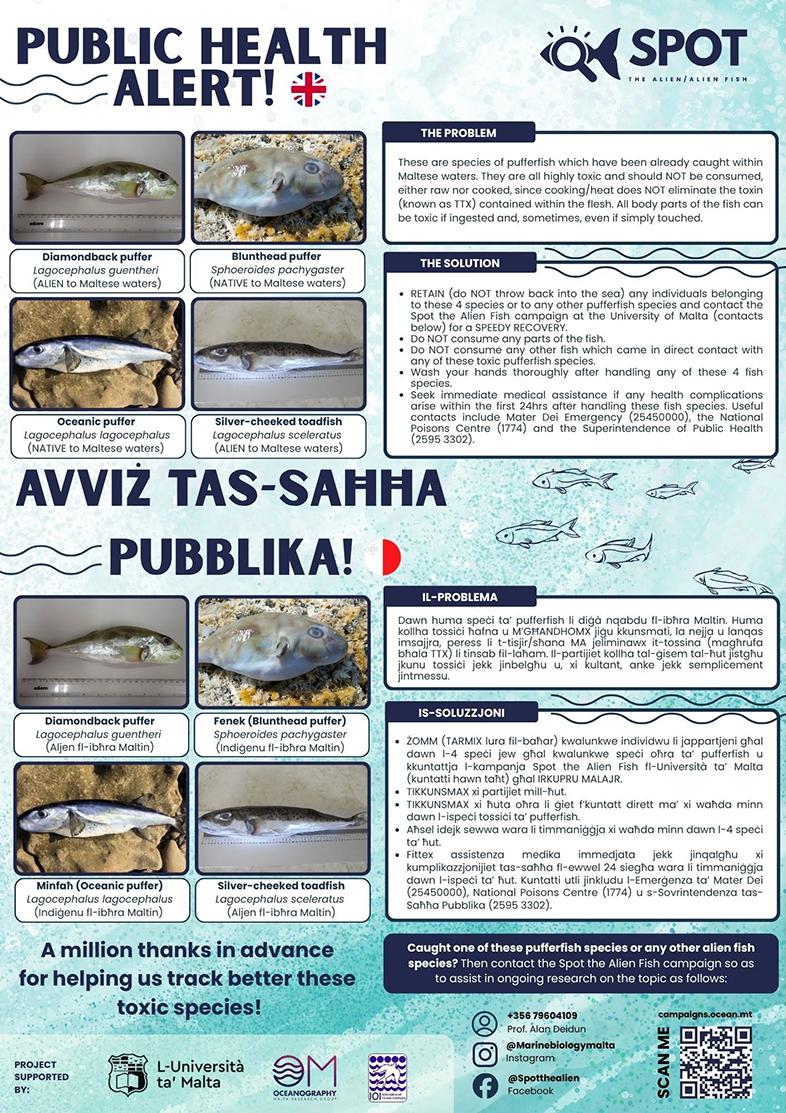 The University of Malta has issued a warning about four species of pufferfish spotted in Maltese waters. Graphic: Oceanography Malta Research Group
The four species featured in the OMRG’s latest “Spot the alien fish” campaign, which describes them as “highly toxic” because they contain the neurotoxin tetrodotoxin. They should not be eaten, even after cooking.
Pufferfish in large numbers
While all the pufferfish featured in the campaign had previously been detected in Maltese waters, silver-cheeked toadfish numbers had “exploded” over the past two years and were now found in large numbers on both coastal flanks of the country, Deidun explained.
Invasive pufferfish also pose an economic threat. Euronews reported last week that fishermen in the Greek island of Crete were losing up to €8,500 a year to the toxic fish, which enter the Mediterranean through the Suez Canal.
Pufferfish have strong teeth that can bite through wood, nylon and even metal fishing hooks. They often tear through nets to escape or attack other fish. Many species of pufferfish are omnivorous and have almost no natural predators in the Mediterranean.
Deidun said current predictions were for fewer jellyfish blooms this summer, as happened last year when jellyfish were largely absent from swimming spots. Scientists remained “baffled” by the phenomenon, said Deidun. The marine biologist’s warning on marine heatwaves follows fellow University of Malta academic Stefano Moncada's recent warning that the Mediterranean is a “climate hotspot” and that Malta should expect more weather extremes such as powerful storms and hotter heatwaves in the coming years.