Why neuroplasticity matters for students facing MATSEC exams
Brainy tips for students, educators and parents to prime for success
A few days before the MATSEC exams, this situation might sound familiar to most post-secondary students in Malta. It is 2am in their quiet bedroom. Past papers are piled high, notes are scattered everywhere, dinner has gone cold on their desk, and they are staring at a page that looks like a foreign language. In that moment of exhaustion, a dangerous thought sneaks in: “I’m just not smart enough for this. My brain wasn’t built for this.” But neuroplasticity has a much more hopeful message for students: your brain is like a garden!
The garden metaphor
This concept is known as neuroplasticity: the brain’s incredible ability to physically reorganise itself in response to what we experience.
Think of your brain as a lush garden. If you walk across the grass in the same spot every day, a clear path forms. In the brain, these are your neural connections. When you practise a new skill or study a difficult topic, you are treading a new path. At first, it’s difficult and overgrown. But the more you walk it, the smoother and more permanent that path becomes.
The same happens in the brain. The more you study a concept; the more neurons form connections through processes called ‘synaptic plasticity’ and ‘dendritic remodelling’. Conversely, old pathways, such as negative self-talk or bad habits, eventually fade if we stop using them, via the neuroplastic process called ‘dendritic pruning’.
The mind’s ‘Miracle-Gro’
How does the brain actually build these paths? The process uses the BDNF (Brain-Derived Neurotrophic Factor). Think of BDNF as ‘Miracle-Gro’ for your neurons. This protein supports the survival of your existing brain cells and promotes the birth of new ones (neurogenesis), particularly in the hippocampus, which is the brain’s ‘library’ for memory. Higher levels of BDNF are linked to better moods, sharper memory and, crucially for sixth formers, greater resilience to exam stress.
Stress trap
However, there is a catch. For students navigating the high-pressure world of A levels and Intermediate exams, stress is a constant companion. While a little bit of ‘up-for-the-challenge’ eustress (good stress) is fine, chronic distress is like a drought in our brain-garden.
Prolonged academic pressure without emotional support can actually lower your BDNF levels and impair the very parts of the brain you need for the exam: memory and emotional regulation. This is why ‘studying harder’ while feeling burnt out often yields poor results.
Neuroplasticity toolkit
To move from ‘fixed ability’ to ‘limitless growth’, we need a new approach to the academic journey. Here is how students, teachers and parents can prime the brain for success.
For students: Feed your brain-garden
• Take a ‘power nap’ and/or go on a ‘power walk’: Physical exercise is one of the fastest ways to spike your BDNF levels. If you’re stuck on a problem, 20 minutes of movement will ‘prime’ your brain to learn better when you return.
• Embrace the ‘mistake-high’: Every time you get a question wrong and then figure out why, your brain is physically reshaping itself. Mistakes are not failures; they are the ‘construction signs’ of a new neural pathway.
• Master metacognition: Don’t just read; reflect on how you learn. Ask yourself: “Why did this strategy work for me today?” This reflection strengthens the circuits used for problem-solving.
For educators: Create ‘Brain-safe’ classrooms
• Focus on the ‘yet’: Shift from performance outcomes to a ‘growth mindset’. Instead of telling a student “you’re good at this”, try saying “the effort you put into that essay has really strengthened your analytical skills”.
• Psychological safety first: When a student feels safe and supported by teachers, their stress levels drop. This isn’t just ‘kindness’. It’s biological optimisation. A relaxed brain is a learning brain.
For parents: Be the emotional buffer
• Validate the struggle, not just the grade: Resilience isn’t about ‘toughening up’ alone; it’s about having the tools to handle challenges. When a student feels ‘seen’ during a setback, they recover faster biologically.
• The ‘stress buffer’ role: You are the gardener’s assistant. By providing a supportive environment and encouraging healthy food, sleep and social connections, you are helping to reverse the negative effects of exam stress on their brain.
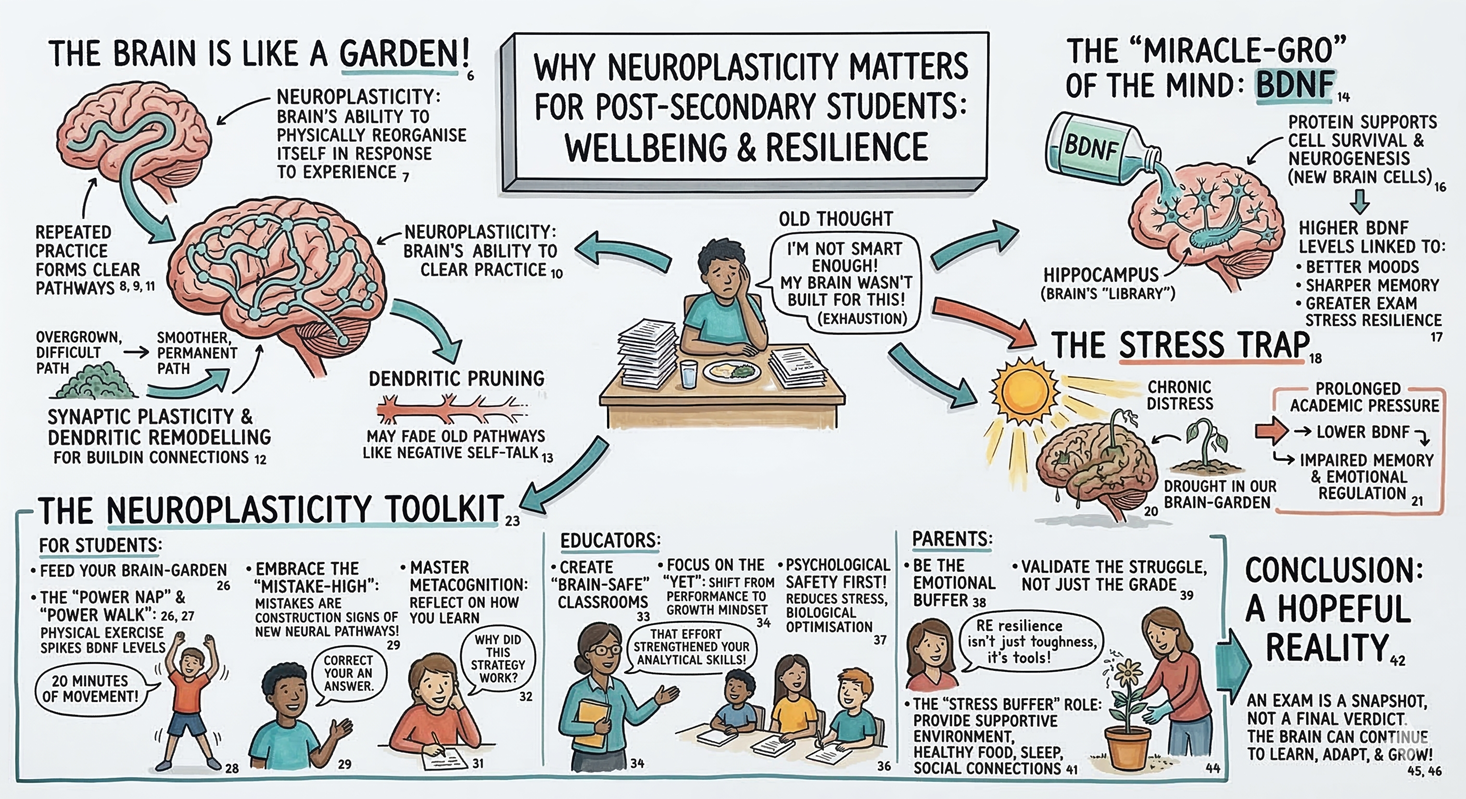 Neuroplasticity is our brain’s incredible ability to physically reorganise itself in response to what we experience.
Conclusion: A hopeful reality
For post-secondary students, the message of neuroplasticity is a game-changer. An exam result or a bad mock paper is not a final verdict on your intelligence. It is simply a snapshot of your garden at one moment in time. With the right tools, support and a bit of ‘Miracle-Gro’ in the form of self-care, the brain can continue to learn, adapt and grow far beyond the walls of the examination hall.

Josephine Ebejer Grech is a doctoral candidate studying the well-being and academic resilience of post-secondary students.