Original White Rocks architect says abandoned homes should be restored
Michael Hirst designed the Married Officers’ Quarters 65 years ago
The British architect behind the Married Officers’ Quarters 65 years ago – today’s derelict White Rocks – would reinstate the houses and have them lived in and enjoyed.
Michael Hirst says this is not just due to nostalgic attachment to the project but because they were designed specifically to deal with the Mediterranean climate.
The clusters of houses and flats were built into the jagged verticality of the terrain between Pembroke and Bahar iċ-Ċagħaq between 1960 and 1963, and Hirst moved on.
It was just one assignment of many in his role as a tropical architect. But it also began his love story with Malta, which he visits every year.
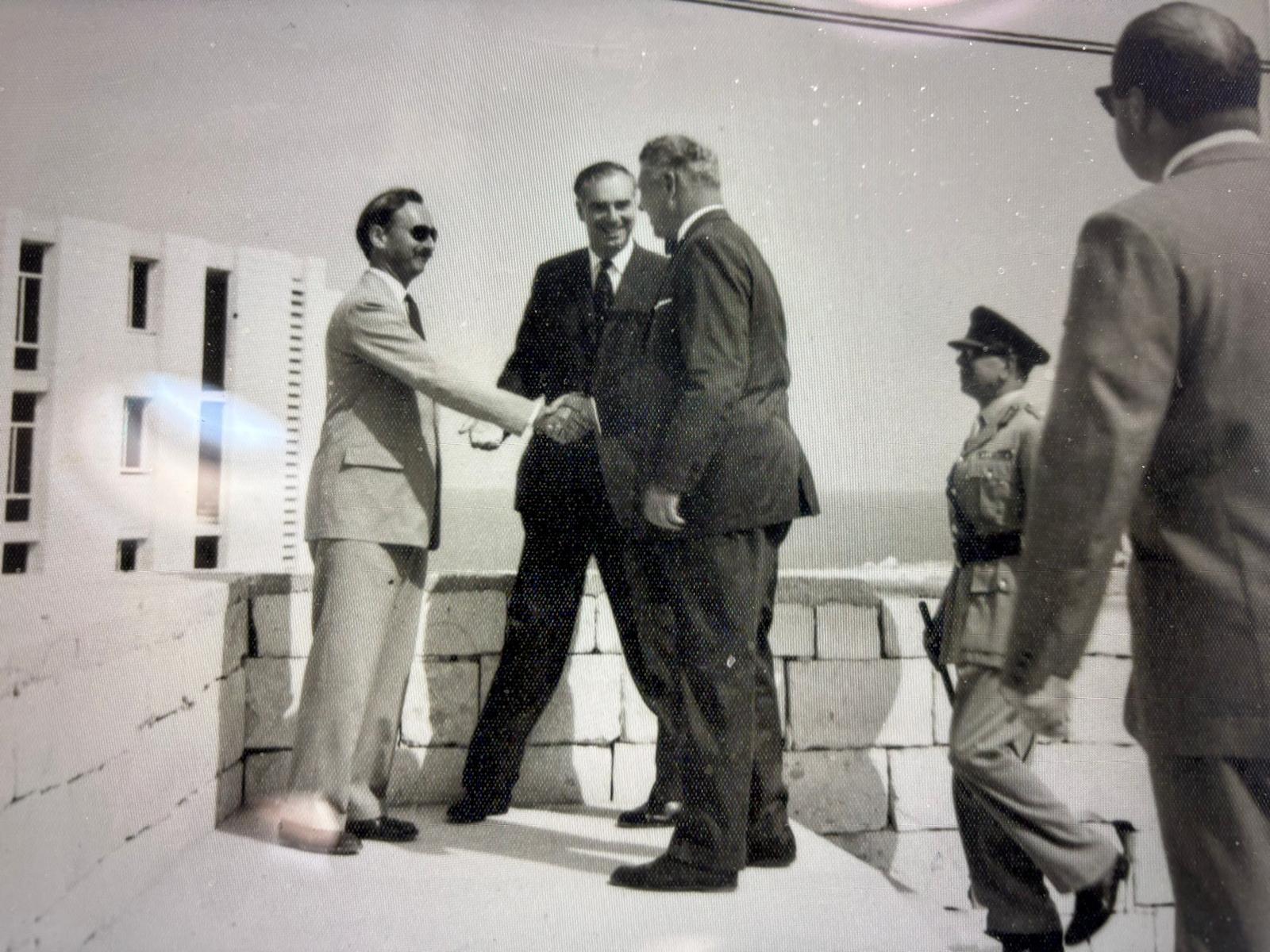 Architect Michael Hirst (left) meeting the governor on site. Photo: Michael Hirst
Despite close and long-standing ties with the island, at 93, he did not expect to be going down memory lane recently and presenting a talk on White Rocks, which the government is planning to turn into a national park after several failed privatisation and redevelopment attempts by successive administrations.
Asked what he would do today, Hirst said he would rehabilitate those 59 dwellings he had built, designed to counter climatic conditions at the time, and make them liveable again.
Hirst described Malta as a “maritime semi-desert” and that dictated much of his redesign of the Married Officers’ Quarters.
They were “good housing, left empty” for decades, and Hirst felt it was a “shame” they were not occupied and made use of.
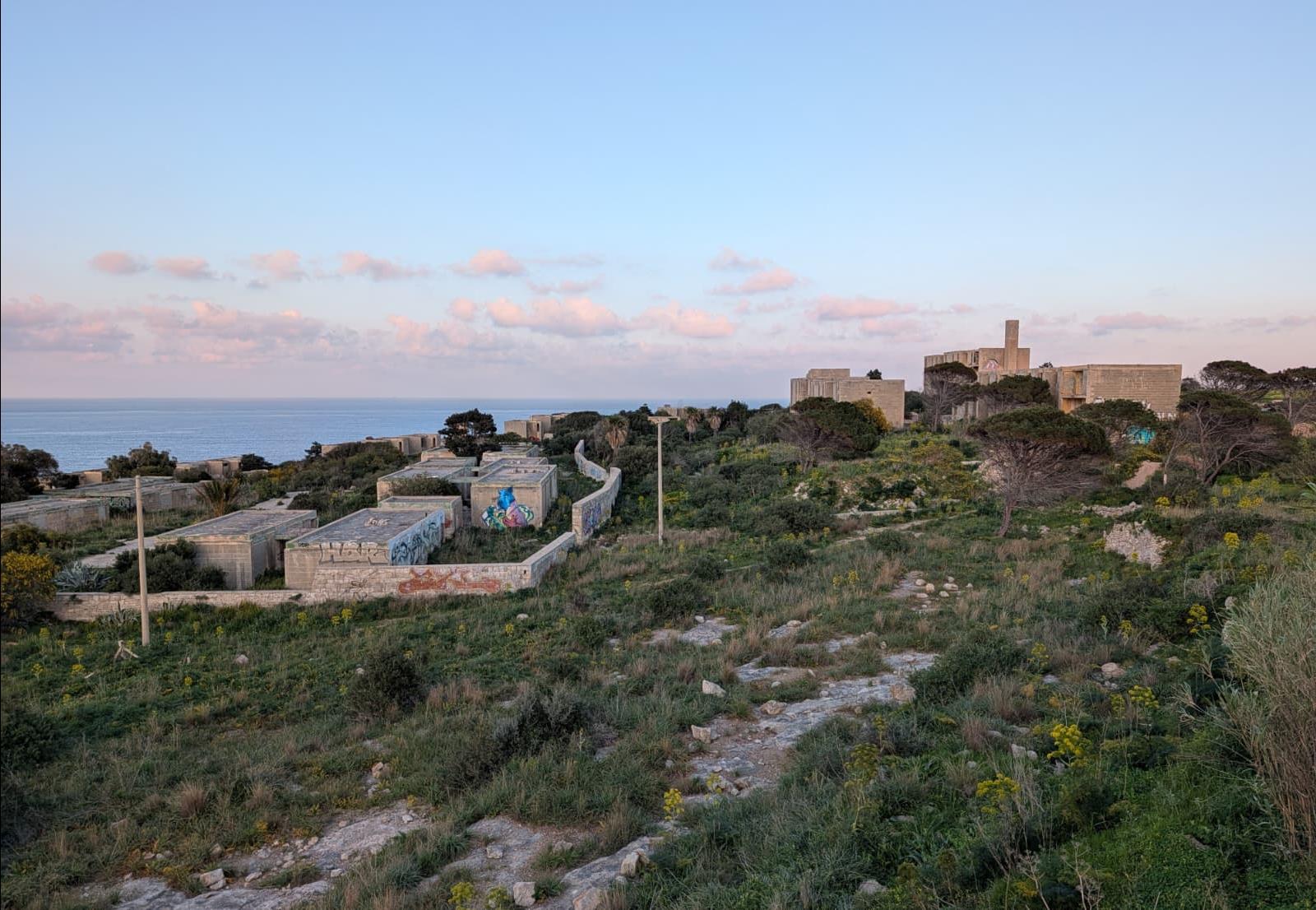 From comfortable officers' quarters to a derelict site. Photo: Chris Sant Fournier
He is back in Malta to deliver a presentation on the project on Tuesday, organised by the Kamra tal-Periti and Din l-Art Ħelwa as the controversial White Rocks, abandoned in 1995 after a brief stint as a holiday complex, is again in the spotlight.
Over six decades later, he can still recall the details, and has even found original designs he did not know he still had, to refer to in his lesson on 1960s architecture across that sprawling swathe of prime coastal land.
Climate was a major consideration when Hirst took on the project for the War Office. His main goal was to make the Married Quarters in the area known as St Patrick’s habitable, in the absence of air conditioners.
Hirst had trained in the Department of Tropical Architecture in London and was fresh from designing the Port of Tema in Ghana. On arrival in Malta, the first thing the lead architect did was explore the situation, researching the climate and unearthing a number of issues.
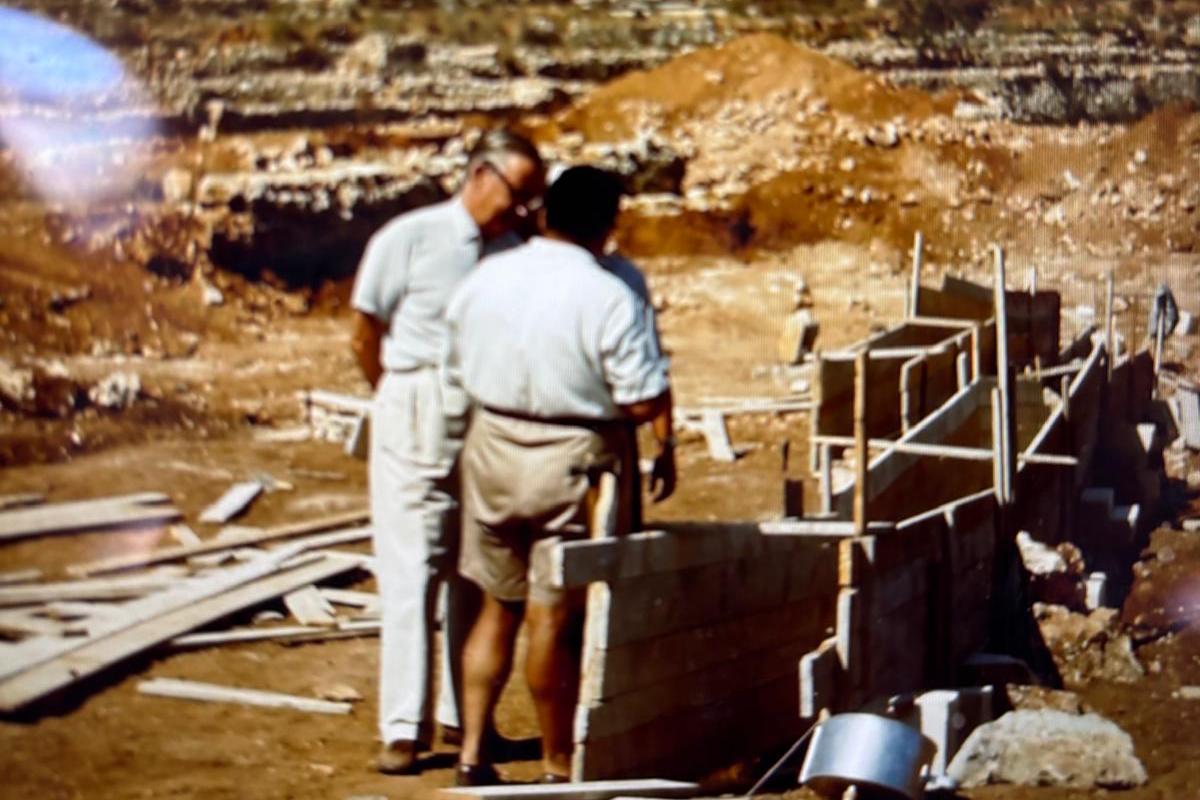 On site at White Rocks in the 1960s
He found that Malta’s traditional method of building “did not match the climate”, using stone that had a high thermal mass, absorbing heat. His assessments raised “anomalies” regarding how the Maltese coped with the climate in high summer.
“I found they must have been suffering at night in traditional houses at the time,” he said.
Hirst’s answer was to “harness the wind”, which he claimed traditional buildings did not. The result was cross-ventilation in every room, he explained, maintaining it was a first and it worked, with the married officers having attested to living in comfortable conditions.
‘It was the natural thing to do’
The original layout that Hirst was presented with underwent many revisions, mainly due to strict cost considerations.
“Architects at the time knew nothing about project management and cost planning. These restrictions, imposed on us by the client, were new to us,” he said.
Hirst said a categorical “no” to the stone samples presented for the project, wanting the stonework to retain the saw marks from the quarry.
“It was the natural thing to do. If a saw was used, you wanted to see the saw marks!”
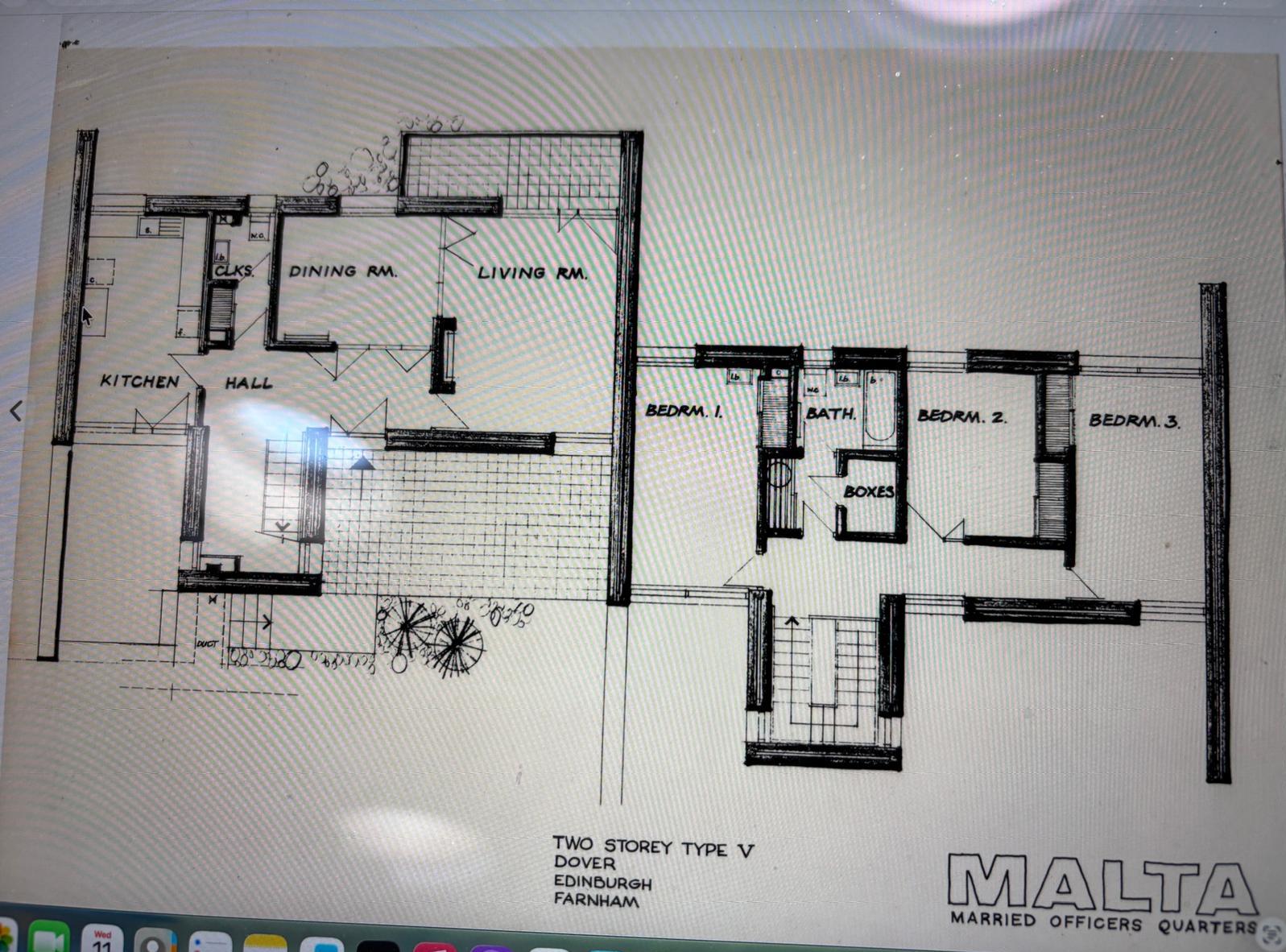 Original plans from the 1960s. Photo: Michael Hirst
But that was not his only demand. He introduced the double, open-jointed roof, adopted from West Africa. Traditional Maltese roofs had to be frequently repaired due to solar damage, but this offered protection and cut down on radiation into the building, he explained.
Hirst said he also introduced a “proper” cavity wall: “I wanted mine empty; two inches filled with nothing” as opposed to “xaħx” (stone fragments).
He also used actinic glazing on the south side to cut out solar radiation, and adjustable glass louvers for ventilation on both sides of the buildings, noting all this has been gouged from the site over the years.
All services were passed through a maze of underground ducts that fed the houses from a central boiler, with the aim of minimal impact on the rocky terrain – again “the natural thing to do”.
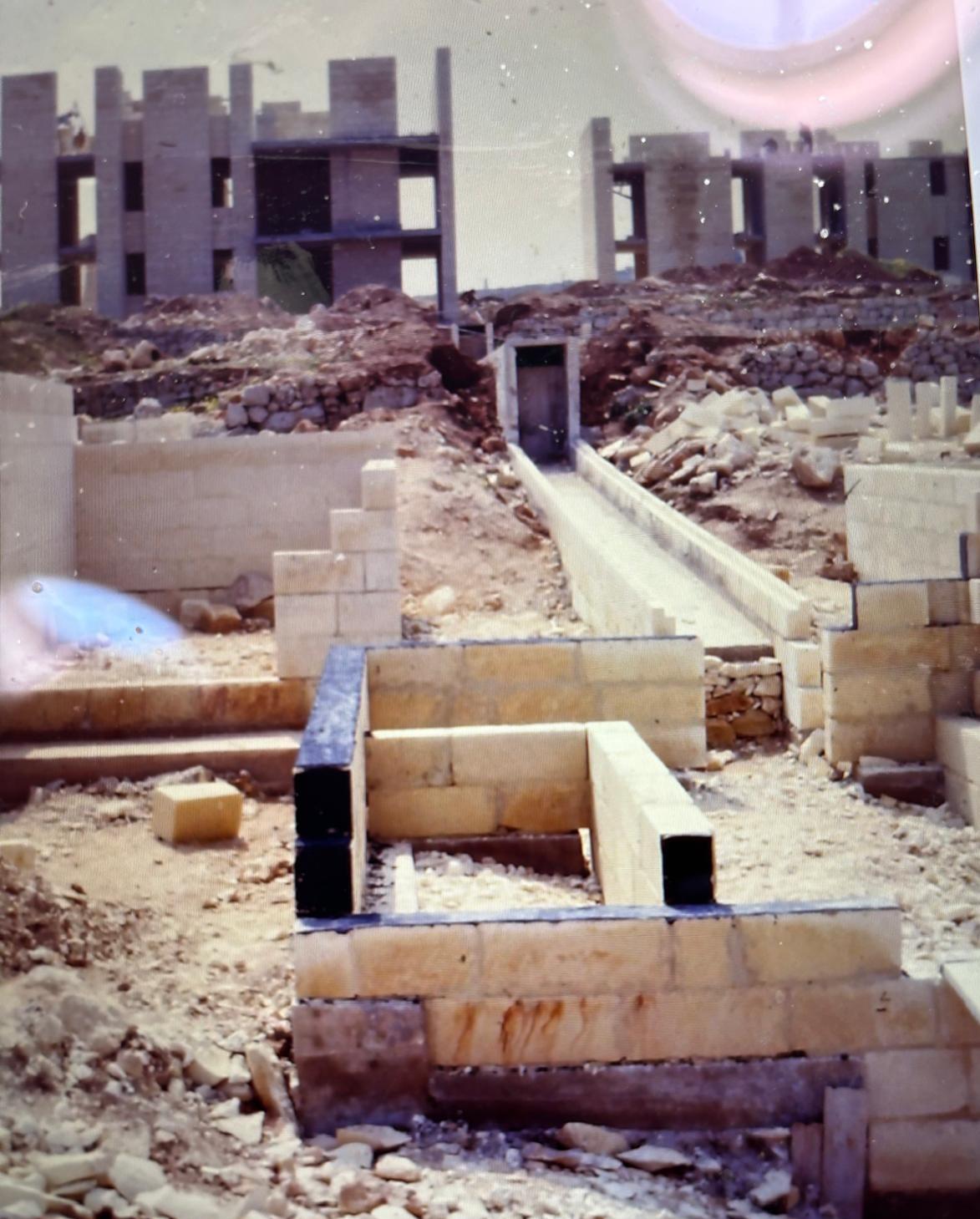 The maze trenchworks under White Rocks. Photo: Michael Hirst
The idea was to preserve the site on the end of the Victoria Lines, with its deeply fissured rock.
Trenches for the pipework were cut and covered with hard landscaping, while big stone “bastions” were built, filled with rubble and topped with soil for planting – and privacy.
Around 18 underground wells were blasted into the rock because every bit of water, scarce as it was, had to be stored, Hirst said.
The groundwork was laid, but the devil is in the detail. Hirst recalled that when markers were positioned on the terrain, outlining the site, young couples’ feathers were ruffled. They saw this as an invasion of their space and were upset – “or so the story goes”.
Times have changed
Painting a picture that contrasts with today’s construction industry reality, Hirst recalled that only four contractors were suitable for the job at a time when only Malta’s infrastructure was being rebuilt and demand for housing was non-existent.
He remained impressed by the “incredibly skilled stone masons, who cut stairs without any drawings” and noted there was “not a tower crane in sight”.
Hirst first fell in love with Malta when he left Ghana and took the “long scenic route” back home, stopping over with his wife in December 1959.
He recalls being advised to visit the Hypogeum: when the couple arrived at the “house”, a woman let them in, commenting that they had “come to see the tomb”. She opened a door to the cellar, switched on the light and “we had it all to ourselves”.
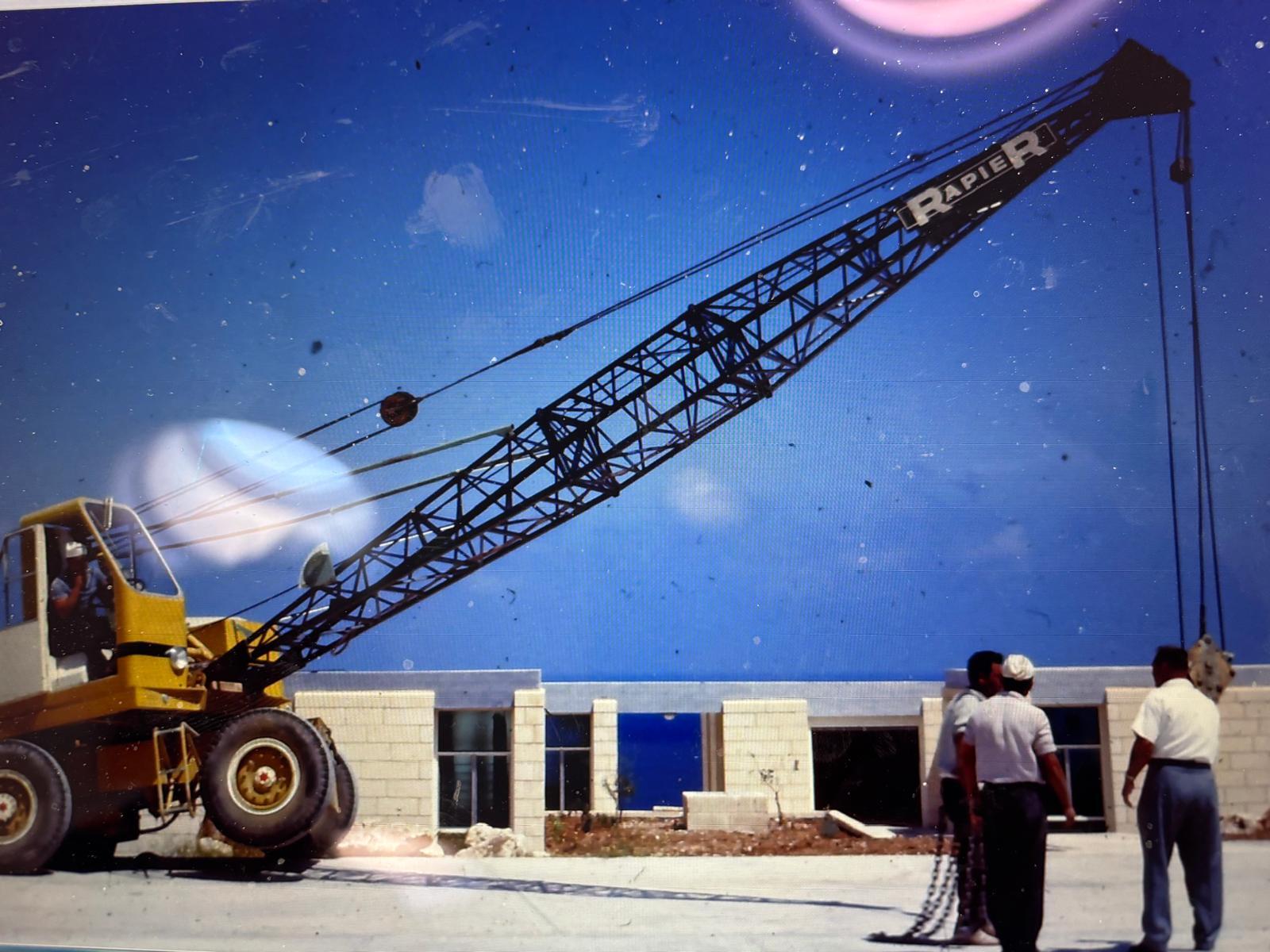 The only semblance of a crane on the construction site in the 1960s. Photo: Michael Hirst
Today, you book a timed appointment online almost three months in advance to visit, you walk on boards and that house has been replaced by an exhibition centre, Hirst noted.
“Times have changed,” he remarked.
It was a time when no one visited Malta unless connected to the army, navy, air force and dockyard. Setting the scene, he said all adult women wore black.
But it was not hard for him to pick the Malta project of the many work opportunities he had been offered during interviews in London. “There was no contest” in his mind, he remembers.
It was only two years ago that he visited White Rocks for the first time since he built it – “out of curiosity to see what it was like and take some photos”.
Appalled by the graffiti damage, he said he also appreciated that elements of it were artistic and worth keeping.
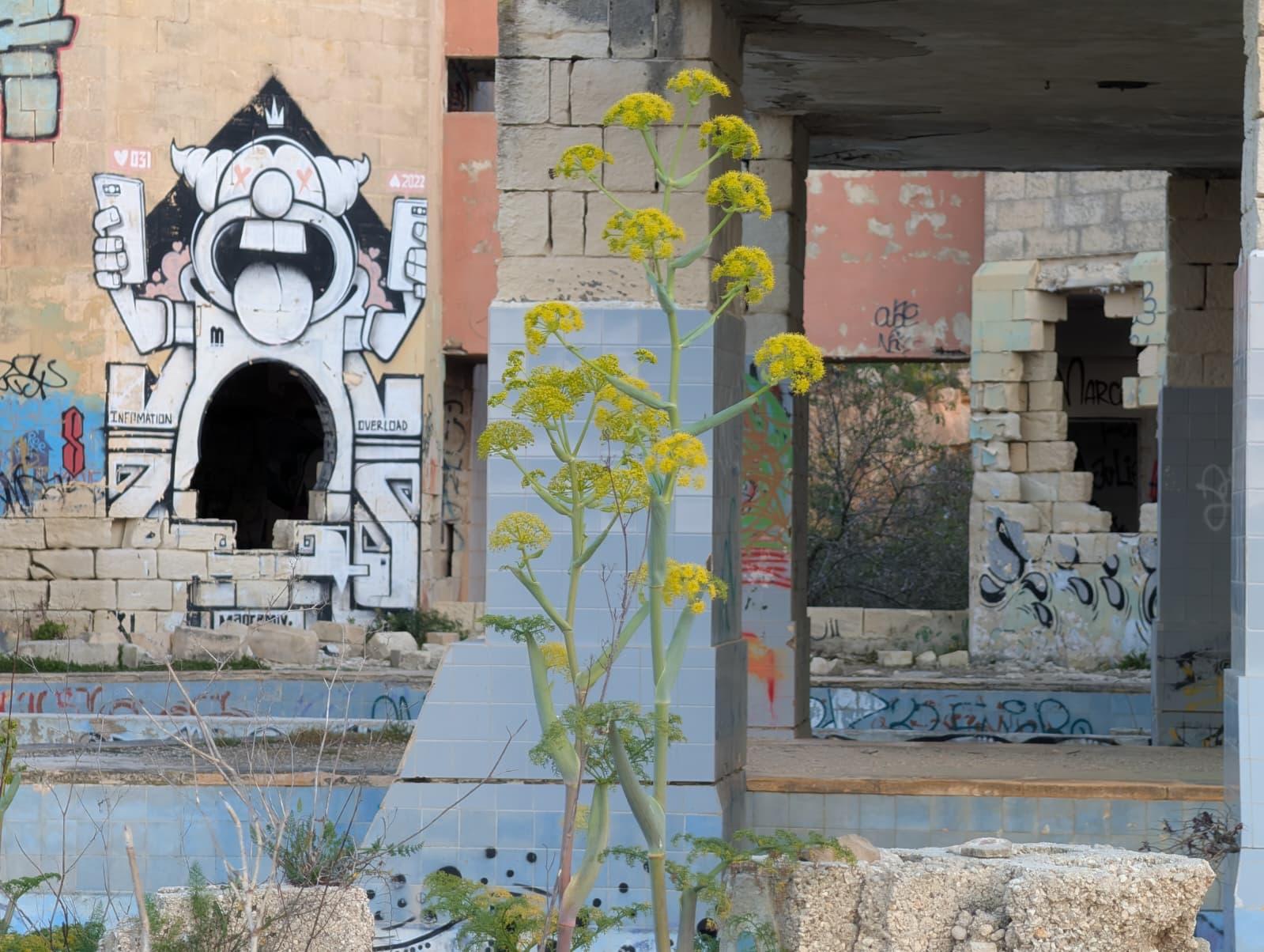 The buildings have been turned into an official site for local graffiti artists. Photo: Chris Sant Fournier
Hirst had noted the site needed a major clean-up as undergrowth had taken over – a job that was undertaken last month, marking the first step towards its regeneration, with 600 tonnes of waste being removed and paving the way to make it accessible shortly.
‘Do they know what a national park is?’
Last November, Prime Minister Robert Abela cancelled a public call for development on the 450,000-square-metre site, saying he wanted to “build the most beautiful park”, asking environmental NGOs to help do it, and guaranteeing it would never be developed in the future.
Asked what he thought about plans to create a national park on the site, Hirst said he did not have much information and had no wish to criticise.
However, he added: “I do not know what is meant by national park. What is the concept? Are there national parks in Malta and do they know what a national park is?”
The whole site was already a park – with 59 dwellings, a “great big block of buildings” in its midst. It was a combination that gave rise to another “anomaly” – how to have people living in a park.
 Now 93, Michael Hirst returned to Malta every year since he designed the buildings. Photo: Jonathan Borg
While keeping the houses would be his priority, he did not see the point of this if nothing was done with them. They had to be “liveable – not a museum”.
Happy to lend his expertise on the original project and partake in the broad consultation process that has kicked off, Hirst could explain “what they were meant to be like” as Project Green, tasked with the transformation, prepares to analyse the site in further detail, including studies on its topography, flora and fauna and an analysis of existing structures.
The development that never was
The development of White Rocks was initially attempted back in 1999 by a Nationalist government but failed to gain any momentum and was put on hold.
In 2010, an attempt to develop the site as a sports village in a €200 million project also never took off.
Following an expression of interest in 2015, a consortium was chosen to build a €400 million luxury village, including a seven-star hotel, commercial and residential units. But negotiations stalled for years, leaving the site in limbo until Abela's announcement last year to transform it into a national park.
Tickets for the seminar on the modernist complex, on March 17, are available from the Kamra tal-Periti’s website. Part of the Concrete and Stone; Conserving Maltese Modernism series, the talk is being held at The Grist (Farson's Brewhouse).