Seven-storey tombstone for catacombs: NGO condemns Qawra development
Objectors have until April 30 to appeal the decision
Din l-Art Ħelwa said on Friday it was seriously concerned about a seven-storey residential development, including a three-floor underground garage, that will be built on a site known to contain catacombs.
The approved planning application (PA/2946/24), filed by ACMUS Group, will see the demolition of dilapidated structures to make way for 47 residential units, a shop and 59 underground garages. The site is located at Triq il-Qawra and Triq il-Fugass, St Paul’s Bay.
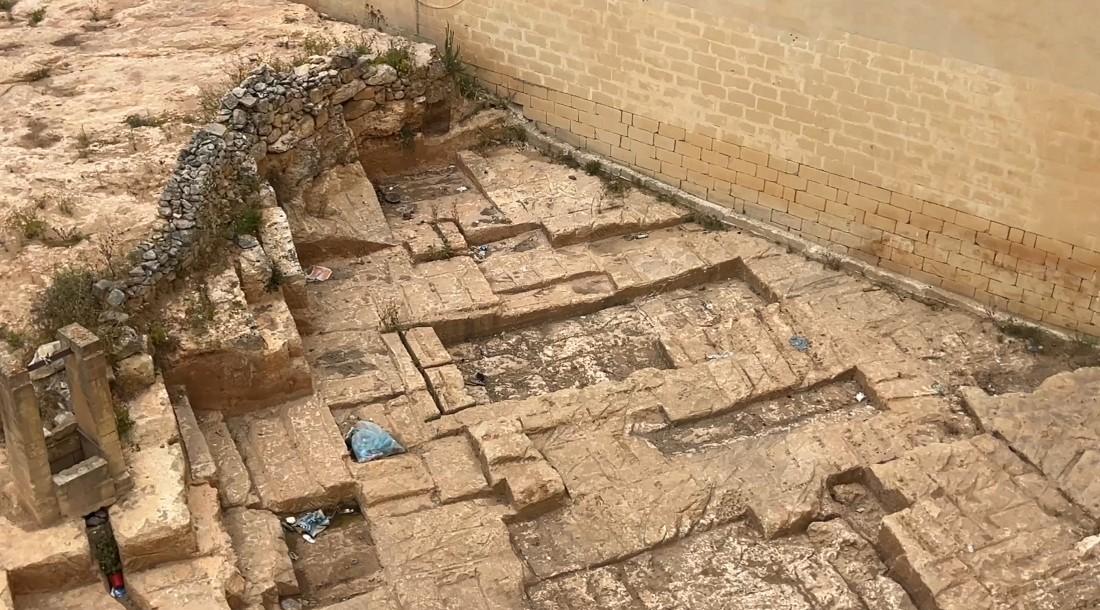 Photo of the site: Din l-Art Ħelwa
The NGO said that while the Superintendence of Cultural Heritage had issued its clearance to the Planning Authority, its final report last month and the earlier assessment from May 2025 "reveal an approach that Din l-Art Ħelwa finds evasive, technically inadequate, and a grave dereliction of the duty to safeguard Malta’s cultural heritage".
The Superintendent’s clearance reads less like a conservation directive and more like an archaeological obituary for this site, it said in a statement.
It lamented that while the SCH’s own documents confirm the discovery of “significant archaeological features… of considerable cultural heritage value", including a burial chamber and a Classical Period quarry, the proposed outcome was not in situ preservation and public valorisation, but rather construction over these features, subject to a series of conditions that are fundamentally incompatible with their long-term survival or accessibility.
DLĦ argued that the approved plans fundamentally undermine the heritage they claim to protect. It said the proposed "buffer zone" is meaningless if construction is allowed "immediately adjacent" to the area, warning that a buffer built over "is no buffer at all".
The NGO also took aim at the proposed method of safeguarding the remains, describing plans to cover them with geotextile fabric during construction as inadequate.
"This is not preservation - it is a temporary dust sheet," DLĦ said.
It warned the construction of the block, including pile-driving and excavation, "will cause irreversible vibration, fracturing, and micro-displacement to fragile rock-cut catacombs, irrespective of what is laid on top."
DLĦ further warned that the project would result in the complete loss of public access, with the remains set to be permanently sealed beneath the development.
"This is not conservation; it is obliteration."
While acknowledging that the presence of an archaeologist on site could help limit damage, the NGO stressed that monitoring cannot replace proper conservation. It criticised the decision to approve the permit in principle before any new discoveries are assessed, arguing that this approach turns the planning process on its head by allowing development to proceed first and heritage concerns to be addressed later.
DLĦ insisted that the project should not proceed as approved.
"The presence of a Late Classical catacomb demands a fundamental redesign of the proposal, or its outright refusal, to allow for the preservation, study, and public display of this nationally significant site.
"The permission should be revoked or suspended until an independent review of the SCH’s mitigation measures is conducted and the true extent and significance of the catacomb and quarry is determined."
While the decision notice for this permission was published on April 1, 2026, objectors have until April 30 to appeal the decision.