Two poultry farms report contagious Newcastle Disease
Veterinary authorities on high alert as chickens are culled and eggs destroyed
Two poultry farms reported cases of the highly contagious virus, Newcastle Disease, the agriculture ministry confirmed.
The ministry said last week the veterinary authorities are working to take concrete and immediate steps to manage the situation after the contagious virus was found in a bird population in Malta.
While highly contagious in bird populations, transmission to humans is very rare. In the unlikely event that a person is exposed, symptoms are usually mild, such as eye irritation or flu-like symptoms, which can be easily treated.
There is no evidence of human-to-human transmission.
The highly contagious and often severe disease that affects birds, including domestic poultry, can cause severe respiratory, nervous and digestive symptoms in birds. The virus spreads rapidly in flocks through droppings, secretions and airborne particles.
A ministry spokesperson said there are 74 licensed layer (poultry farms for egg production) and broiler (chickens raised for meat production) farms across Malta and Gozo, confirming two cases of the disease were reported in separate poultry farms.
The spokesperson explained that the affected chickens were “humanely euthanised” following EU legislation, and the eggs and meat from the infected farms were destroyed by incineration.
Farmers whose chickens have tested positive for the virus and comply with the veterinary regulatory directorate (VRD) instructions are entitled to compensation.
“The veterinary regulatory directorate (VRD) has established multiple teams to monitor the situation, including farm visits and tracing efforts, with notifications sent to zoos, pet shops, falconries, pigeon racers and local councils,” the spokesperson said.
The authorities confirmed vaccination is available and is already required for all farms to prevent and eradicate the disease.
Fears
Poultry farmer Karl Scerri pointed out that the virus is nothing like bird flu and does not transmit to humans easily.
“Our concern is now there will be people who will decide not to purchase or eat chicken meat or eggs as a safety measure, and this will be a problem in the industry,” he said.
Scerri has already started the vaccination process for his farm and hopes the vaccination will be successful. The main concern is ensuring others will vaccinate their chickens.
“Those people who keep chickens as pets need to register them and notify the authorities to vaccinate them. The virus spreads easily among birds and their brood could be carrying the virus without them realising.”
Scerri said this is not the first time Maltese poultry farmers experienced an outbreak of Newcastle Disease, and that, in recent months, other EU countries have experienced outbreaks.
Then agriculture minister Lawrence Gatt announced in parliament in May 1993 the eradication of Newcastle Disease from Malta.
He had said the disease was introduced to Malta on February 13 by the importation of “fancy birds” from Holland, and that the disease was first noticed in the Mgħatab area.
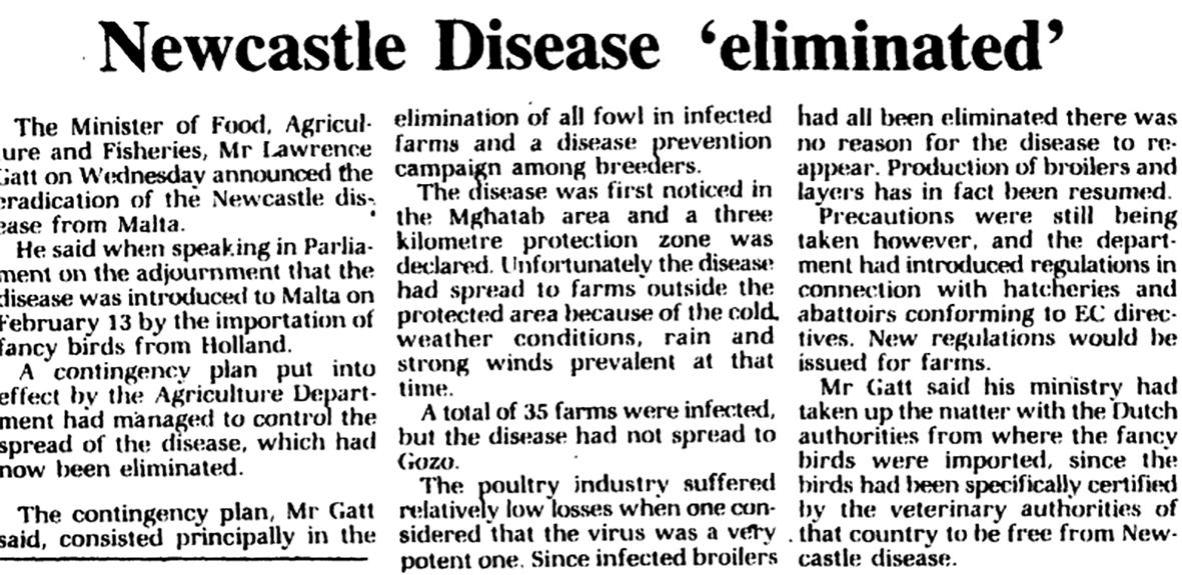 A Times of Malta article dating back to 1993 reported how 35 farms were infected by the disease. Photo: Times of Malta
Back then, a total of 35 farms in Malta were infected, but the disease had not spread to Gozo.
“The poultry industry suffered relatively low losses when one considered that the virus was a very potent one,” the report reads.
“Since infected broilers had all been eliminated, there was no reason for the disease to reappear.”
In more recent news, a case of Newcastle Disease was found in pigeons being privately kept in Oldenzaal, in the Netherlands, a Dutch article reported last week.
Earlier this year, Poland’s egg industry finally experienced a rebound after experiencing outbreaks of bird flu and Newcastle Disease.
Malcolm Borg, president of the Għaqda Bdiewa Attivi, echoed Scerri’s concerns.
“While it is still early, I fear that people will be hesitant to buy chicken or eggs as they do not know how it will affect them,” he said.
“This, of course, is an issue for the local product, and we are expecting a slight dent in consumption as consumers would prefer to ‘play it safe’.”
Borg also highlighted how the virus does not impact humans, and the vaccination process is well underway, while the authorities are monitoring the situation closely.
“Another concern for farmers is that they would have invested hundreds in their coop, only for them to find out their chickens are infected and would have to be culled. That is a big worry.”
Both Scerri and Borg raised concerns about feral chickens found on streets and roundabouts, and how they could be carrying the virus.
“Ideally, these feral chickens and birds are checked, collected and controlled so they do not roam around freely,” Borg said.