'They had no chance': Vulcan captain returns to Żabbar 50 years after crash
Pilot Garth Robert Alcock meets Maltese victim’s son for first time
Captain Garth Robert Alcock, one of only two men to survive the 1975 Vulcan crash in Żabbar, has lived with survivor’s guilt ever since, a burden his close friend and former crewmate recounts in vivid detail, including the final moments of the doomed flight.
Fifty years since the tragedy, Alcock recently returned to Malta for the first time, choosing to keep the visit private until after he had left the island. For the former captain, the journey was a deeply personal one: an emotional pilgrimage shaped by decades of guilt, fear and grief.
At the centre of the visit was a meeting that had never taken place before – between Alcock and Mario Zammit, the son of Vincenza Zammit, the only Maltese civilian to die on the ground.
“It must have been a tense moment for both of them,” said James Vinales, Alcock’s former crewmate and close friend.
The tragedy struck Żabbar on the afternoon of October 14, 1975, when an Avro Vulcan V.2 bomber exploded in the sky above the locality.
Minutes earlier, the aircraft had attempted to land at Luqa but undershot the runway, making a hard landing that sheared off its undercarriage.
Instead of continuing with the landing, Alcock managed to get the aircraft airborne once more and attempted to circle back for another approach. But the impact damaged both main undercarriages and the fuel system. The fuel tank was consumed by an enraging fire before it exploded, causing the starboard wing to separate from the rest of the aircraft.
Alcock tried to save the aircraft, but the fire consuming it was becoming uncontrollable. When he realised it was too late, the pilot and co-pilot ejected, Vinales recounted.
The explosion sent a rain of metal and highly flammable aviation fuel down onto Żabbar’s main street. A burning wing fell in Sanctuary Street and the remaining part of the aircraft fell in a field on the outskirts of the town, killing the remaining five crew members who could not bail out.
Six people died in total and others were badly injured.
Among them was 47-year-old Vincenza Zammit, who had rushed out of her home toward her mother’s house after hearing explosions. As neighbours urged everyone to take shelter, she continued. She was struck by burning fuel as the wing fell in Sanctuary Street and hit the ground, splattering fuel over her. She died just feet from her mother’s doorstep.
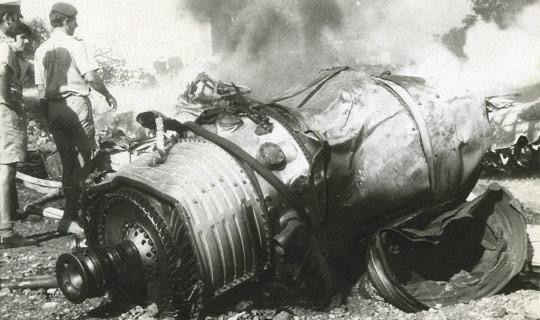 Scattered parts of the Vulcan in Zabbar. Photo: Mark Zammit Cordina
Final moments of the flight
The final moments of the doomed flight have been recounted in detail by Vinales, as recounted by his friend.
“Bob could feel the increasing loss of control over the aircraft. Desperately, he looked over his shoulder and saw Stan Lambert struggling to open the jammed door,” Vinales said.
“Stan had no way of knowing that damage to one of the wings, sustained during the hard landing at Luqa, had destroyed part of the pneumatic mechanism controlling the aircraft’s only rear cabin exit.” As the situation worsened, the aircraft lurched violently to the left.
“Bob immediately ordered the co-pilot to eject. The aircraft was now left-wing down and heading towards the ground. He ejected, perilously late, so late that he would hit the ground still sitting in his ejector seat.”
Five crew members – Squadron Leader David Beeden, Flight Lieutenants Stanley Lambert and Tony Pulman, Chief Technician Gordon Barrow and Sergeant Peter Atkins – died in the cabin.
“The five companions, not having the advantage of ejector seats, had no chance,” said Vinales, who had previously survived another Vulcan flight that ran into trouble together with Alcock.
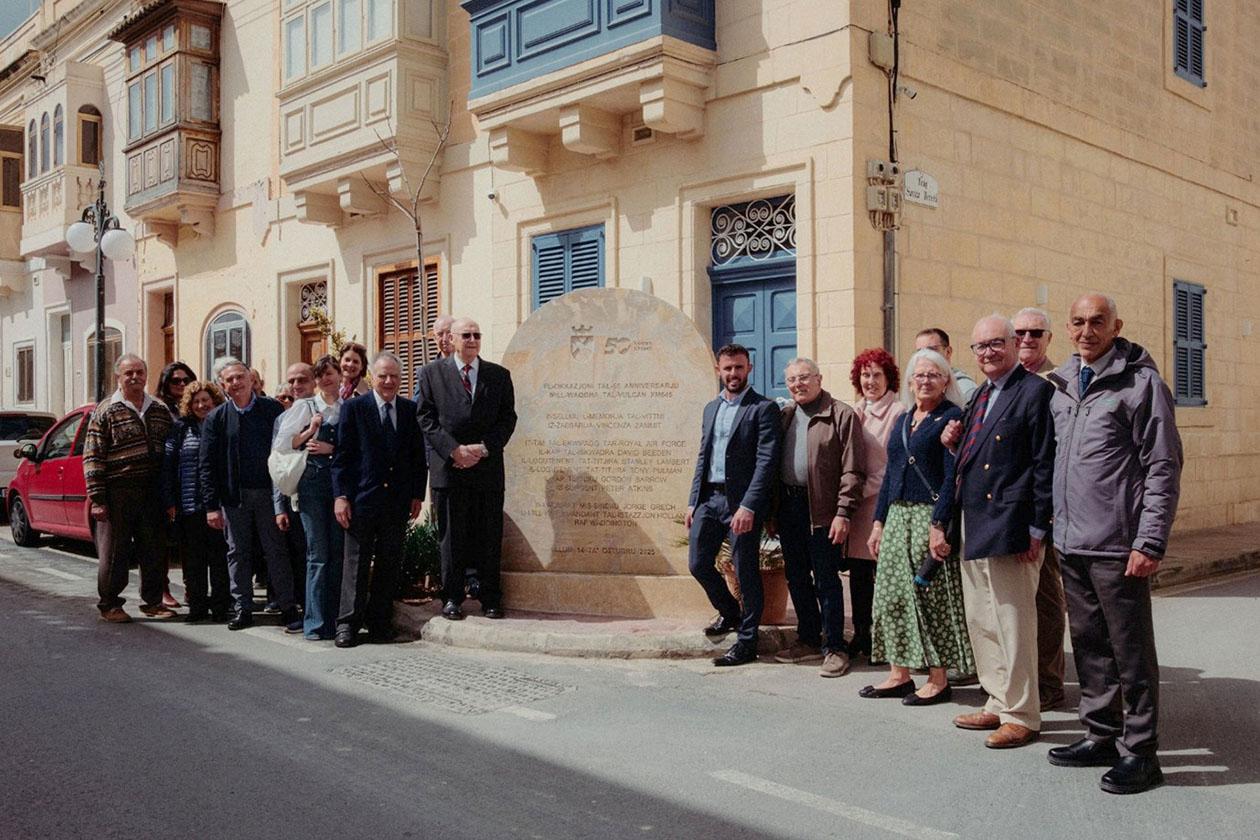 Alcock, along with former friends, colleagues and their families, were welcomed in Żabbar by mayor Jorge Grech and parish priest Roderick Camilleri. Here they are seen standing by the monument erected last year in memory of the crash victims. Photo: Andre
A burden carried for decades
Though a court martial later found Alcock not guilty of negligence, the emotional burden of surviving while five of his companions died as well as a woman on the ground never left him.
According to Vinales, Alcock had long avoided returning to Malta, fearing hostility from the people of Żabbar.
It was only after the death of his wife, Susan, last November – whom he had cared for during a long illness – that those closest to him encouraged him to make the journey.
His former crewmates, including Vinales and Rodger Barker, reassured him he would be met with kindness.
“We assured him that the people of the city were highly considerate and would treat him with kindness,” Vinales said.
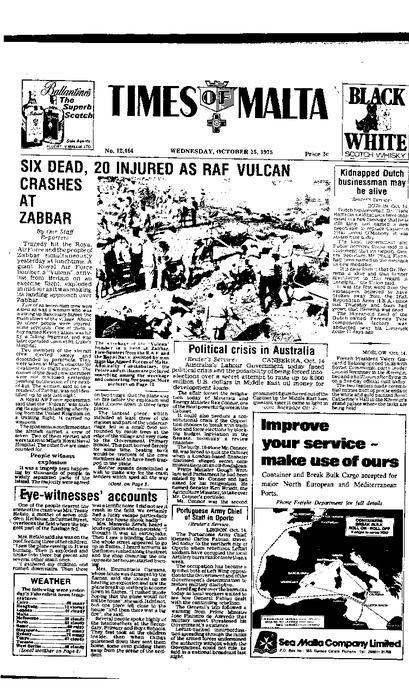 The front page of Times of Malta featuring the crash.
Returning to Żabbar
Alcock returned to Żabbar on March 14, accompanied by a small group from England.
He was received at the Żabbar Sanctuary Museum by volunteers, author David Grech, parish priest Roderick Camilleri, mayor Jorge Grech, families and friends. During the visit, he viewed remnants of the aircraft preserved in the parish museum’s Vulcan Room.
Archpriest Roderick Camilleri led prayers for the victims at the church of Our Lady of Graces.
The visit concluded at the monument erected last year at the crossing of Sanctuary and St Theresa Streets in memory of those who died.
Among those present was Żejtun resident David Grech, who was a 10-year-old boy on a school bus when the plane crashed. He witnessed the burning aircraft and the two parachutes descending – memories he later documented in his book Forty-six feet short.
Alcock was accompanied by six companions, including Vinales, Rodger Barker and his wife Margaret, Mike and Jane Herring, and Ruth Wilson, all members of the Kingscliffe friends’ association.
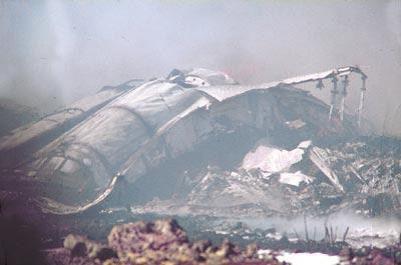 The devastating site where the Vulcan crashed. Photo: Richard J. Caruana