Revised Villa Rosa local plan paves way for maximum of 39 storey hotel
This revised local plan is currently open for public consultation
A proposed partial review of the local plan for the Villa Rosa site would allow for the construction of one hotel reaching up to 39 storeys, and two additional hotels of up to 22 storeys each.
The draft review of the local plan at St George's Bay, presented by the Planning Authority (PA) and currently open for public consultation, divides the site into 12 zones.
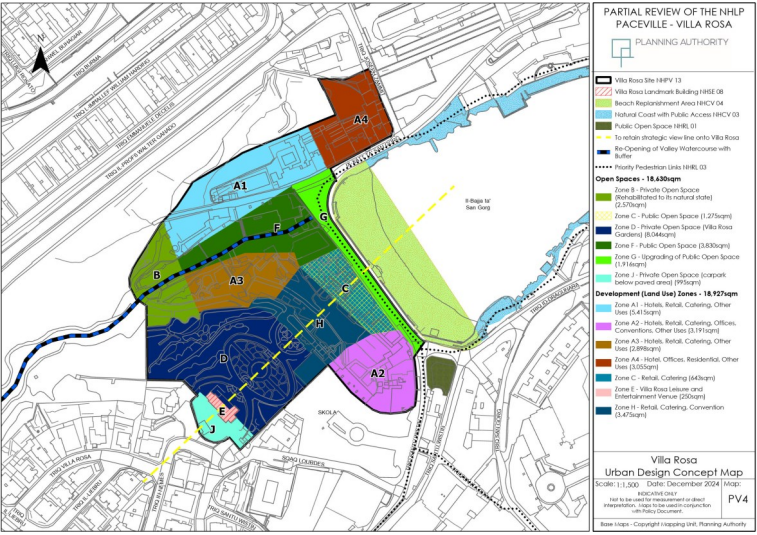 The proposed revised local plans. Photo: Planning Authority
If a hotel is built in zone A2, located at the bottom of Triq Santu Wistin, it may reach a maximum height of 39 floors. In zone A3, adjacent to the Villa Rosa gardens, and zone A1, located nearby, the maximum permitted height for hotels is 22 floors.
The maximum gross developable floorspace (GDF) for the 39-storey hotel is 40,300 square metres, while the combined GDF for the two 22-storey hotels is 88,500 square metres.
In total, the revised plan permits up to 128,800 square metres of hotel development across the three zones.
In the draft, the Planning Authority cites the Height Limitation Adjustment Policy for Hotels (2014) that allows for the hotel building heights to be increased.
The revised local plan closely mirrors the project proposed by developer Anthony Camilleri, known as Tal-Franċiż, who submitted plans for a large-scale development including a 34-storey tower and two 27-storey towers.
An Environmental Impact Assessment (EIA) found that this project would have significant impacts on both the environment and air quality.
In October, Times of Malta reported that the Cabinet had formally approved the partial review of the Villa Rosa site, which was expected to “multiply” the original project.
Shortly after, the PA launched the amendment process and opened it for public consultation.
The permit for the original development plans was overturned by a court in December.
"The main objectives of this revised planning framework include the protection of key environmental and cultural assets, such as the Grade 1 scheduled Villa Rosa building and the Level 1 Harq Hammiem Cave, ensuring these features are preserved within the context of sensitive and sustainable development," the PA said.
It added that the inclusion of hotel skyrises "will contribute to Paceville’s distinctive skyline and support the site’s transformation from a location to a leading tourism destination".
The proposed redevelopment scheme also includes at least 5,100 square metres of public open space and 10,610 square metres of private open space.
Members of the public have until June 11 to submit their feedback on the proposed policy changes by emailing: villarosa.consultation@pa.org.mt.
Graffitti hits out at 'farcial process'
Moviment Graffitti in an initial reaction said it was shocked by the 'blatant subversion of the democratic process' in the Planning Authority.
"The PA has listed over 4,000 individuals as having submitted responses in favour of the revision, when in reality, the overwhelming majority opposed it," the pressure group said.
"Moviment Graffitti facilitated the submission of objections to the PA by providing an online platform through which people could send their representations. Over 3,000 submissions were sent through this form in opposition to the project. The online form had a live counter showing how many people objected and, by the end of the process, 3,047 objections were submitted through it.
"Yet, only a handful of these objections are acknowledged in the PA's documentation. In contrast, the PA lists over 4,000 individuals as having submitted statements of support for the Local Plan review."
Alarmingly, it added, hundreds of individuals who submitted an objection through its online form were listed as having sent a statement of support to the Villa Rosa review in the list provided by the PA.
Even before the consultation report had been published, the developer publicly claimed that over 4,000 people had supported the project.
"How did the developer know this number, when emails were sent directly to the PA, and no submission-tracking system — such as the one provided by Moviment Graffitti — was made available by the developer?" the group asked.
It said that either those with vested interests in the local plan revision submitted false data to the PA to fabricate support, or the PA deliberately manipulated their data in collusion with the developer.
The group urged the PA to cancel this farcical process and for those responsible for such 'disgraceful manipulation' to be held accountable.