Don't call it slime: Fish farms say Buġibba foam is not their doing
Sectoral lobby chief says many farms are still in closed season and not yet stocked
A large patch of what appeared to be foamy slime spotted off the coast of St Paul’s Bay on Wednesday is foam caused by “natural phenomena”, according to offshore fish farm operators.
Photos and videos sent to Times of Malta showed a large patch of foamy white substance in St Paul’s Bay, close to the Buġibba jetty at Dawret il-Gzejjer, and several other patches further along the northern coast.
The images raised fears of repeat occurrences from previous years, when slime caused by oily fish farm feed ended up polluting local shores.
But fish farm operators told Times of Malta they had nothing to do with it.
Maltese Aquaculture Producers Federation CEO Charlon Gouder said the substance was foam, and not slime, and attributed it to strong winds and rough seas experienced in recent days.
On Tuesday, the Met Office issued a yellow weather warning, as winds were expected to reach Force 5 to 6.
“While such occurrences may raise concern, it is important to clarify that these are well-known natural phenomena and are not linked to bluefin tuna farming activities,” Gouder told Times of Malta.
He said the tuna farming season has not yet started, adding that most tuna farms around Malta are not stocked.
“The absence of fish in the cages means that there are no feeding or operational activities taking place that could be linked to such phenomena.”
In response to questions, Gouder said the sea foam was generated when organic matter such as algae, dissolved proteins and other biological material was agitated by rough waves.
He added that Malta has a documented history of natural marine phenomena, which can occur due to biological processes such as phytoplankton activity and changing environmental conditions.
“It is therefore important to avoid drawing incorrect associations between natural marine processes and aquaculture,” he said.
“The available evidence clearly indicates that the recent observations are the result of a weather-driven natural phenomenon, combined with organic material present in the marine environment, rather than any activity related to bluefin tuna farming.”
ERA: Material was seafoam and not sea slime
The Environment Authority (ERA) said that following the reports of slime at St Paul's bay, its officers went on site and observed that the material was seafoam and not sea slime.
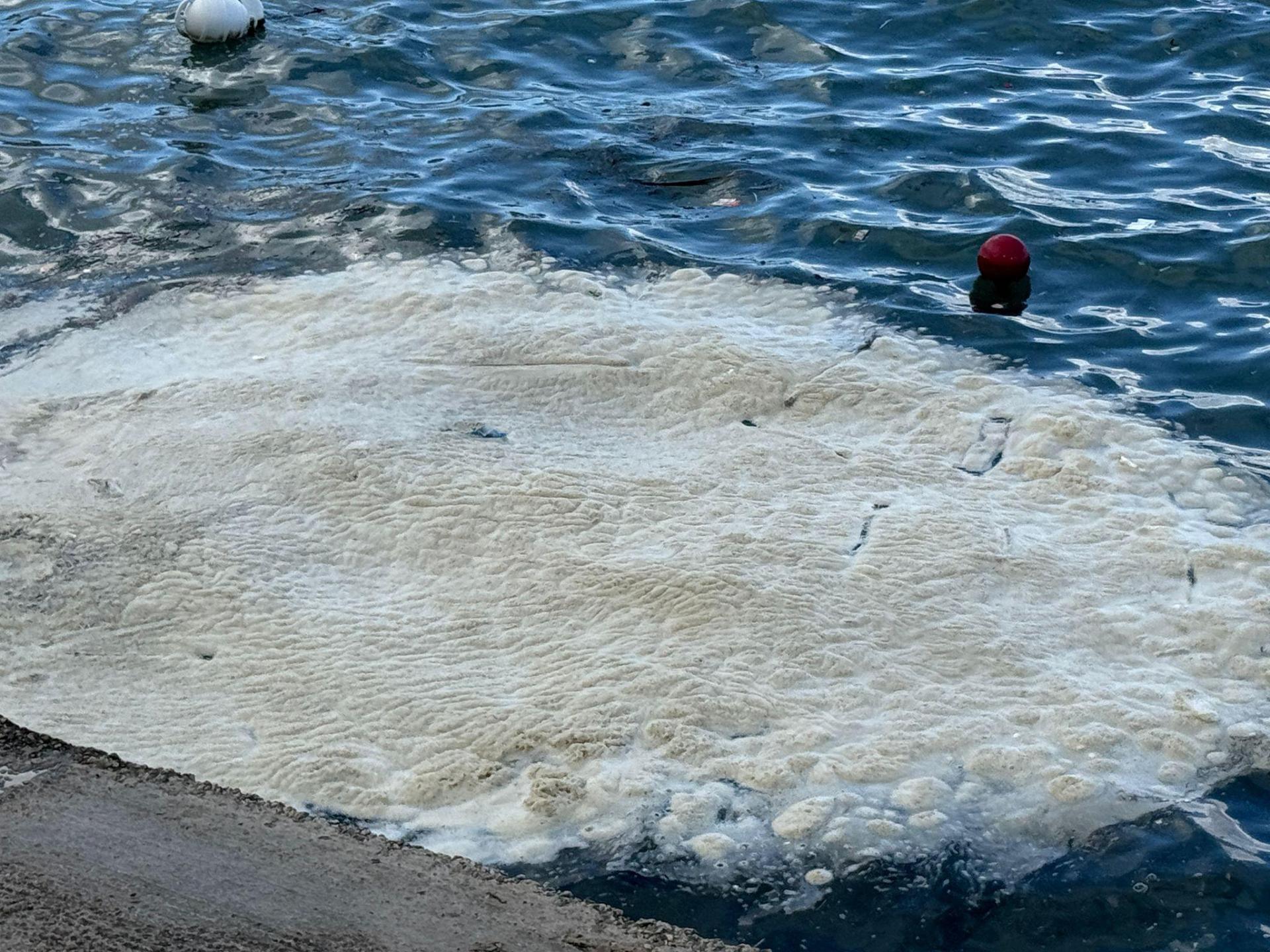 The patch of foam located in St Paul's Bay.
Last September, a similar report of apparent slime was also dismissed as foam, with the environmental regulator also saying the substance in that instance was foam.
This is not the first time sea foam has been spotted on Maltese shores. Such a foamy substance was previously spotted in Spinola Bay and Marsascala.
Last year, the issue of sea slime dominated headlines after Times of Malta highlighted the issue of slime emanating from offshore fish farms during the Santa Maria weekend.
Fish farm operators initially argued that the slime was not necessarily their doing, before workers at a tuna farm off St Paul’s Bay were filmed using a net and bucket in an attempt to contain sea slime from pens.
FMAP, the sectoral lobby, subsequently apologised and took responsibility for the slime. Later on, the Environment and Resources Authority (ERA) fined four tuna farms a total of €14,000.