St George’s Bay crashes down Malta's quality beach rankings
Study by UoM professor reveals rising levels of unsafe bacteria in waters of seven beaches
Residents living near the sandy St George’s Bay once enjoyed swimming at one of the cleanest beaches in Malta.
But, in just over a decade, the water quality has deteriorated so dramatically that it has dropped from one of the best in 2013 to one of the worst in 2024, according to a study that measured bacteria levels.
And the study’s author, Victor Axiak, professor of biology at the University of Malta, has linked the Paceville beach’s downfall to the increase in population and, particularly, the influx of tourism.
Trends from the study show that in just one year St George’s Bay could reach contamination levels of Balluta Bay, which was previously found to have the poorest bathing water quality in Malta.
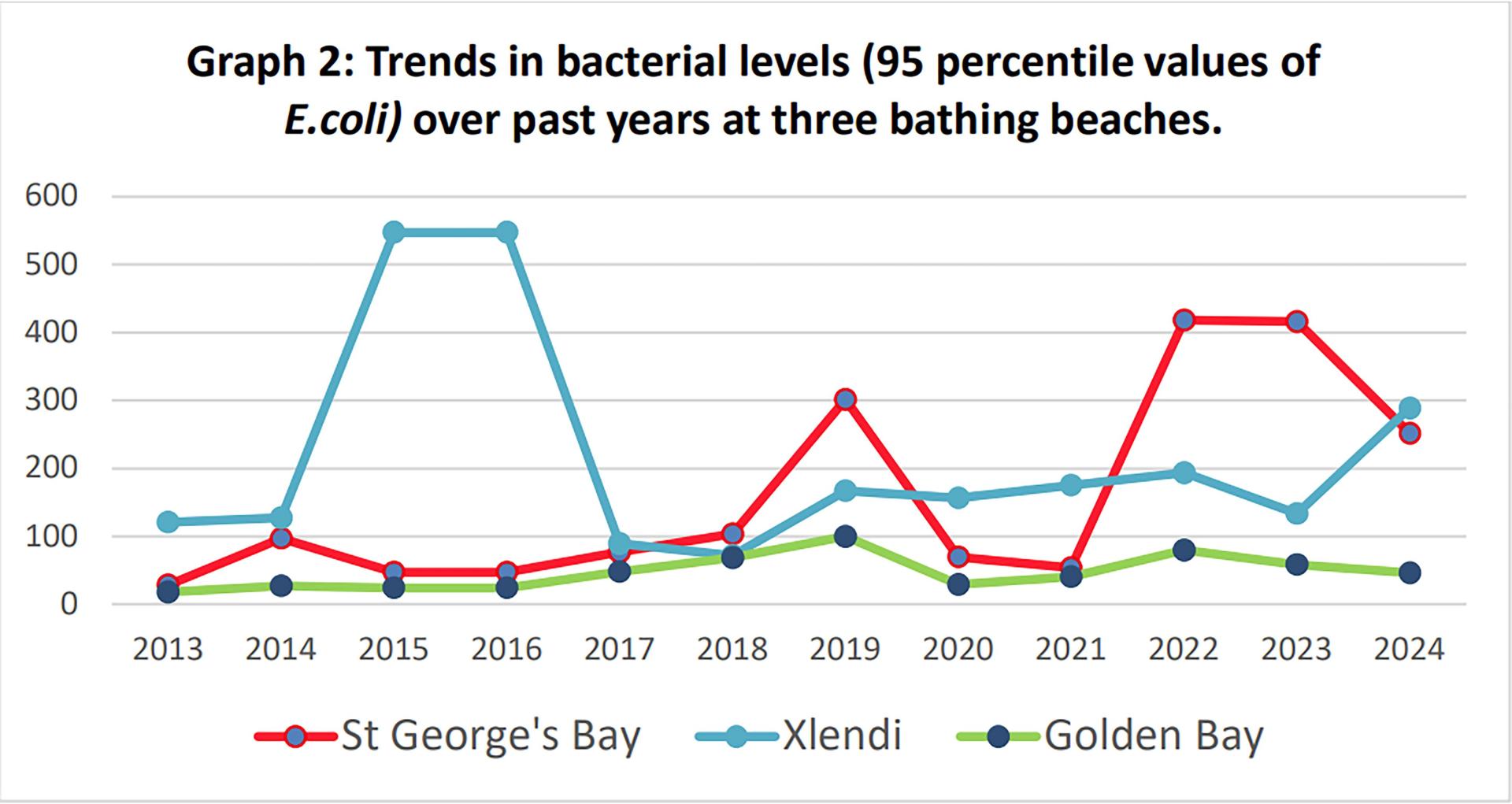 A graph showing the increased levels of E. coli recorded at St George’s Bay, Xlendi and Golden Bay. Photo: Victor Axiak
Another beach, St Paul’s Bay, is on track to reach Balluta Bay levels in three years, he said.
The leading environmental consultant called for an end to further development in both areas.
The last census revealed that St Paul’s Bay’s population has doubled in a decade, while at St George’s Bay developers db Group are constructing two high-rise towers. The area is also subject to a proposal to revise the local plan, paving the way for three hotels at Villa Rosa.
Axiak looked at E. coli levels found at seven bays – Sliema, St George’s Bay, St Paul’s Bay, Mellieħa Bay, Xlendi, Golden Bay and Għajn Tuffieħa.
His study revealed rising levels of the unsafe bacteria in the waters of all seven beaches, based on a sample taken every summer from 2013 to 2024. Readings were not taken when a bay was closed for swimming due to short-term pollution.
Xlendi, St George's Bay recorded highest bacteria levels
The increase ranged from twofold to ninefold. He found that Xlendi and St George’s Bay recorded the highest bacterial levels, while Golden Bay had the lowest levels.
He noted that “...the most interesting change was found for the bacterial levels at St George’s Bay. This showed a persistent upward trend changing the beach from one of the best in Malta in 2013, to one of the worst (like Xlendi) over this period.”
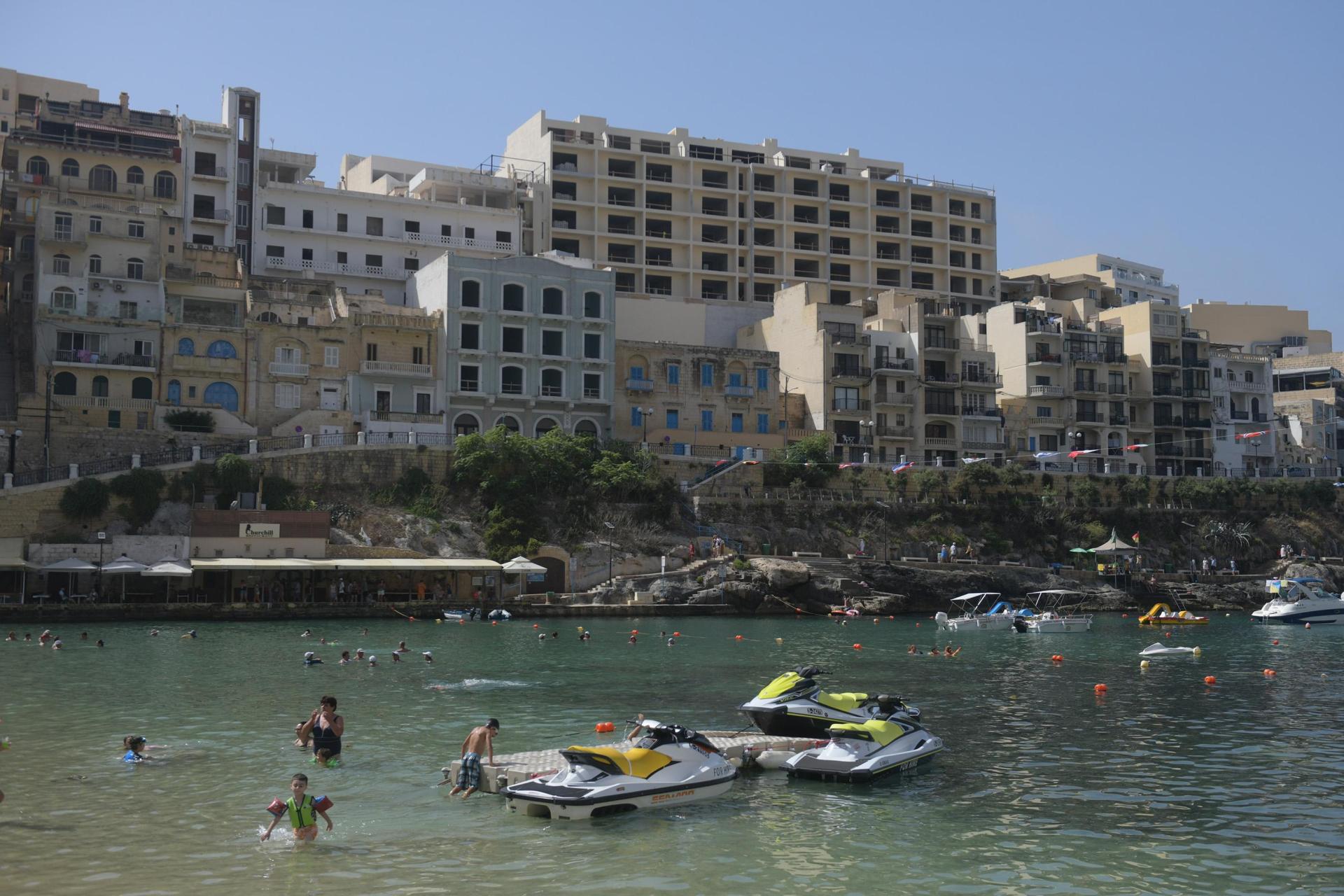 The study showed a spike in bacteria levels in Xlendi between 2015 and 2019. The water in the bay remains among the lowest quailty. File photo: Matthew Mirabelli
Despite the increase, almost all reported bays (99.5 per cent) were in line with the minimum quality standards set by the EU.
Axiak then looked at national statistics data over the same period.
NSO data showed that resident population increased by almost 27 per cent from 2013 to 2024. If the impact of tourism is also taken into account, based on the total nights spent by tourists, the estimated increase rises to 30 per cent.
The changes in bacterial levels at the seven beaches were correlated with data on resident population, tourist influx and a combination of these two (effective population). He noted that any correlation reported is only indicative and not a direct cause-and-effect relationship.
“As expected, there was a significant effect of the island’s resident population on bacterial quality at all beaches except for Xlendi and Għajn Tuffieħa,” the study reads.
“However, the influx of tourists only had significant effects on the bacterial levels of St George’s Bay and Għajn Tuffieħa, suggesting an unequal distribution of tourists influx to the various beaches,” the study notes.
Regarding effective population, the study found that the most significant effects of the effective population were found at five of the beaches, except for Xlendi and Għajn Tuffieħa.
The study also showed a spike in bacteria levels at Xlendi between 2015 and 2016, which Axiak notes might be due to high overflows from nearby farms. Also, in 2019 he notes that most beaches reported a rise in bacteria levels, the reasons for which are still being investigated.
The university professor raised “immediate concerns” about the impact of foreign residents and tourism on Malta’s infrastructure and coastal development, particularly at St George’s Bay and St Paul’s Bay.
“Evidently, the spread of any further developments in this area should be stopped. Otherwise, bathing water quality, which is an important attractive asset for incoming tourists, will be expected to be significantly degraded,” he said.
The university professor called for a shift in Malta’s economic model that takes into account the country’s carrying capacity.
“This requires strict controls over the influx of foreign residents and of tourists with any strategies adopted in each case giving priority to quality rather than quantity,” Axiak wrote.